

Ontogeny of Marine Turtle Gonads
211
7.5 PUBERTY
The changes that occur in the gonads and associated ducts of marine turtles during
puberty have been studied only in the loggerhead turtle, C. caretta (Limpus, 1990;
Limpus and Limpus, in press). The process of puberty, as demonstrated by sequential
laparoscopic examination, required about 10 years from initiation to completion
(Limpus, 1990).
During puberty, the female reproductive system undergoes a series of morphological changes, including the enlargement of the stroma of the ovary to become
partly expanded. The previtellogenetic follicles are mostly of uniform size, but a
few scattered atretic follicles may occur in the stroma.
Change occurs in the size and appearance of the oviduct assessed adjacent to
the ovary before changes in the ovary become apparent (Table 7.4). The oviduct
changes from being immature (white, straight, approximately cylindrical, and <2
mm in diameter) to the adult form (pink, convoluted, flattened, and >15 mm in
diameter) over a period of about 4 years in loggerhead turtles (Limpus, 1990) in
eastern Australia. Presumably, other species require about the same interval for their
oviducts to reach adult size, although there may be differences in rates of maturation
in different populations, particularly if there are differences in food abundance or
temperatures. During puberty the oviduct typically is partly convoluted and <15 mm
in flattened diameter.
In the loggerhead study (Limpus, 1990; Limpus and Limpus, in press), enlargement of the oviducts was followed by ovarian activity in the form of nonreproductive vitellogenesis. The ovarian stroma expanded from the compact form it
exhibited previously. The distance between previtellogenetic follicles increased as
the stroma expanded until the ovary had assumed the appearance of a curtain
gathered at the top (Owens, 1980). For a small group of loggerhead turtles, the
first nonreproductive vitellogenesis occurred in the second to fourth year following
the changes in the oviduct. Although they departed from the foraging area and
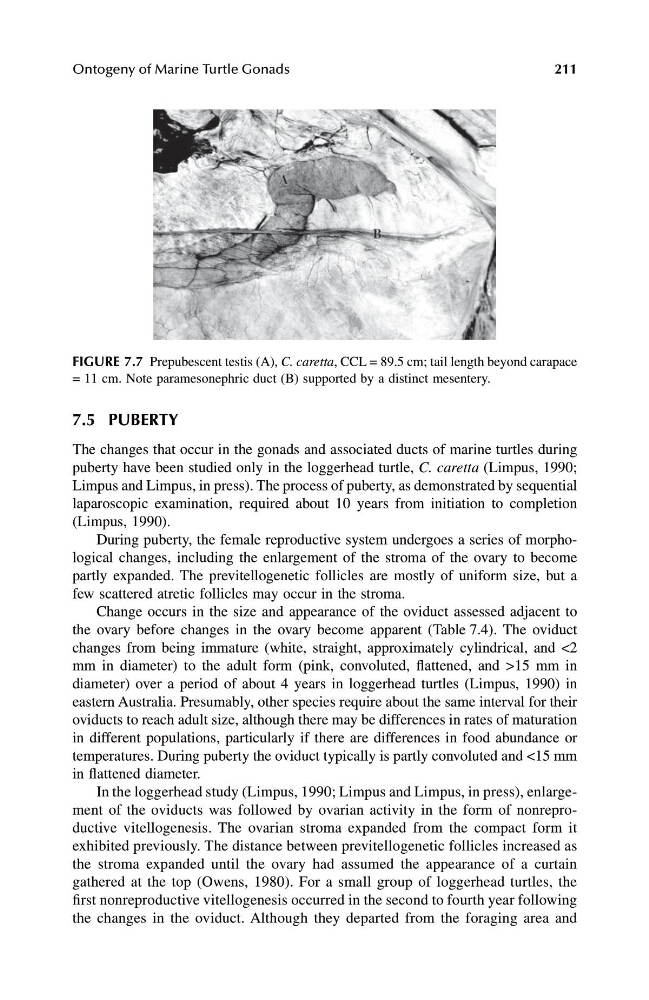
FIGURE 7.7 Prepubescent testis (A), C. caretta , CCL = 89.5 cm; tail length beyond carapace
= 11 cm. Note paramesonephric duct (B) supported by a distinct mesentery.
1123 book.book Page 211 Monday, November 11, 2002 11:11 AM
211
7.5 PUBERTY
The changes that occur in the gonads and associated ducts of marine turtles during
puberty have been studied only in the loggerhead turtle, C. caretta (Limpus, 1990;
Limpus and Limpus, in press). The process of puberty, as demonstrated by sequential
laparoscopic examination, required about 10 years from initiation to completion
(Limpus, 1990).
During puberty, the female reproductive system undergoes a series of morphological changes, including the enlargement of the stroma of the ovary to become
partly expanded. The previtellogenetic follicles are mostly of uniform size, but a
few scattered atretic follicles may occur in the stroma.
Change occurs in the size and appearance of the oviduct assessed adjacent to
the ovary before changes in the ovary become apparent (Table 7.4). The oviduct
changes from being immature (white, straight, approximately cylindrical, and <2
mm in diameter) to the adult form (pink, convoluted, flattened, and >15 mm in
diameter) over a period of about 4 years in loggerhead turtles (Limpus, 1990) in
eastern Australia. Presumably, other species require about the same interval for their
oviducts to reach adult size, although there may be differences in rates of maturation
in different populations, particularly if there are differences in food abundance or
temperatures. During puberty the oviduct typically is partly convoluted and <15 mm
in flattened diameter.
In the loggerhead study (Limpus, 1990; Limpus and Limpus, in press), enlargement of the oviducts was followed by ovarian activity in the form of nonreproductive vitellogenesis. The ovarian stroma expanded from the compact form it
exhibited previously. The distance between previtellogenetic follicles increased as
the stroma expanded until the ovary had assumed the appearance of a curtain
gathered at the top (Owens, 1980). For a small group of loggerhead turtles, the
first nonreproductive vitellogenesis occurred in the second to fourth year following
the changes in the oviduct. Although they departed from the foraging area and
FIGURE 7.7 Prepubescent testis (A), C. caretta , CCL = 89.5 cm; tail length beyond carapace
= 11 cm. Note paramesonephric duct (B) supported by a distinct mesentery.
1123 book.book Page 211 Monday, November 11, 2002 11:11 AM