

Physiological and Genetic Responses to Environmental Stress
181
(Wyneken and Milton, unpublished observations). Lactate levels are lower in swimming (nonfrenzy) hatchlings than in crawling, emerging, or frenzy-swimming animals, though species-specific differences exist. Only in leatherback hatchlings were
there no significant differences in lactate levels induced by activity (crawling, resting,
or frenzy or postfrenzy swimming). By contrast, green and loggerhead hatchlings
appear to rely more heavily on anaerobic metabolism for burst activities: lactate
levels were significantly higher in crawling and frenzy-swimming green and loggerhead hatchlings than in resting or swimming animals (Wyneken and Milton, unpublished observations). Swimming appears to be particularly efficient in leatherback
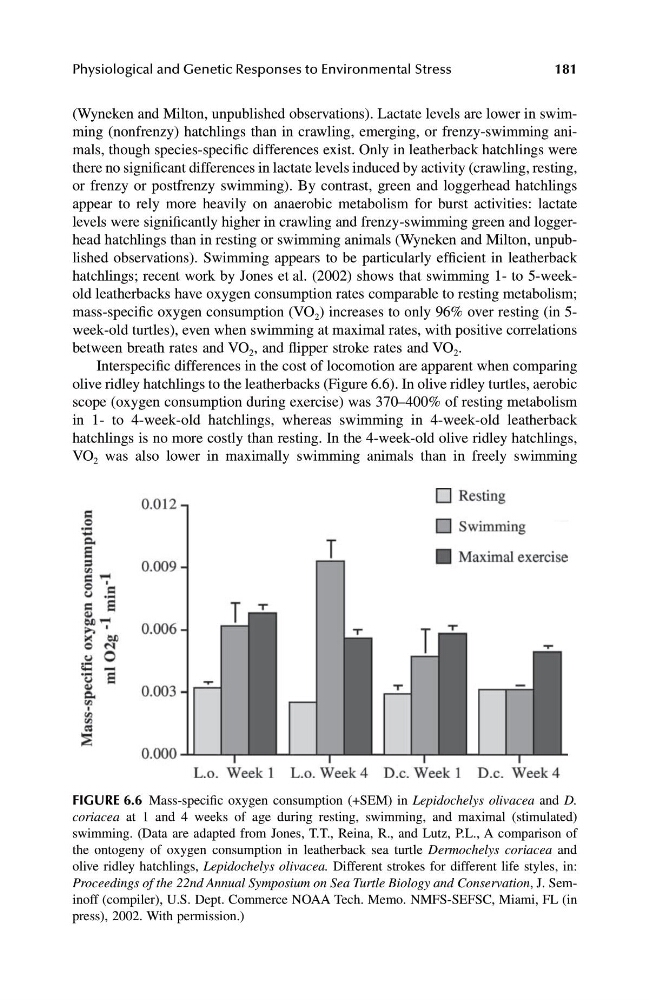
hatchlings; recent work by Jones et al. (2002) shows that swimming 1- to 5-weekold leatherbacks have oxygen consumption rates comparable to resting metabolism;
mass-specific oxygen consumption (VO 2 ) increases to only 96% over resting (in 5week-old turtles), even when swimming at maximal rates, with positive correlations
between breath rates and VO 2 , and flipper stroke rates and VO 2 .
Interspecific differences in the cost of locomotion are apparent when comparing
olive ridley hatchlings to the leatherbacks (Figure 6.6). In olive ridley turtles, aerobic
scope (oxygen consumption during exercise) was 370–400% of resting metabolism
in 1- to 4-week-old hatchlings, whereas swimming in 4-week-old leatherback
hatchlings is no more costly than resting. In the 4-week-old olive ridley hatchlings,
VO 2 was also lower in maximally swimming animals than in freely swimming
FIGURE 6.6 Mass-specific oxygen consumption (+SEM) in Lepidochelys olivacea and D.
coriacea at 1 and 4 weeks of age during resting, swimming, and maximal (stimulated)
swimming. (Data are adapted from Jones, T.T., Reina, R., and Lutz, P.L., A comparison of
the ontogeny of oxygen consumption in leatherback sea turtle Dermochelys coriacea and
olive ridley hatchlings, Lepidochelys olivacea. Different strokes for different life styles, in:
Proceedings of the 22nd Annual Symposium on Sea Turtle Biology and Conservation, J. Seminoff (compiler), U.S. Dept. Commerce NOAA Tech. Memo. NMFS-SEFSC, Miami, FL (in
press), 2002. With permission.)
1123 book.book Page 181 Monday, November 11, 2002 11:11 AM
181
(Wyneken and Milton, unpublished observations). Lactate levels are lower in swimming (nonfrenzy) hatchlings than in crawling, emerging, or frenzy-swimming animals, though species-specific differences exist. Only in leatherback hatchlings were
there no significant differences in lactate levels induced by activity (crawling, resting,
or frenzy or postfrenzy swimming). By contrast, green and loggerhead hatchlings
appear to rely more heavily on anaerobic metabolism for burst activities: lactate
levels were significantly higher in crawling and frenzy-swimming green and loggerhead hatchlings than in resting or swimming animals (Wyneken and Milton, unpublished observations). Swimming appears to be particularly efficient in leatherback
hatchlings; recent work by Jones et al. (2002) shows that swimming 1- to 5-weekold leatherbacks have oxygen consumption rates comparable to resting metabolism;
mass-specific oxygen consumption (VO 2 ) increases to only 96% over resting (in 5week-old turtles), even when swimming at maximal rates, with positive correlations
between breath rates and VO 2 , and flipper stroke rates and VO 2 .
Interspecific differences in the cost of locomotion are apparent when comparing
olive ridley hatchlings to the leatherbacks (Figure 6.6). In olive ridley turtles, aerobic
scope (oxygen consumption during exercise) was 370–400% of resting metabolism
in 1- to 4-week-old hatchlings, whereas swimming in 4-week-old leatherback
hatchlings is no more costly than resting. In the 4-week-old olive ridley hatchlings,
VO 2 was also lower in maximally swimming animals than in freely swimming
FIGURE 6.6 Mass-specific oxygen consumption (+SEM) in Lepidochelys olivacea and D.
coriacea at 1 and 4 weeks of age during resting, swimming, and maximal (stimulated)
swimming. (Data are adapted from Jones, T.T., Reina, R., and Lutz, P.L., A comparison of
the ontogeny of oxygen consumption in leatherback sea turtle Dermochelys coriacea and
olive ridley hatchlings, Lepidochelys olivacea. Different strokes for different life styles, in:
Proceedings of the 22nd Annual Symposium on Sea Turtle Biology and Conservation, J. Seminoff (compiler), U.S. Dept. Commerce NOAA Tech. Memo. NMFS-SEFSC, Miami, FL (in
press), 2002. With permission.)
1123 book.book Page 181 Monday, November 11, 2002 11:11 AM