

120
The Biology of Sea Turtles, Vol. II
hormones), it could prove logistically feasible to sex large numbers of hatchlings,
because blood sampling from hatchlings is a relatively simple procedure. 99 However,
for now, histological evaluation of the gonads appears to be the most accurate method
for sexing individual hatchlings.
4.3.7.2 Indirect Methods for Predicting Hatchling Sex Ratios
The logistical difficulty of sexing individual hatchlings combined with the conservational dilemma associated with the killing of hatchlings for sex ratio studies has
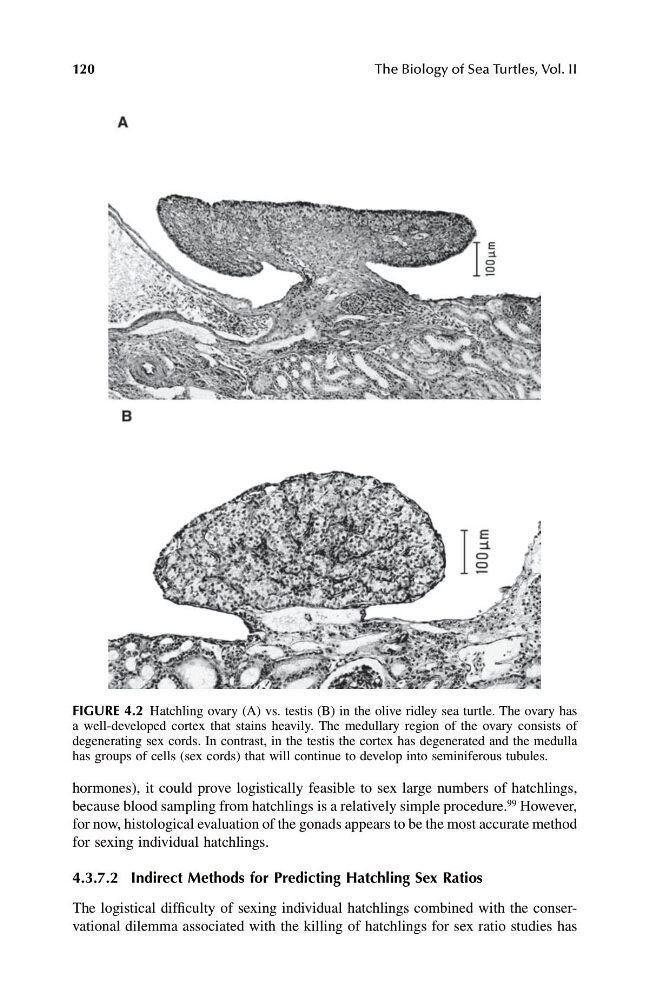
FIGURE 4.2 Hatchling ovary (A) vs. testis (B) in the olive ridley sea turtle. The ovary has
a well-developed cortex that stains heavily. The medullary region of the ovary consists of
degenerating sex cords. In contrast, in the testis the cortex has degenerated and the medulla
has groups of cells (sex cords) that will continue to develop into seminiferous tubules.
1123 book.book Page 120 Monday, November 11, 2002 11:11 AM
The Biology of Sea Turtles, Vol. II
hormones), it could prove logistically feasible to sex large numbers of hatchlings,
because blood sampling from hatchlings is a relatively simple procedure. 99 However,
for now, histological evaluation of the gonads appears to be the most accurate method
for sexing individual hatchlings.
4.3.7.2 Indirect Methods for Predicting Hatchling Sex Ratios
The logistical difficulty of sexing individual hatchlings combined with the conservational dilemma associated with the killing of hatchlings for sex ratio studies has
FIGURE 4.2 Hatchling ovary (A) vs. testis (B) in the olive ridley sea turtle. The ovary has
a well-developed cortex that stains heavily. The medullary region of the ovary consists of
degenerating sex cords. In contrast, in the testis the cortex has degenerated and the medulla
has groups of cells (sex cords) that will continue to develop into seminiferous tubules.
1123 book.book Page 120 Monday, November 11, 2002 11:11 AM