

108
The Biology of Sea Turtles, Vol. II
provide a general characterization of the TRT in some species. The findings from these
studies indicate that the TRT can vary between species and populations.
As with pivotal temperatures, the values of the lower and upper limits of the
TRT, as well as the width of the TRT, can vary between species and populations.
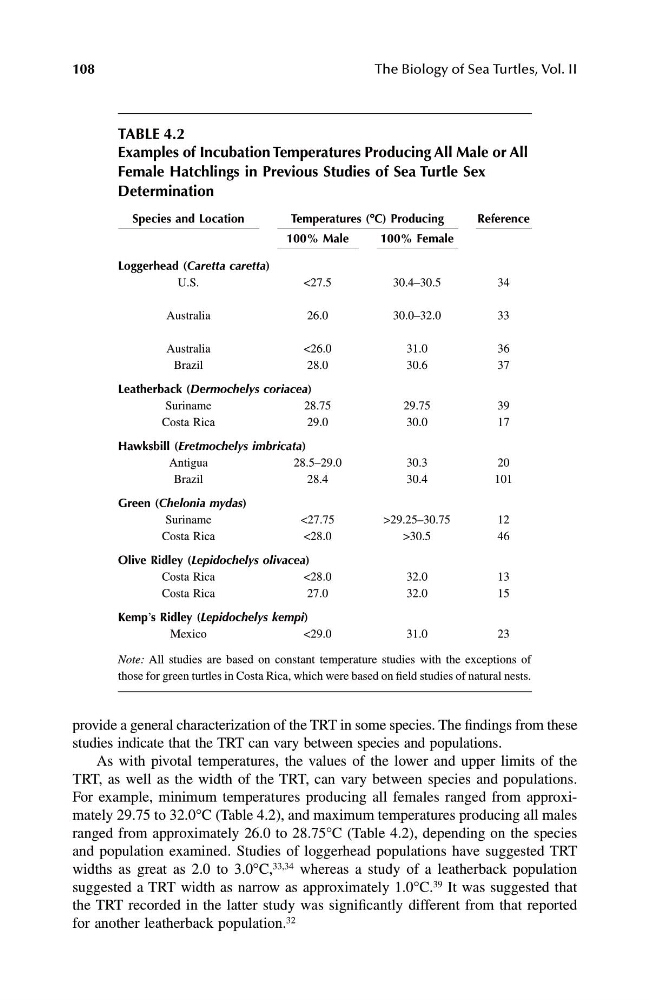
For example, minimum temperatures producing all females ranged from approximately 29.75 to 32.0 ∞ C (Table 4.2), and maximum temperatures producing all males
ranged from approximately 26.0 to 28.75 ∞ C (Table 4.2), depending on the species
and population examined. Studies of loggerhead populations have suggested TRT
widths as great as 2.0 to 3.0 ∞ C, 33,34 whereas a study of a leatherback population
suggested a TRT width as narrow as approximately 1.0 ∞ C. 39 It was suggested that
the TRT recorded in the latter study was significantly different from that reported
for another leatherback population. 32
TABLE 4.2
Examples of Incubation Temperatures Producing All Male or All
Female Hatchlings in Previous Studies of Sea Turtle Sex
Determination
Species and Location
Temperatures ( ∞ ∞ ∞
∞ C) Producing
Reference
100% Male
100% Female
Loggerhead ( Caretta caretta )
U.S.
<27.5
30.4–30.5
34
Australia
26.0
30.0–32.0
33
Australia
<26.0
31.0
36
Brazil
28.0
30.6
37
Leatherback ( Dermochelys coriacea )
Suriname
28.75
29.75
39
Costa Rica
29.0
30.0
17
Hawksbill ( Eretmochelys imbricata )
Antigua
28.5–29.0
30.3
20
Brazil
28.4
30.4
101
Green ( Chelonia mydas )
Suriname
<27.75
>29.25–30.75
12
Costa Rica
<28.0
>30.5
46
Olive Ridley ( Lepidochelys olivacea )
Costa Rica
<28.0
32.0
13
Costa Rica
27.0
32.0
15
Kemp ’ s Ridley ( Lepidochelys kempi )
Mexico
<29.0
31.0
23
Note: All studies are based on constant temperature studies with the exceptions of
those for green turtles in Costa Rica, which were based on field studies of natural nests.
1123 book.book Page 108 Monday, November 11, 2002 11:11 AM
The Biology of Sea Turtles, Vol. II
provide a general characterization of the TRT in some species. The findings from these
studies indicate that the TRT can vary between species and populations.
As with pivotal temperatures, the values of the lower and upper limits of the
TRT, as well as the width of the TRT, can vary between species and populations.
For example, minimum temperatures producing all females ranged from approximately 29.75 to 32.0 ∞ C (Table 4.2), and maximum temperatures producing all males
ranged from approximately 26.0 to 28.75 ∞ C (Table 4.2), depending on the species
and population examined. Studies of loggerhead populations have suggested TRT
widths as great as 2.0 to 3.0 ∞ C, 33,34 whereas a study of a leatherback population
suggested a TRT width as narrow as approximately 1.0 ∞ C. 39 It was suggested that
the TRT recorded in the latter study was significantly different from that reported
for another leatherback population. 32
TABLE 4.2
Examples of Incubation Temperatures Producing All Male or All
Female Hatchlings in Previous Studies of Sea Turtle Sex
Determination
Species and Location
Temperatures ( ∞ ∞ ∞
∞ C) Producing
Reference
100% Male
100% Female
Loggerhead ( Caretta caretta )
U.S.
<27.5
30.4–30.5
34
Australia
26.0
30.0–32.0
33
Australia
<26.0
31.0
36
Brazil
28.0
30.6
37
Leatherback ( Dermochelys coriacea )
Suriname
28.75
29.75
39
Costa Rica
29.0
30.0
17
Hawksbill ( Eretmochelys imbricata )
Antigua
28.5–29.0
30.3
20
Brazil
28.4
30.4
101
Green ( Chelonia mydas )
Suriname
<27.75
>29.25–30.75
12
Costa Rica
<28.0
>30.5
46
Olive Ridley ( Lepidochelys olivacea )
Costa Rica
<28.0
32.0
13
Costa Rica
27.0
32.0
15
Kemp ’ s Ridley ( Lepidochelys kempi )
Mexico
<29.0
31.0
23
Note: All studies are based on constant temperature studies with the exceptions of
those for green turtles in Costa Rica, which were based on field studies of natural nests.
1123 book.book Page 108 Monday, November 11, 2002 11:11 AM