

Sensory Biology of Sea Turtles
93
stimulation. ABRs reflect the synchronous discharge of large populations of neurons
within the auditory pathway, and therefore are useful monitors of the functioning
of the throughput of the auditory system. Historically, ABRs have been used as a
method for testing for audition and acoustic threshold in noncommunicative species.
The technique is noninvasive, is rapid, and requires no overt training of the subjects.
These recordings have been found to be consistent within species and similar across
vertebrate classes in general form and origin, regardless of auditory apparatus (Corwin et al., 1982). Furthermore, the technique can be performed on awake subject
animals (Bullock, 1991; Corwin et al., 1982). Bartol et al. (1999) recorded auditory
evoked potentials from juvenile loggerheads using subdermal platinum electrodes
implanted on awake animals. Vibratory stimuli, of known frequency, were delivered
directly to the dermal plates over the sea turtle’s tympanum. Signal averaging
techniques were used to isolate the auditory evoked potentials from unrelated neural
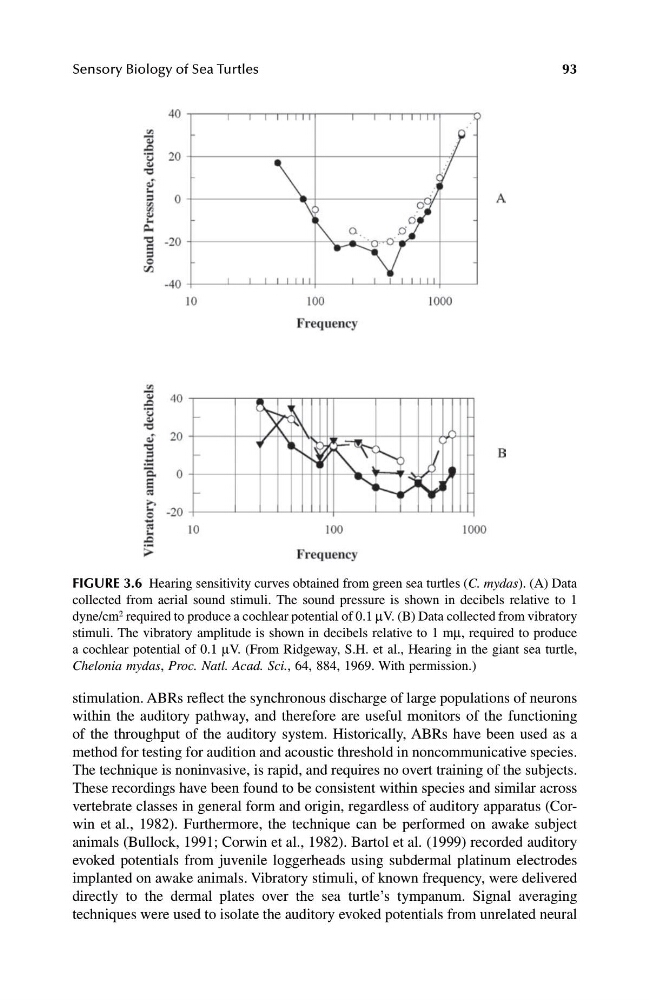
FIGURE 3.6 Hearing sensitivity curves obtained from green sea turtles (C. mydas). (A) Data
collected from aerial sound stimuli. The sound pressure is shown in decibels relative to 1
dyne/cm 2 required to produce a cochlear potential of 0.1 mV. (B) Data collected from vibratory
stimuli. The vibratory amplitude is shown in decibels relative to 1 mm, required to produce
a cochlear potential of 0.1 mV. (From Ridgeway, S.H. et al., Hearing in the giant sea turtle,
Chelonia mydas, Proc. Natl. Acad. Sci., 64, 884, 1969. With permission.)
1123 book.book Page 93 Monday, November 11, 2002 11:11 AM
93
stimulation. ABRs reflect the synchronous discharge of large populations of neurons
within the auditory pathway, and therefore are useful monitors of the functioning
of the throughput of the auditory system. Historically, ABRs have been used as a
method for testing for audition and acoustic threshold in noncommunicative species.
The technique is noninvasive, is rapid, and requires no overt training of the subjects.
These recordings have been found to be consistent within species and similar across
vertebrate classes in general form and origin, regardless of auditory apparatus (Corwin et al., 1982). Furthermore, the technique can be performed on awake subject
animals (Bullock, 1991; Corwin et al., 1982). Bartol et al. (1999) recorded auditory
evoked potentials from juvenile loggerheads using subdermal platinum electrodes
implanted on awake animals. Vibratory stimuli, of known frequency, were delivered
directly to the dermal plates over the sea turtle’s tympanum. Signal averaging
techniques were used to isolate the auditory evoked potentials from unrelated neural
FIGURE 3.6 Hearing sensitivity curves obtained from green sea turtles (C. mydas). (A) Data
collected from aerial sound stimuli. The sound pressure is shown in decibels relative to 1
dyne/cm 2 required to produce a cochlear potential of 0.1 mV. (B) Data collected from vibratory
stimuli. The vibratory amplitude is shown in decibels relative to 1 mm, required to produce
a cochlear potential of 0.1 mV. (From Ridgeway, S.H. et al., Hearing in the giant sea turtle,
Chelonia mydas, Proc. Natl. Acad. Sci., 64, 884, 1969. With permission.)
1123 book.book Page 93 Monday, November 11, 2002 11:11 AM