

Sensory Biology of Sea Turtles
91
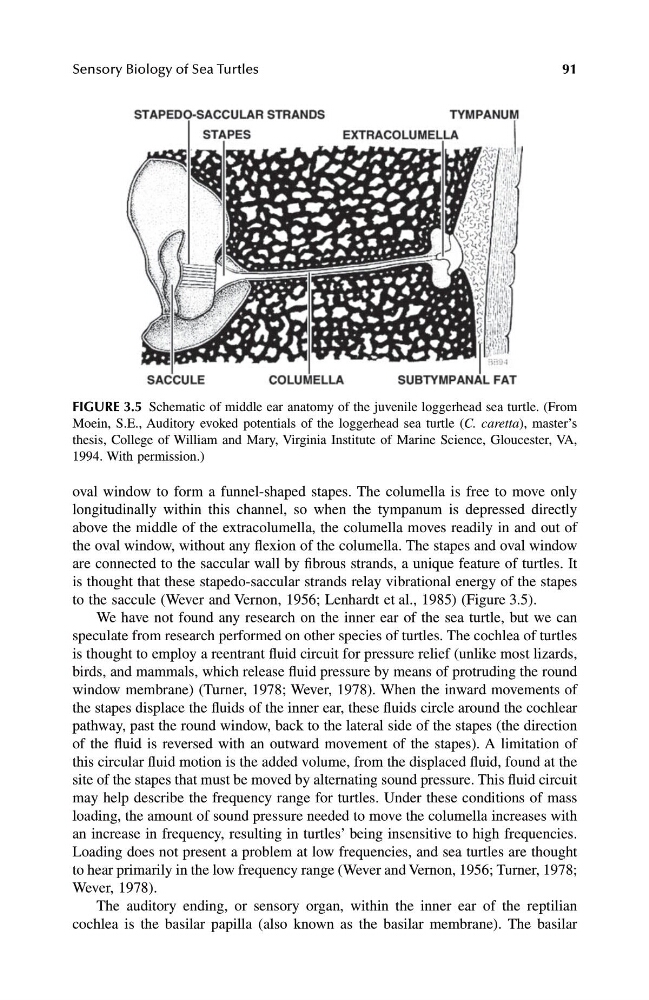
oval window to form a funnel-shaped stapes. The columella is free to move only
longitudinally within this channel, so when the tympanum is depressed directly
above the middle of the extracolumella, the columella moves readily in and out of
the oval window, without any flexion of the columella. The stapes and oval window
are connected to the saccular wall by fibrous strands, a unique feature of turtles. It
is thought that these stapedo-saccular strands relay vibrational energy of the stapes
to the saccule (Wever and Vernon, 1956; Lenhardt et al., 1985) (Figure 3.5).
We have not found any research on the inner ear of the sea turtle, but we can
speculate from research performed on other species of turtles. The cochlea of turtles
is thought to employ a reentrant fluid circuit for pressure relief (unlike most lizards,
birds, and mammals, which release fluid pressure by means of protruding the round
window membrane) (Turner, 1978; Wever, 1978). When the inward movements of
the stapes displace the fluids of the inner ear, these fluids circle around the cochlear
pathway, past the round window, back to the lateral side of the stapes (the direction
of the fluid is reversed with an outward movement of the stapes). A limitation of
this circular fluid motion is the added volume, from the displaced fluid, found at the
site of the stapes that must be moved by alternating sound pressure. This fluid circuit
may help describe the frequency range for turtles. Under these conditions of mass
loading, the amount of sound pressure needed to move the columella increases with
an increase in frequency, resulting in turtles’ being insensitive to high frequencies.
Loading does not present a problem at low frequencies, and sea turtles are thought
to hear primarily in the low frequency range (Wever and Vernon, 1956; Turner, 1978;
Wever, 1978).
The auditory ending, or sensory organ, within the inner ear of the reptilian
cochlea is the basilar papilla (also known as the basilar membrane). The basilar
FIGURE 3.5 Schematic of middle ear anatomy of the juvenile loggerhead sea turtle. (From
Moein, S.E., Auditory evoked potentials of the loggerhead sea turtle ( C. caretta ), master’s
thesis, College of William and Mary, Virginia Institute of Marine Science, Gloucester, VA,
1994. With permission.)
1123 book.book Page 91 Monday, November 11, 2002 11:11 AM
91
oval window to form a funnel-shaped stapes. The columella is free to move only
longitudinally within this channel, so when the tympanum is depressed directly
above the middle of the extracolumella, the columella moves readily in and out of
the oval window, without any flexion of the columella. The stapes and oval window
are connected to the saccular wall by fibrous strands, a unique feature of turtles. It
is thought that these stapedo-saccular strands relay vibrational energy of the stapes
to the saccule (Wever and Vernon, 1956; Lenhardt et al., 1985) (Figure 3.5).
We have not found any research on the inner ear of the sea turtle, but we can
speculate from research performed on other species of turtles. The cochlea of turtles
is thought to employ a reentrant fluid circuit for pressure relief (unlike most lizards,
birds, and mammals, which release fluid pressure by means of protruding the round
window membrane) (Turner, 1978; Wever, 1978). When the inward movements of
the stapes displace the fluids of the inner ear, these fluids circle around the cochlear
pathway, past the round window, back to the lateral side of the stapes (the direction
of the fluid is reversed with an outward movement of the stapes). A limitation of
this circular fluid motion is the added volume, from the displaced fluid, found at the
site of the stapes that must be moved by alternating sound pressure. This fluid circuit
may help describe the frequency range for turtles. Under these conditions of mass
loading, the amount of sound pressure needed to move the columella increases with
an increase in frequency, resulting in turtles’ being insensitive to high frequencies.
Loading does not present a problem at low frequencies, and sea turtles are thought
to hear primarily in the low frequency range (Wever and Vernon, 1956; Turner, 1978;
Wever, 1978).
The auditory ending, or sensory organ, within the inner ear of the reptilian
cochlea is the basilar papilla (also known as the basilar membrane). The basilar
FIGURE 3.5 Schematic of middle ear anatomy of the juvenile loggerhead sea turtle. (From
Moein, S.E., Auditory evoked potentials of the loggerhead sea turtle ( C. caretta ), master’s
thesis, College of William and Mary, Virginia Institute of Marine Science, Gloucester, VA,
1994. With permission.)
1123 book.book Page 91 Monday, November 11, 2002 11:11 AM