

88
The Biology of Sea Turtles, Vol. II
adults. The type of visual stimuli used by sea turtles (whether shapes, colors, or
brightness cues) has been the subject of many research articles (Ehrenfeld and Carr,
1967; Ehrenfeld, 1968; Mrosovsky and Shettleworth, 1968; Witherington and Bjorndal, 1991; Salmon and Wyneken, 1990; 1994). In some of the earliest studies,
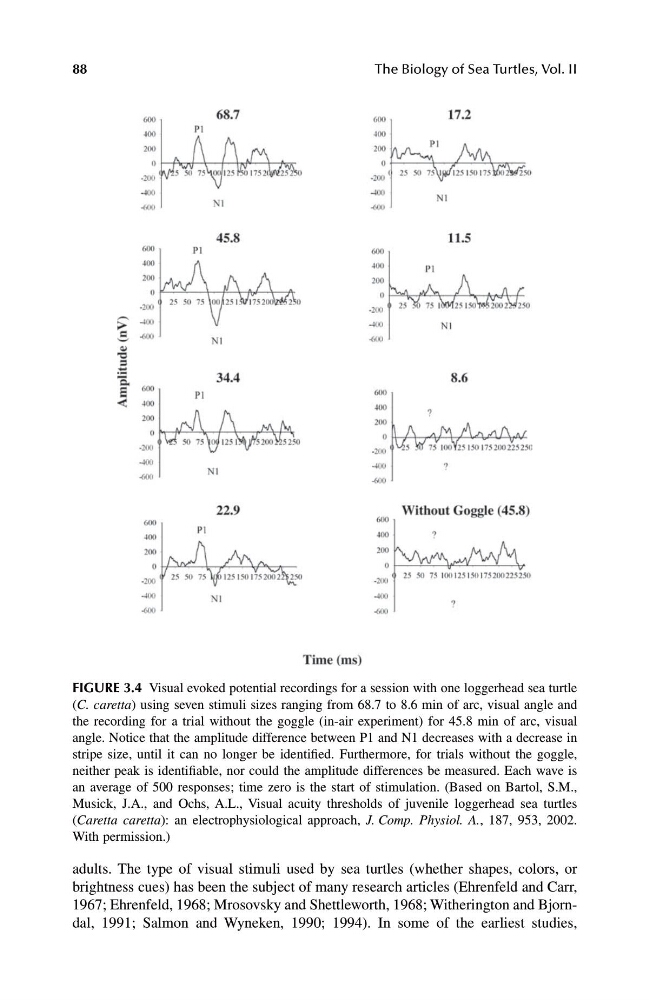
FIGURE 3.4 Visual evoked potential recordings for a session with one loggerhead sea turtle
( C. caretta ) using seven stimuli sizes ranging from 68.7 to 8.6 min of arc, visual angle and
the recording for a trial without the goggle (in-air experiment) for 45.8 min of arc, visual
angle. Notice that the amplitude difference between P1 and N1 decreases with a decrease in
stripe size, until it can no longer be identified. Furthermore, for trials without the goggle,
neither peak is identifiable, nor could the amplitude differences be measured. Each wave is
an average of 500 responses; time zero is the start of stimulation. (Based on Bartol, S.M.,
Musick, J.A., and Ochs, A.L., Visual acuity thresholds of juvenile loggerhead sea turtles
( Caretta caretta ): an electrophysiological approach, J. Comp. Physiol. A. , 187, 953, 2002.
With permission.)
1123 book.book Page 88 Monday, November 11, 2002 11:11 AM
The Biology of Sea Turtles, Vol. II
adults. The type of visual stimuli used by sea turtles (whether shapes, colors, or
brightness cues) has been the subject of many research articles (Ehrenfeld and Carr,
1967; Ehrenfeld, 1968; Mrosovsky and Shettleworth, 1968; Witherington and Bjorndal, 1991; Salmon and Wyneken, 1990; 1994). In some of the earliest studies,
FIGURE 3.4 Visual evoked potential recordings for a session with one loggerhead sea turtle
( C. caretta ) using seven stimuli sizes ranging from 68.7 to 8.6 min of arc, visual angle and
the recording for a trial without the goggle (in-air experiment) for 45.8 min of arc, visual
angle. Notice that the amplitude difference between P1 and N1 decreases with a decrease in
stripe size, until it can no longer be identified. Furthermore, for trials without the goggle,
neither peak is identifiable, nor could the amplitude differences be measured. Each wave is
an average of 500 responses; time zero is the start of stimulation. (Based on Bartol, S.M.,
Musick, J.A., and Ochs, A.L., Visual acuity thresholds of juvenile loggerhead sea turtles
( Caretta caretta ): an electrophysiological approach, J. Comp. Physiol. A. , 187, 953, 2002.
With permission.)
1123 book.book Page 88 Monday, November 11, 2002 11:11 AM