

68
Biology of Sea Turtles, Vol. II
the ambiens, which is a protractor and abductor (Table 2.1). The puboishiofemoralis
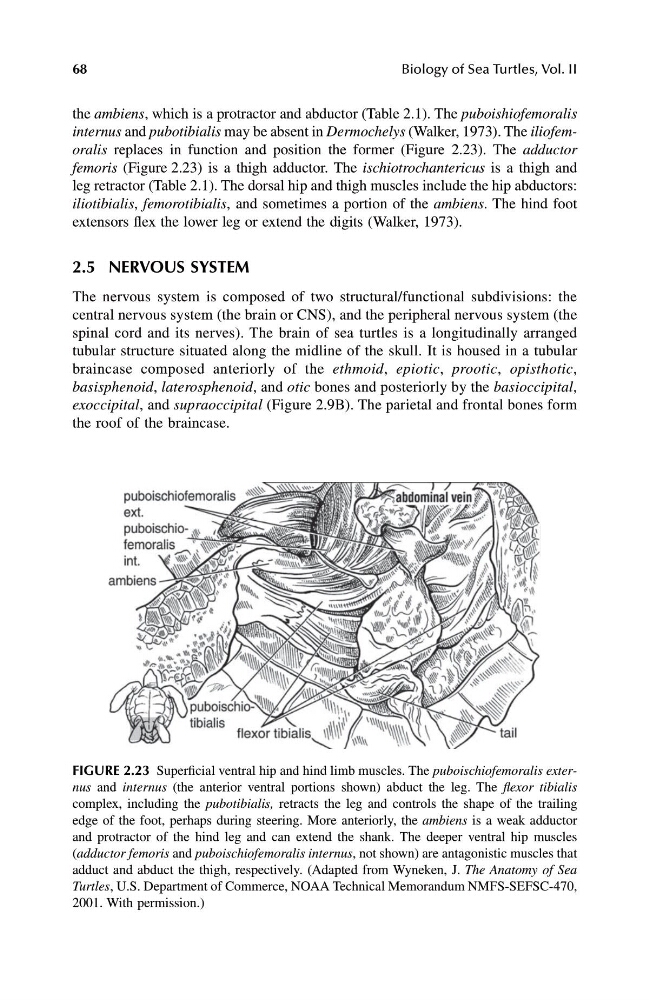
internus and pubotibialis may be absent in Dermochelys (Walker, 1973). The iliofemoralis replaces in function and position the former (Figure 2.23). The adductor
femoris (Figure 2.23) is a thigh adductor. The ischiotrochantericus is a thigh and
leg retractor (Table 2.1). The dorsal hip and thigh muscles include the hip abductors:
iliotibialis, femorotibialis, and sometimes a portion of the ambiens. The hind foot
extensors flex the lower leg or extend the digits (Walker, 1973).
2.5 NERVOUS SYSTEM
The nervous system is composed of two structural/functional subdivisions: the
central nervous system (the brain or CNS), and the peripheral nervous system (the
spinal cord and its nerves). The brain of sea turtles is a longitudinally arranged
tubular structure situated along the midline of the skull. It is housed in a tubular
braincase composed anteriorly of the ethmoid, epiotic, prootic, opisthotic,
basisphenoid, laterosphenoid, and otic bones and posteriorly by the basioccipital,
exoccipital, and supraoccipital (Figure 2.9B). The parietal and frontal bones form
the roof of the braincase.
FIGURE 2.23 Superficial ventral hip and hind limb muscles. The puboischiofemoralis externus and internus (the anterior ventral portions shown) abduct the leg. The flexor tibialis
complex, including the pubotibialis, retracts the leg and controls the shape of the trailing
edge of the foot, perhaps during steering. More anteriorly, the ambiens is a weak adductor
and protractor of the hind leg and can extend the shank. The deeper ventral hip muscles
(adductor femoris and puboischiofemoralis internus, not shown) are antagonistic muscles that
adduct and abduct the thigh, respectively. (Adapted from Wyneken, J. The Anatomy of Sea
Turtles, U.S. Department of Commerce, NOAA Technical Memorandum NMFS-SEFSC-470,
2001. With permission.)
1123_C02.fm Page 68 Friday, November 15, 2002 11:16 AM
Biology of Sea Turtles, Vol. II
the ambiens, which is a protractor and abductor (Table 2.1). The puboishiofemoralis
internus and pubotibialis may be absent in Dermochelys (Walker, 1973). The iliofemoralis replaces in function and position the former (Figure 2.23). The adductor
femoris (Figure 2.23) is a thigh adductor. The ischiotrochantericus is a thigh and
leg retractor (Table 2.1). The dorsal hip and thigh muscles include the hip abductors:
iliotibialis, femorotibialis, and sometimes a portion of the ambiens. The hind foot
extensors flex the lower leg or extend the digits (Walker, 1973).
2.5 NERVOUS SYSTEM
The nervous system is composed of two structural/functional subdivisions: the
central nervous system (the brain or CNS), and the peripheral nervous system (the
spinal cord and its nerves). The brain of sea turtles is a longitudinally arranged
tubular structure situated along the midline of the skull. It is housed in a tubular
braincase composed anteriorly of the ethmoid, epiotic, prootic, opisthotic,
basisphenoid, laterosphenoid, and otic bones and posteriorly by the basioccipital,
exoccipital, and supraoccipital (Figure 2.9B). The parietal and frontal bones form
the roof of the braincase.
FIGURE 2.23 Superficial ventral hip and hind limb muscles. The puboischiofemoralis externus and internus (the anterior ventral portions shown) abduct the leg. The flexor tibialis
complex, including the pubotibialis, retracts the leg and controls the shape of the trailing
edge of the foot, perhaps during steering. More anteriorly, the ambiens is a weak adductor
and protractor of the hind leg and can extend the shank. The deeper ventral hip muscles
(adductor femoris and puboischiofemoralis internus, not shown) are antagonistic muscles that
adduct and abduct the thigh, respectively. (Adapted from Wyneken, J. The Anatomy of Sea
Turtles, U.S. Department of Commerce, NOAA Technical Memorandum NMFS-SEFSC-470,
2001. With permission.)
1123_C02.fm Page 68 Friday, November 15, 2002 11:16 AM