

The External, Musculoskeletal and Neuro-Anatomy of Sea Turtles
65
2.4.2 APPENDICULAR MUSCLES
The muscles of the fore limbs (including the shoulders) and hind limbs (including
the hips) are the appendicular muscles.
2.4.2.1 Pectoral Muscles
The massive ventral musculature is dominated by pectoral muscles that adduct,
retract, rotate, and flex the flippers (Wyneken, 1988), whereas the dorsal pectoral
muscles are primarily flipper abductors, extensors, and protractors. The pectoral
muscles, innervated by the nerves of the brachial plexus, are described in Tables 2.1
and 2.2 and illustrated in Figure 2.22. The major shoulder muscles are the latissimus
dorsi–teres major complex, the scapular head of the deltoideus, and the subscapularis (Figure 2.22 and Table 2.1). These are responsible for flipper protraction, retraction, abduction, and adduction.
The remaining dorsal shoulder muscles are the triceps brachii (triceps superficialis), biceps complex (biceps superficialis and biceps profundus), and brachialis
(a flipper flexor). The biceps muscles extend across the shoulder and the elbow and
act as retractors of the humerus or flexors of the flipper at the elbow. Walker (1973)
reports that in Dermochelys and Lepidochelys, there is often just a single head, the
biceps superficialis, inserting on the radius and ulna.
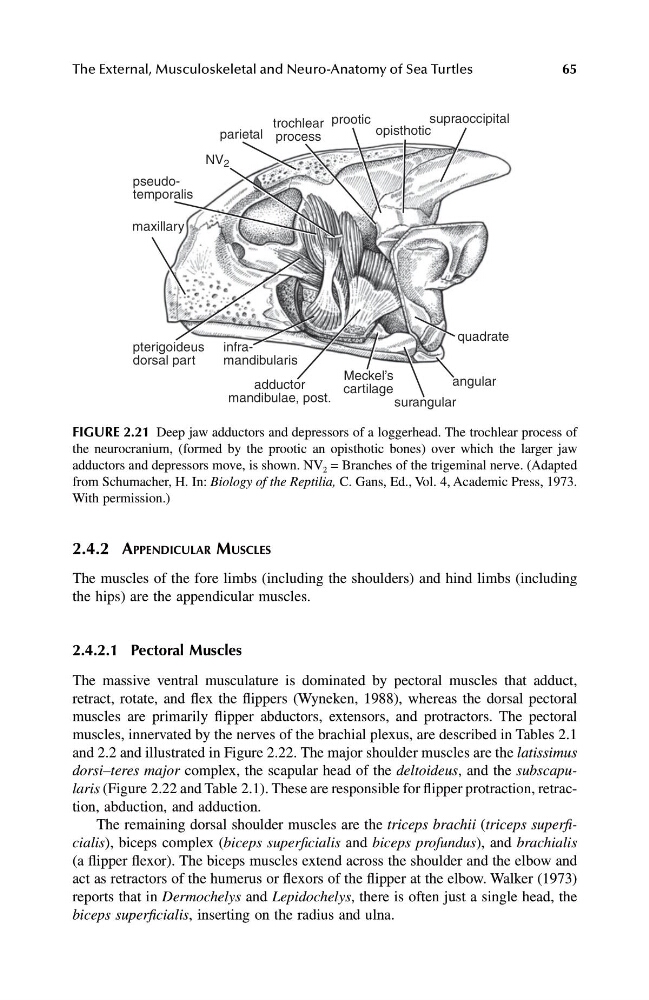
FIGURE 2.21 Deep jaw adductors and depressors of a loggerhead. The trochlear process of
the neurocranium, (formed by the prootic an opisthotic bones) over which the larger jaw
adductors and depressors move, is shown. NV 2 = Branches of the trigeminal nerve. (Adapted
from Schumacher, H. In: Biology of the Reptilia, C. Gans, Ed., Vol. 4, Academic Press, 1973.
With permission.)
parietal
NV 2
trochlear
process
prootic
opisthotic
supraoccipital
quadrate
angular
surangular
Meckel’s
cartilage
adductor
mandibulae, post.
inframandibularis
pterigoideus
dorsal part
maxillary
pseudotemporalis
1123_C02.fm Page 65 Friday, November 15, 2002 11:16 AM
65
2.4.2 APPENDICULAR MUSCLES
The muscles of the fore limbs (including the shoulders) and hind limbs (including
the hips) are the appendicular muscles.
2.4.2.1 Pectoral Muscles
The massive ventral musculature is dominated by pectoral muscles that adduct,
retract, rotate, and flex the flippers (Wyneken, 1988), whereas the dorsal pectoral
muscles are primarily flipper abductors, extensors, and protractors. The pectoral
muscles, innervated by the nerves of the brachial plexus, are described in Tables 2.1
and 2.2 and illustrated in Figure 2.22. The major shoulder muscles are the latissimus
dorsi–teres major complex, the scapular head of the deltoideus, and the subscapularis (Figure 2.22 and Table 2.1). These are responsible for flipper protraction, retraction, abduction, and adduction.
The remaining dorsal shoulder muscles are the triceps brachii (triceps superficialis), biceps complex (biceps superficialis and biceps profundus), and brachialis
(a flipper flexor). The biceps muscles extend across the shoulder and the elbow and
act as retractors of the humerus or flexors of the flipper at the elbow. Walker (1973)
reports that in Dermochelys and Lepidochelys, there is often just a single head, the
biceps superficialis, inserting on the radius and ulna.
FIGURE 2.21 Deep jaw adductors and depressors of a loggerhead. The trochlear process of
the neurocranium, (formed by the prootic an opisthotic bones) over which the larger jaw
adductors and depressors move, is shown. NV 2 = Branches of the trigeminal nerve. (Adapted
from Schumacher, H. In: Biology of the Reptilia, C. Gans, Ed., Vol. 4, Academic Press, 1973.
With permission.)
parietal
NV 2
trochlear
process
prootic
opisthotic
supraoccipital
quadrate
angular
surangular
Meckel’s
cartilage
adductor
mandibulae, post.
inframandibularis
pterigoideus
dorsal part
maxillary
pseudotemporalis
1123_C02.fm Page 65 Friday, November 15, 2002 11:16 AM