

56
Biology of Sea Turtles, Vol. II
three bones contribute to form the hip socket (acetabulum). In young cheloniids and
all D. coriacea, the three bones are separate and joined by cartilage. In maturing and
mature cheloniids, they ossify and ankylose to form a single structure (Figure 2.17).
The hind limb is somewhat flattened as a rudderlike structure. The femur has a
relatively straight shaft with a strongly offset head that articulates with the pelvis at
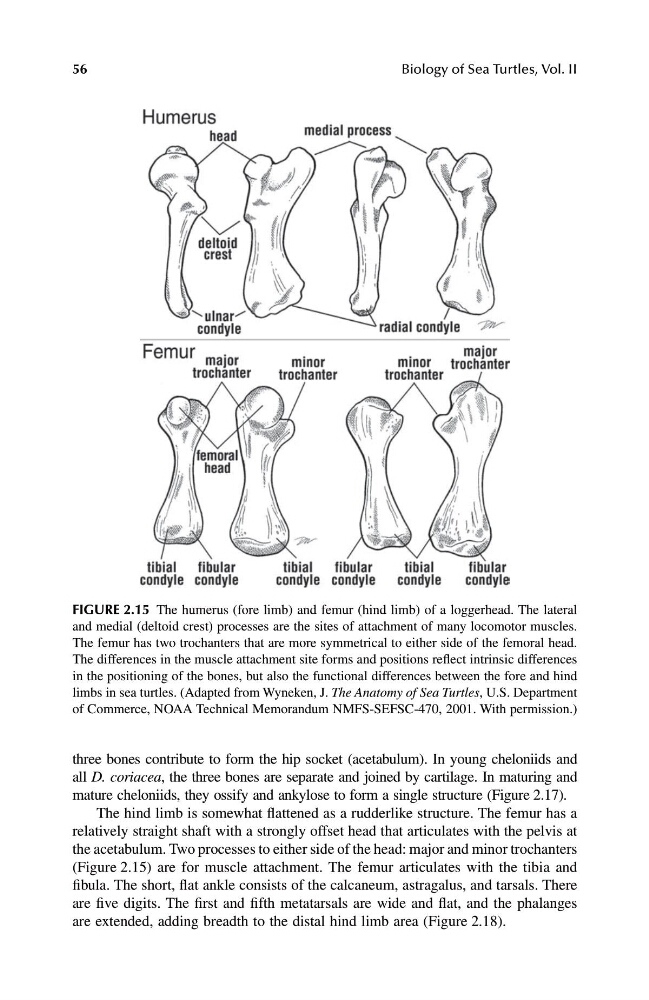
the acetabulum. Two processes to either side of the head: major and minor trochanters
(Figure 2.15) are for muscle attachment. The femur articulates with the tibia and
fibula. The short, flat ankle consists of the calcaneum, astragalus, and tarsals. There
are five digits. The first and fifth metatarsals are wide and flat, and the phalanges
are extended, adding breadth to the distal hind limb area (Figure 2.18).
FIGURE 2.15 The humerus (fore limb) and femur (hind limb) of a loggerhead. The lateral
and medial (deltoid crest) processes are the sites of attachment of many locomotor muscles.
The femur has two trochanters that are more symmetrical to either side of the femoral head.
The differences in the muscle attachment site forms and positions reflect intrinsic differences
in the positioning of the bones, but also the functional differences between the fore and hind
limbs in sea turtles. (Adapted from Wyneken, J. The Anatomy of Sea Turtles, U.S. Department
of Commerce, NOAA Technical Memorandum NMFS-SEFSC-470, 2001. With permission.)
1123_C02.fm Page 56 Friday, November 15, 2002 11:16 AM
Biology of Sea Turtles, Vol. II
three bones contribute to form the hip socket (acetabulum). In young cheloniids and
all D. coriacea, the three bones are separate and joined by cartilage. In maturing and
mature cheloniids, they ossify and ankylose to form a single structure (Figure 2.17).
The hind limb is somewhat flattened as a rudderlike structure. The femur has a
relatively straight shaft with a strongly offset head that articulates with the pelvis at
the acetabulum. Two processes to either side of the head: major and minor trochanters
(Figure 2.15) are for muscle attachment. The femur articulates with the tibia and
fibula. The short, flat ankle consists of the calcaneum, astragalus, and tarsals. There
are five digits. The first and fifth metatarsals are wide and flat, and the phalanges
are extended, adding breadth to the distal hind limb area (Figure 2.18).
FIGURE 2.15 The humerus (fore limb) and femur (hind limb) of a loggerhead. The lateral
and medial (deltoid crest) processes are the sites of attachment of many locomotor muscles.
The femur has two trochanters that are more symmetrical to either side of the femoral head.
The differences in the muscle attachment site forms and positions reflect intrinsic differences
in the positioning of the bones, but also the functional differences between the fore and hind
limbs in sea turtles. (Adapted from Wyneken, J. The Anatomy of Sea Turtles, U.S. Department
of Commerce, NOAA Technical Memorandum NMFS-SEFSC-470, 2001. With permission.)
1123_C02.fm Page 56 Friday, November 15, 2002 11:16 AM