

3.1 Infrastructure standards
69
A profile may become a standard on its own and is then called an International
Standardised Profile (ISP). In the mid-nineties, the Joint Technical Committee of
ISO and IEC (ISO/IEC JTC1) created the International Standardised Profile as a new
type of document. In order to receive the status of an ISO standard, the document describing a profile has to follow the procedures for the development of an International Standard. As a result, it receives its own ISO-number. Profiles defined according to the ISO standard "Profile" may become this type of an International Standard.
One may argue that in times of fast computers and the availability of enormous
amounts of disc space, it is not necessary to artificially narrow the options offered by
a large environment like the ISO 19100 family of standards. However, the idea of the
introduction of profiles is to promote a better interoperability between the systems
by restricting the choices. It is easier for users and system suppliers to agree on a
smaller set of common standards then on a large set.
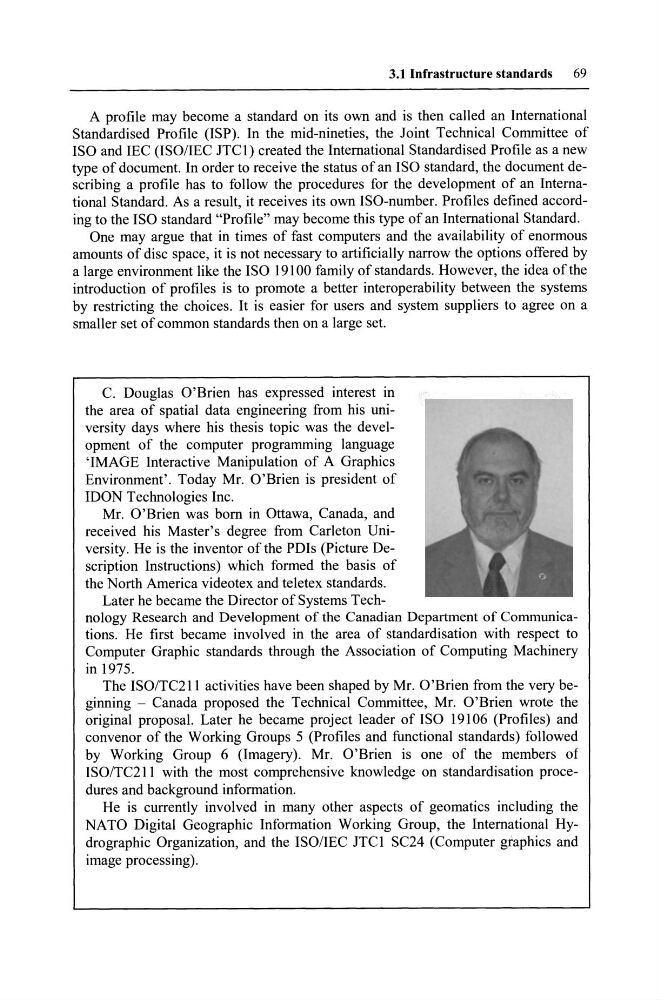
C. Douglas O'Brien has expressed interest in
the area of spatial data engineering from his university days where his thesis topic was the development of the computer programming language
'IMAGE Interactive Manipulation of A Graphics
Environment'. Today Mr. O'Brien is president of
mON Technologies Inc.
Mr. O'Brien was born in Ottawa, Canada, and
received his Master's degree from Carleton University. He is the inventor of the PDIs (Picture Description Instructions) which formed the basis of
the North America videotex and teletex standards.
Later he became the Director ofSystems Technology Research and Development of the Canadian Department of Communications. He first became involved in the area of standardisation with respect to
Computer Graphie standards through the Association of Computing Machinery
in 1975.
The ISO/TC2ll activities have been shaped by Mr. O'Brien from the very beginning - Canada proposed the Technical Committee, Mr. O'Brien wrote the
original proposal. Later he became project leader of ISO 19106 (Profiles) and
convenor of the Working Groups 5 (Profiles and functional standards) followed
by Working Group 6 (Imagery). Mr. O'Brien is one of the members of
ISO/TC211 with the most comprehensive knowledge on standardisation procedures and background information.
He is currently involved in many other aspects of geomatics including the
NATO Digital Geographie Information Working Group, the International Hydrographie Organization, and the ISO/IEC HCI SC24 (Computer graphics and
image processing).
69
A profile may become a standard on its own and is then called an International
Standardised Profile (ISP). In the mid-nineties, the Joint Technical Committee of
ISO and IEC (ISO/IEC JTC1) created the International Standardised Profile as a new
type of document. In order to receive the status of an ISO standard, the document describing a profile has to follow the procedures for the development of an International Standard. As a result, it receives its own ISO-number. Profiles defined according to the ISO standard "Profile" may become this type of an International Standard.
One may argue that in times of fast computers and the availability of enormous
amounts of disc space, it is not necessary to artificially narrow the options offered by
a large environment like the ISO 19100 family of standards. However, the idea of the
introduction of profiles is to promote a better interoperability between the systems
by restricting the choices. It is easier for users and system suppliers to agree on a
smaller set of common standards then on a large set.
C. Douglas O'Brien has expressed interest in
the area of spatial data engineering from his university days where his thesis topic was the development of the computer programming language
'IMAGE Interactive Manipulation of A Graphics
Environment'. Today Mr. O'Brien is president of
mON Technologies Inc.
Mr. O'Brien was born in Ottawa, Canada, and
received his Master's degree from Carleton University. He is the inventor of the PDIs (Picture Description Instructions) which formed the basis of
the North America videotex and teletex standards.
Later he became the Director ofSystems Technology Research and Development of the Canadian Department of Communications. He first became involved in the area of standardisation with respect to
Computer Graphie standards through the Association of Computing Machinery
in 1975.
The ISO/TC2ll activities have been shaped by Mr. O'Brien from the very beginning - Canada proposed the Technical Committee, Mr. O'Brien wrote the
original proposal. Later he became project leader of ISO 19106 (Profiles) and
convenor of the Working Groups 5 (Profiles and functional standards) followed
by Working Group 6 (Imagery). Mr. O'Brien is one of the members of
ISO/TC211 with the most comprehensive knowledge on standardisation procedures and background information.
He is currently involved in many other aspects of geomatics including the
NATO Digital Geographie Information Working Group, the International Hydrographie Organization, and the ISO/IEC HCI SC24 (Computer graphics and
image processing).