

286
Annexes
8.14.6 Telephone information
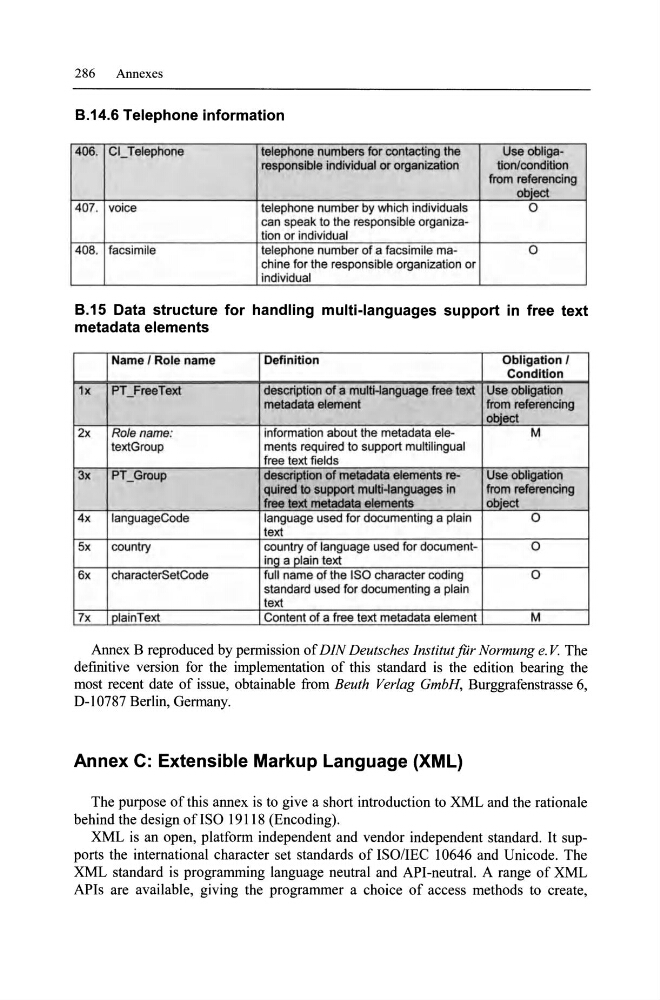
406. CL Telephone
telephone numbers for contacting the
Use obligaresponsible individual or organization
tionlcondition
from referencing
object
407. voice
telephone number by wh ich individuals
0
can speak to the responsible organization or individual
408. facsimile
telephone number of a facsim ile ma0
ch ine for the responsible organization or
individual
8.15 Data structure for handling multi-Ianguages support in free text
metadata elements
Name I Role name
Definition
Obligation I
Condition
1x PT_ FreeText
description of a multi-Ianguage free text Use obligation
metadata element
from referencing
obiect
2x
Ro/ename:
information about the metadata eleM
textGroup
ments required to support multilingual
free text fjelds
3x PT_Group
description of metadata elements reUse obligation
quired to support multi-languages in
trom referencing
free text metadata elements
obiect
4x
languageCode
language used for documenting a plain
0
text
5x
country
country of language used for document0
ing a plain text
6x
characterSetCode
full name of the ISO character coding
0
standard used for documenting a plain
text
7x I plainText
Content of a free text metadata element
M
Annex B reproduced by permission of DIN Deutsches Institut for Normung e. V. The
definitive version for the implementation of this standard is the edition bearing the
most recent date of issue, obtainable from Beuth Verlag GmbH, Burggrafenstrasse 6,
D-I0787 Berlin, Germany.
Annex C: Extensible Markup Language (XML)
The purpose of this annex is to give a short introduction to XML and the rationale
behind the design of ISO 19118 (Encoding).
XML is an open, platform independent and vendor independent standard. lt supports the international character set standards of ISO/lEe 10646 and Unicode. The
XML standard is programming language neutral and API-neutral. A range of XML
APIs are available, giving the programmer a choice of access methods to create,
Annexes
8.14.6 Telephone information
406. CL Telephone
telephone numbers for contacting the
Use obligaresponsible individual or organization
tionlcondition
from referencing
object
407. voice
telephone number by wh ich individuals
0
can speak to the responsible organization or individual
408. facsimile
telephone number of a facsim ile ma0
ch ine for the responsible organization or
individual
8.15 Data structure for handling multi-Ianguages support in free text
metadata elements
Name I Role name
Definition
Obligation I
Condition
1x PT_ FreeText
description of a multi-Ianguage free text Use obligation
metadata element
from referencing
obiect
2x
Ro/ename:
information about the metadata eleM
textGroup
ments required to support multilingual
free text fjelds
3x PT_Group
description of metadata elements reUse obligation
quired to support multi-languages in
trom referencing
free text metadata elements
obiect
4x
languageCode
language used for documenting a plain
0
text
5x
country
country of language used for document0
ing a plain text
6x
characterSetCode
full name of the ISO character coding
0
standard used for documenting a plain
text
7x I plainText
Content of a free text metadata element
M
Annex B reproduced by permission of DIN Deutsches Institut for Normung e. V. The
definitive version for the implementation of this standard is the edition bearing the
most recent date of issue, obtainable from Beuth Verlag GmbH, Burggrafenstrasse 6,
D-I0787 Berlin, Germany.
Annex C: Extensible Markup Language (XML)
The purpose of this annex is to give a short introduction to XML and the rationale
behind the design of ISO 19118 (Encoding).
XML is an open, platform independent and vendor independent standard. lt supports the international character set standards of ISO/lEe 10646 and Unicode. The
XML standard is programming language neutral and API-neutral. A range of XML
APIs are available, giving the programmer a choice of access methods to create,