

180
4 Geometry standards
The topology of a dataset is described by the topological primitives nodes, edges,
faces, and topological solids. Nodes are topological points where edges meet. Edges
are topological lines where faces meet. Faces are topological surfaces where solids
meet.
Topological relations are described with boundaries, coboundaries, and directed
topologie al primitives. The topological primitive "edge" is bounded by two directed
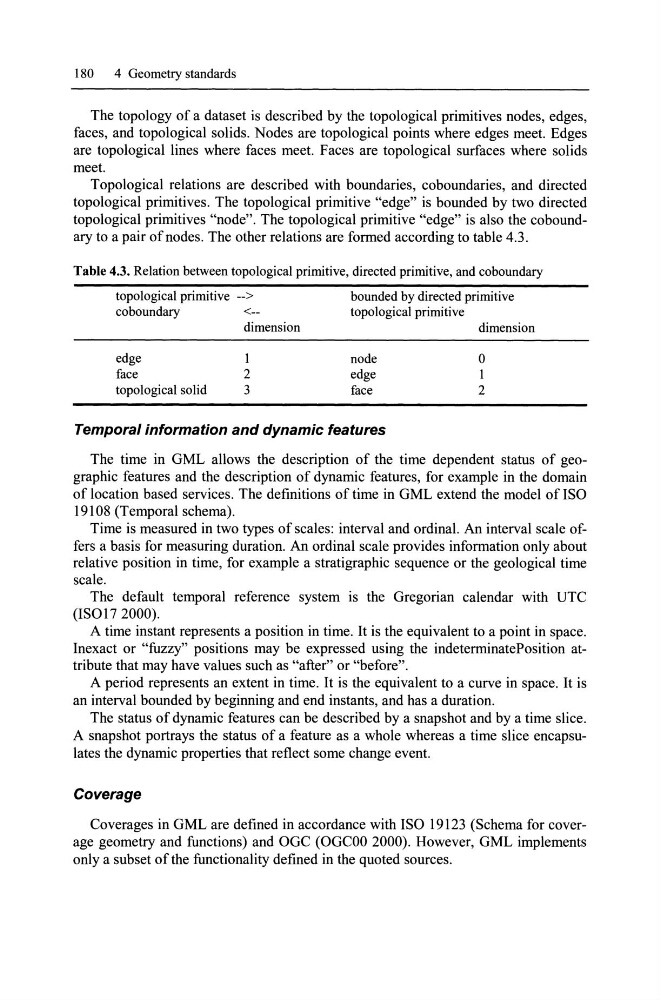
topological primitives "node". The topological primitive "edge" is also the coboundary to a pair of nodes. The other relations are formed according to table 4.3.
Table 4.3. Relation between topological primitive, directed primitive, and coboundary
topological primitive -->
coboundary
<-edge
face
topological solid
dimension
1
2
3
bounded by directed primitive
topological primitive
node
edge
face
dimension
o
1
2
Temporal information and dynamic features
The time in GML allows the description of the time dependent status of geographie features and the description of dynamic features, for example in the domain
of location based services. The definitions of time in GML extend the model of ISO
19108 (Temporal schema).
Time is measured in two types of scales: interval and ordinal. An interval scale offers a basis for measuring duration. An ordinal scale provides information only about
relative position in time, for example a stratigraphie sequence or the geological time
scale.
The default temporal reference system is the Gregorian calendar with UTC
(IS0l7 2000).
A time instant represents a position in time. It is the equivalent to a point in space.
Inexact or "fuzzy" positions may be expressed using the indeterminatePosition attribute that may have values such as "after" or "before".
Aperiod represents an extent in time. It is the equivalent to a curve in space. It is
an interval bounded by beginning and end instants, and has a duration.
The status of dynamic features can be described by a snapshot and by a time slice.
A snapshot portrays the status of a feature as a whole whereas a time slice encapsulates the dynamic properties that reflect some change event.
Coverage
Coverages in GML are defined in accordance with ISO 19123 (Schema for coverage geometry and functions) and OGC (OGCOO 2000). However, GML implements
only a subset of the functionality defined in the quoted sources.
4 Geometry standards
The topology of a dataset is described by the topological primitives nodes, edges,
faces, and topological solids. Nodes are topological points where edges meet. Edges
are topological lines where faces meet. Faces are topological surfaces where solids
meet.
Topological relations are described with boundaries, coboundaries, and directed
topologie al primitives. The topological primitive "edge" is bounded by two directed
topological primitives "node". The topological primitive "edge" is also the coboundary to a pair of nodes. The other relations are formed according to table 4.3.
Table 4.3. Relation between topological primitive, directed primitive, and coboundary
topological primitive -->
coboundary
<-edge
face
topological solid
dimension
1
2
3
bounded by directed primitive
topological primitive
node
edge
face
dimension
o
1
2
Temporal information and dynamic features
The time in GML allows the description of the time dependent status of geographie features and the description of dynamic features, for example in the domain
of location based services. The definitions of time in GML extend the model of ISO
19108 (Temporal schema).
Time is measured in two types of scales: interval and ordinal. An interval scale offers a basis for measuring duration. An ordinal scale provides information only about
relative position in time, for example a stratigraphie sequence or the geological time
scale.
The default temporal reference system is the Gregorian calendar with UTC
(IS0l7 2000).
A time instant represents a position in time. It is the equivalent to a point in space.
Inexact or "fuzzy" positions may be expressed using the indeterminatePosition attribute that may have values such as "after" or "before".
Aperiod represents an extent in time. It is the equivalent to a curve in space. It is
an interval bounded by beginning and end instants, and has a duration.
The status of dynamic features can be described by a snapshot and by a time slice.
A snapshot portrays the status of a feature as a whole whereas a time slice encapsulates the dynamic properties that reflect some change event.
Coverage
Coverages in GML are defined in accordance with ISO 19123 (Schema for coverage geometry and functions) and OGC (OGCOO 2000). However, GML implements
only a subset of the functionality defined in the quoted sources.