

112
3 Non-geometry standards
The content of a registry includes the following items:
• A unique numerical registration identifier
• A name for the registered object
• The name of the sponsoring authority
• The address of the sponsoring authority
• The date on which the object was entered into the register
• The registration status of the object that will have one of the following values
"proposed", "accepted", "rejected", "replaced", or "obsolete"
• The date at which the registered object was superseded or made obsolete
• The registration identifier ofthe object that replaced it
• A description of the registered object, including the field of application
• A description ofthe relationship ofthe registered object to existing standards
• Information describing the registered object in compliance with the requirements
ofthe technical standard that defines the object class
The registry allows a dynamic update of the registered objects.
3.4.2 Feature catalogues (ISO 19110)
The name of the ISO 19110 is "Methodology for feature cataloguing" with a feature being the fundamental unit of geographic information. The details of the modelHiroshi Imai is Japanese born in Kobe. He is
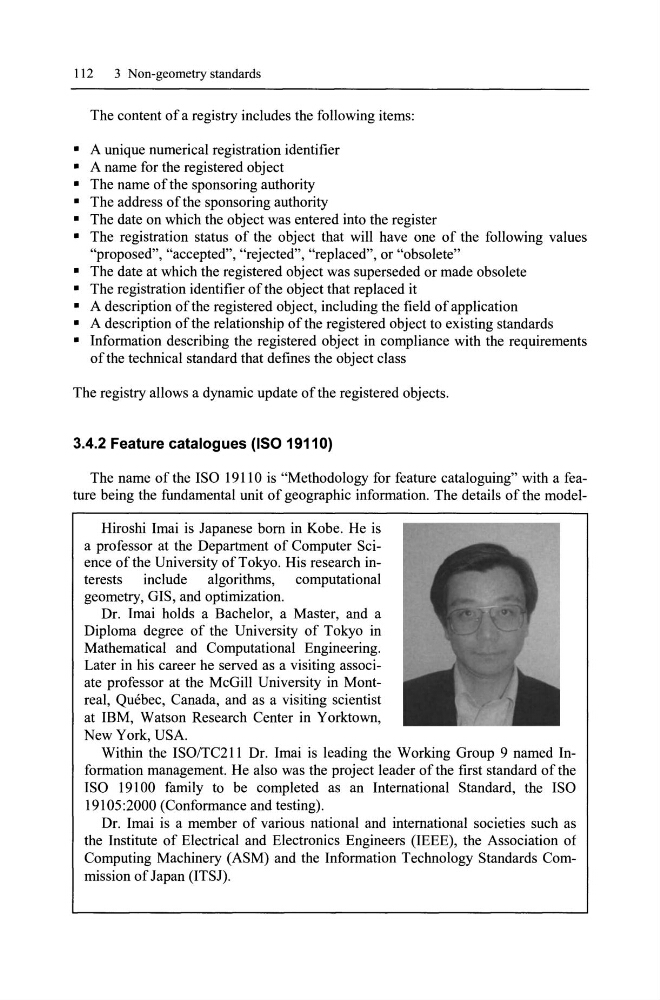
a professor at the Department of Computer Science ofthe University ofTokyo. His research interests include algorithms, computational
geometry, GIS, and optimization.
Dr. Imai holds a Bachelor, a Master, and a
Diploma degree of the University of Tokyo in
Mathematical and Computational Engineering.
Later in his career he served as a visiting associate professor at the McGill University in Montreal, Quebec, Canada, and as a visiting scientist
at IBM, Watson Research Center in Yorktown,
New York, USA.
Within the ISO/TC211 Dr. Imai is leading the Working Group 9 named Information management. He also was the project leader of the first standard of the
ISO 19100 family to be completed as an International Standard, the ISO
19105:2000 (Conformance and testing).
Dr. Imai is a member of various national and international societies such as
the Institute of Electrical and Electronics Engineers (IEEE), the Association of
Computing Machinery (ASM) and the Information Technology Standards Commission of Japan (ITSJ).
3 Non-geometry standards
The content of a registry includes the following items:
• A unique numerical registration identifier
• A name for the registered object
• The name of the sponsoring authority
• The address of the sponsoring authority
• The date on which the object was entered into the register
• The registration status of the object that will have one of the following values
"proposed", "accepted", "rejected", "replaced", or "obsolete"
• The date at which the registered object was superseded or made obsolete
• The registration identifier ofthe object that replaced it
• A description of the registered object, including the field of application
• A description ofthe relationship ofthe registered object to existing standards
• Information describing the registered object in compliance with the requirements
ofthe technical standard that defines the object class
The registry allows a dynamic update of the registered objects.
3.4.2 Feature catalogues (ISO 19110)
The name of the ISO 19110 is "Methodology for feature cataloguing" with a feature being the fundamental unit of geographic information. The details of the modelHiroshi Imai is Japanese born in Kobe. He is
a professor at the Department of Computer Science ofthe University ofTokyo. His research interests include algorithms, computational
geometry, GIS, and optimization.
Dr. Imai holds a Bachelor, a Master, and a
Diploma degree of the University of Tokyo in
Mathematical and Computational Engineering.
Later in his career he served as a visiting associate professor at the McGill University in Montreal, Quebec, Canada, and as a visiting scientist
at IBM, Watson Research Center in Yorktown,
New York, USA.
Within the ISO/TC211 Dr. Imai is leading the Working Group 9 named Information management. He also was the project leader of the first standard of the
ISO 19100 family to be completed as an International Standard, the ISO
19105:2000 (Conformance and testing).
Dr. Imai is a member of various national and international societies such as
the Institute of Electrical and Electronics Engineers (IEEE), the Association of
Computing Machinery (ASM) and the Information Technology Standards Commission of Japan (ITSJ).