

558
D.R. Green and S.D. King
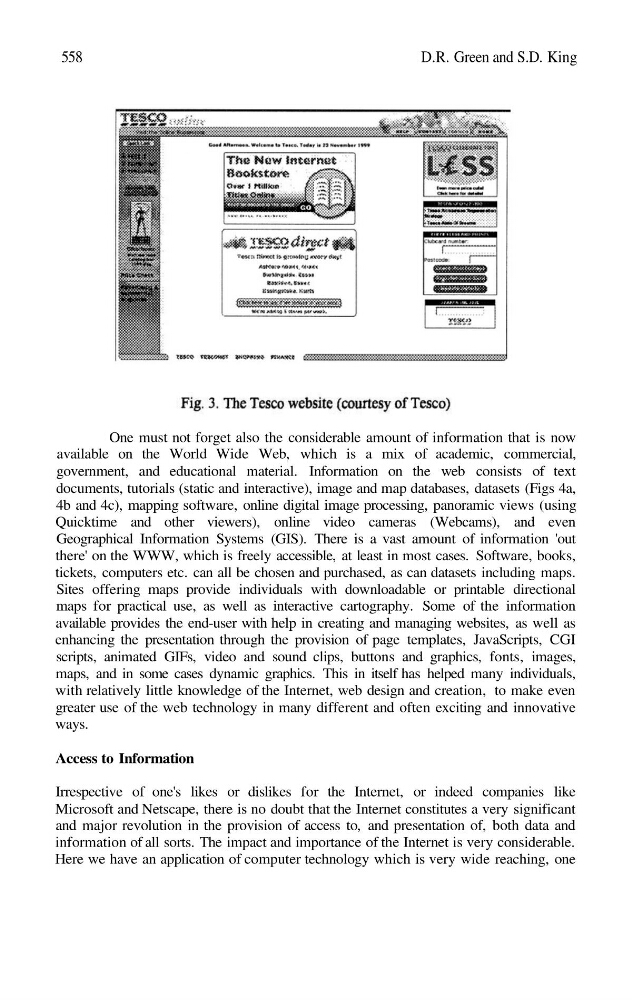
One must not forget also the considerable amount of information that is now
available on the World Wide Web, which is a mix of academic, commercial,
government, and educational material. Information on the web consists of text
documents, tutorials (static and interactive), image and map databases, datasets (Figs 4a,
4b and 4c), mapping software, online digital image processing, panoramic views (using
Quicktime and other viewers), online video cameras (Webcams), and even
Geographical Information Systems (GIS). There is a vast amount of information 'out
there' on the WWW, which is freely accessible, at least in most cases. Software, books,
tickets, computers etc. can all be chosen and purchased, as can datasets including maps.
Sites offering maps provide individuals with downloadable or printable directional
maps for practical use, as well as interactive cartography. Some of the information
available provides the end-user with help in creating and managing websites, as well as
enhancing the presentation through the provision of page templates, JavaScripts, CGI
scripts, animated GIFs, video and sound clips, buttons and graphics, fonts, images,
maps, and in some cases dynamic graphics. This in itself has helped many individuals,
with relatively little knowledge of the Internet, web design and creation, to make even
greater use of the web technology in many different and often exciting and innovative
ways.
Access to Information
Irrespective of one's likes or dislikes for the Internet, or indeed companies like
Microsoft and Netscape, there is no doubt that the Internet constitutes a very significant
and major revolution in the provision of access to, and presentation of, both data and
information of all sorts. The impact and importance of the Internet is very considerable.
Here we have an application of computer technology which is very wide reaching, one
D.R. Green and S.D. King
One must not forget also the considerable amount of information that is now
available on the World Wide Web, which is a mix of academic, commercial,
government, and educational material. Information on the web consists of text
documents, tutorials (static and interactive), image and map databases, datasets (Figs 4a,
4b and 4c), mapping software, online digital image processing, panoramic views (using
Quicktime and other viewers), online video cameras (Webcams), and even
Geographical Information Systems (GIS). There is a vast amount of information 'out
there' on the WWW, which is freely accessible, at least in most cases. Software, books,
tickets, computers etc. can all be chosen and purchased, as can datasets including maps.
Sites offering maps provide individuals with downloadable or printable directional
maps for practical use, as well as interactive cartography. Some of the information
available provides the end-user with help in creating and managing websites, as well as
enhancing the presentation through the provision of page templates, JavaScripts, CGI
scripts, animated GIFs, video and sound clips, buttons and graphics, fonts, images,
maps, and in some cases dynamic graphics. This in itself has helped many individuals,
with relatively little knowledge of the Internet, web design and creation, to make even
greater use of the web technology in many different and often exciting and innovative
ways.
Access to Information
Irrespective of one's likes or dislikes for the Internet, or indeed companies like
Microsoft and Netscape, there is no doubt that the Internet constitutes a very significant
and major revolution in the provision of access to, and presentation of, both data and
information of all sorts. The impact and importance of the Internet is very considerable.
Here we have an application of computer technology which is very wide reaching, one