

512
J. Ojeda Zújar et al.
which moves sediments eastward. The net eastward movement has recently been
modelled mathematically at 260,000 m3/yr. (Medina, 1991).
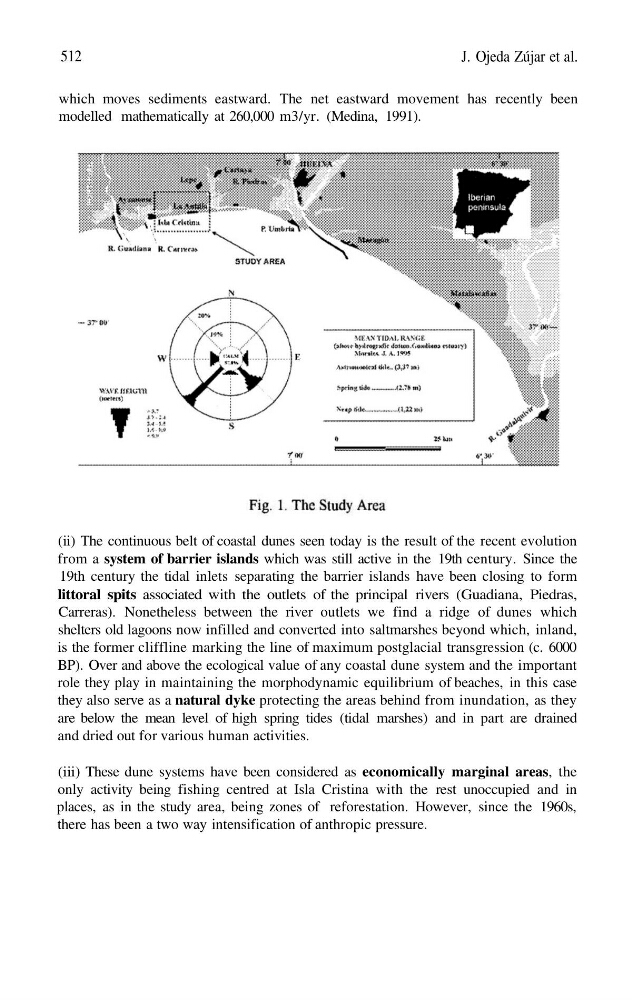
(ii) The continuous belt of coastal dunes seen today is the result of the recent evolution
from a system of barrier islands which was still active in the 19th century. Since the
19th century the tidal inlets separating the barrier islands have been closing to form
littoral spits associated with the outlets of the principal rivers (Guadiana, Piedras,
Carreras). Nonetheless between the river outlets we find a ridge of dunes which
shelters old lagoons now infilled and converted into saltmarshes beyond which, inland,
is the former cliffline marking the line of maximum postglacial transgression (c. 6000
BP). Over and above the ecological value of any coastal dune system and the important
role they play in maintaining the morphodynamic equilibrium of beaches, in this case
they also serve as a natural dyke protecting the areas behind from inundation, as they
are below the mean level of high spring tides (tidal marshes) and in part are drained
and dried out for various human activities.
(iii) These dune systems have been considered as economically marginal areas, the
only activity being fishing centred at Isla Cristina with the rest unoccupied and in
places, as in the study area, being zones of reforestation. However, since the 1960s,
there has been a two way intensification of anthropic pressure.
J. Ojeda Zújar et al.
which moves sediments eastward. The net eastward movement has recently been
modelled mathematically at 260,000 m3/yr. (Medina, 1991).
(ii) The continuous belt of coastal dunes seen today is the result of the recent evolution
from a system of barrier islands which was still active in the 19th century. Since the
19th century the tidal inlets separating the barrier islands have been closing to form
littoral spits associated with the outlets of the principal rivers (Guadiana, Piedras,
Carreras). Nonetheless between the river outlets we find a ridge of dunes which
shelters old lagoons now infilled and converted into saltmarshes beyond which, inland,
is the former cliffline marking the line of maximum postglacial transgression (c. 6000
BP). Over and above the ecological value of any coastal dune system and the important
role they play in maintaining the morphodynamic equilibrium of beaches, in this case
they also serve as a natural dyke protecting the areas behind from inundation, as they
are below the mean level of high spring tides (tidal marshes) and in part are drained
and dried out for various human activities.
(iii) These dune systems have been considered as economically marginal areas, the
only activity being fishing centred at Isla Cristina with the rest unoccupied and in
places, as in the study area, being zones of reforestation. However, since the 1960s,
there has been a two way intensification of anthropic pressure.