

505
Kelp Biomass Assessment Using Remote Sensing
The total weight recorded in sampled quadrants ranged from 1.8 to
The
total biomass in quadrant occupied only by L. digitata and A. esculenta was more
important, up to twice the biomass occupied by other species composition. The
presence ina quadrat of other species such as D. viridis, L. longicruris, Fucus sp. or A.
nodosum resulted in biomass values of only 1.8 to
Equation 1 was applied to estimate the total biomass with the median value of
sampled data. The minimum and maximum biomass were calculated with the lower
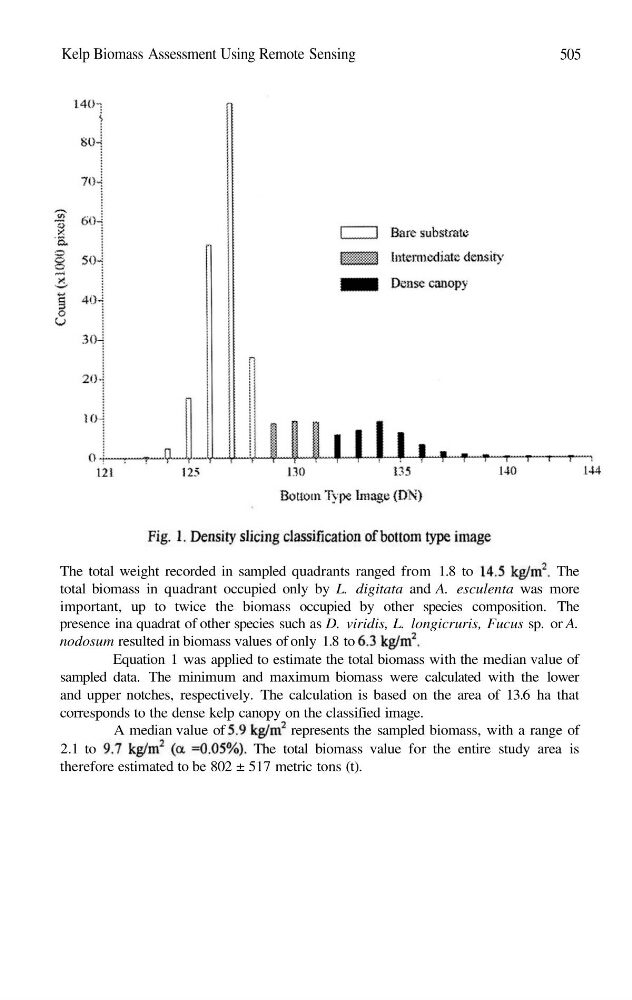
and upper notches, respectively. The calculation is based on the area of 13.6 ha that
corresponds to the dense kelp canopy on the classified image.
A median value of
represents the sampled biomass, with a range of
2.1 to
The total biomass value for the entire study area is
therefore estimated to be 802 ± 517 metric tons (t).
Kelp Biomass Assessment Using Remote Sensing
The total weight recorded in sampled quadrants ranged from 1.8 to
The
total biomass in quadrant occupied only by L. digitata and A. esculenta was more
important, up to twice the biomass occupied by other species composition. The
presence ina quadrat of other species such as D. viridis, L. longicruris, Fucus sp. or A.
nodosum resulted in biomass values of only 1.8 to
Equation 1 was applied to estimate the total biomass with the median value of
sampled data. The minimum and maximum biomass were calculated with the lower
and upper notches, respectively. The calculation is based on the area of 13.6 ha that
corresponds to the dense kelp canopy on the classified image.
A median value of
represents the sampled biomass, with a range of
2.1 to
The total biomass value for the entire study area is
therefore estimated to be 802 ± 517 metric tons (t).