

Internet-Based Information Systems
461
the information contained within via e.g. links, hotwords, graphics, text and so on.
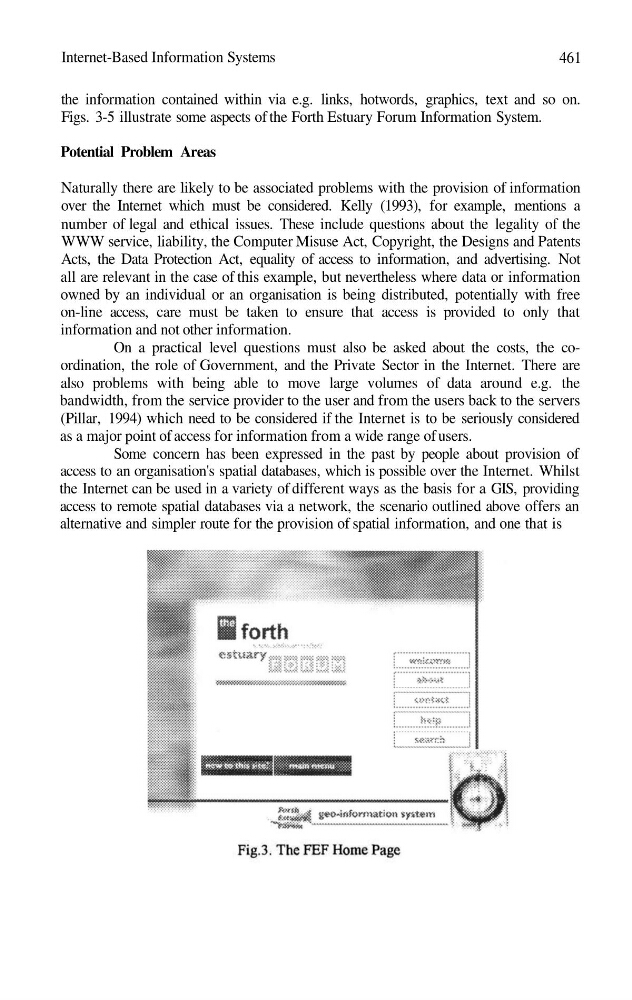
Figs. 3-5 illustrate some aspects of the Forth Estuary Forum Information System.
Potential Problem Areas
Naturally there are likely to be associated problems with the provision of information
over the Internet which must be considered. Kelly (1993), for example, mentions a
number of legal and ethical issues. These include questions about the legality of the
WWW service, liability, the Computer Misuse Act, Copyright, the Designs and Patents
Acts, the Data Protection Act, equality of access to information, and advertising. Not
all are relevant in the case of this example, but nevertheless where data or information
owned by an individual or an organisation is being distributed, potentially with free
on-line access, care must be taken to ensure that access is provided to only that
information and not other information.
On a practical level questions must also be asked about the costs, the coordination, the role of Government, and the Private Sector in the Internet. There are
also problems with being able to move large volumes of data around e.g. the
bandwidth, from the service provider to the user and from the users back to the servers
(Pillar, 1994) which need to be considered if the Internet is to be seriously considered
as a major point of access for information from a wide range of users.
Some concern has been expressed in the past by people about provision of
access to an organisation's spatial databases, which is possible over the Internet. Whilst
the Internet can be used in a variety of different ways as the basis for a GIS, providing
access to remote spatial databases via a network, the scenario outlined above offers an
alternative and simpler route for the provision of spatial information, and one that is
461
the information contained within via e.g. links, hotwords, graphics, text and so on.
Figs. 3-5 illustrate some aspects of the Forth Estuary Forum Information System.
Potential Problem Areas
Naturally there are likely to be associated problems with the provision of information
over the Internet which must be considered. Kelly (1993), for example, mentions a
number of legal and ethical issues. These include questions about the legality of the
WWW service, liability, the Computer Misuse Act, Copyright, the Designs and Patents
Acts, the Data Protection Act, equality of access to information, and advertising. Not
all are relevant in the case of this example, but nevertheless where data or information
owned by an individual or an organisation is being distributed, potentially with free
on-line access, care must be taken to ensure that access is provided to only that
information and not other information.
On a practical level questions must also be asked about the costs, the coordination, the role of Government, and the Private Sector in the Internet. There are
also problems with being able to move large volumes of data around e.g. the
bandwidth, from the service provider to the user and from the users back to the servers
(Pillar, 1994) which need to be considered if the Internet is to be seriously considered
as a major point of access for information from a wide range of users.
Some concern has been expressed in the past by people about provision of
access to an organisation's spatial databases, which is possible over the Internet. Whilst
the Internet can be used in a variety of different ways as the basis for a GIS, providing
access to remote spatial databases via a network, the scenario outlined above offers an
alternative and simpler route for the provision of spatial information, and one that is