

456
D. R. Green and S. D. King
secondly it provides a standard secondary interface in itself offering users a customised
set of tools to access, retrieve, display, and output information. Within the Netscape or
other browser interface, individual Internet pages offer the user a third level of
interface using point and click buttons/text which is simple, intuitive, and ideally
suited to the casual or infrequent system user.
Internet and GIS
The Internet, or the World Wide Web (WWW) has also been widely discussed in the
context of a Geographical Information System (e.g. Murnion and Munroe, 1994a;
1994b). New hardware, software, and communications technologies have facilitated
the rapid transfer and movement of all kinds of data and information including large
map and image data files, e.g. satellite imagery.
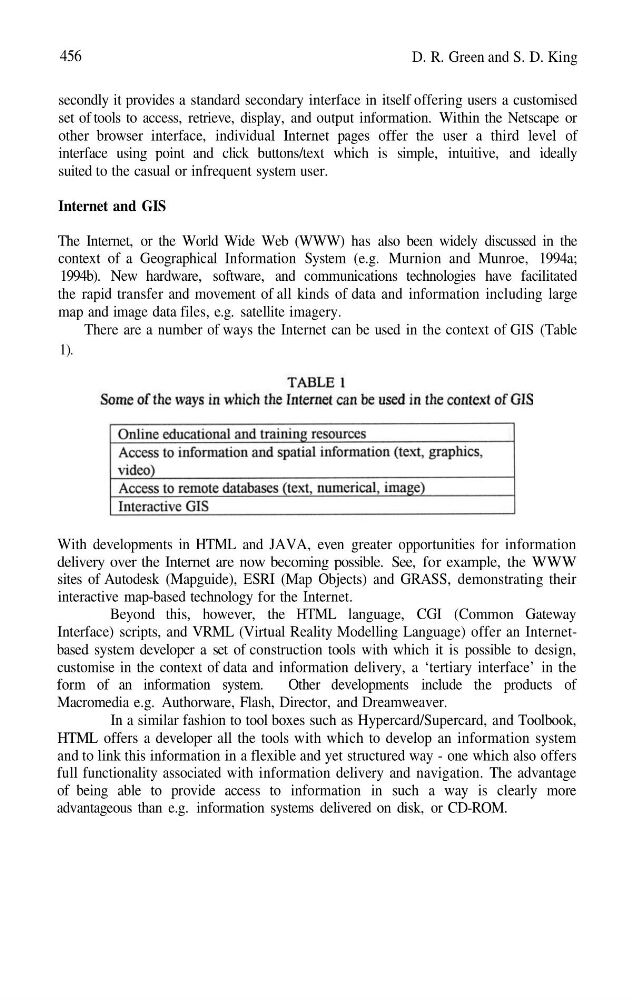
There are a number of ways the Internet can be used in the context of GIS (Table
1).
With developments in HTML and JAVA, even greater opportunities for information
delivery over the Internet are now becoming possible. See, for example, the WWW
sites of Autodesk (Mapguide), ESRI (Map Objects) and GRASS, demonstrating their
interactive map-based technology for the Internet.
Beyond this, however, the HTML language, CGI (Common Gateway
Interface) scripts, and VRML (Virtual Reality Modelling Language) offer an Internetbased system developer a set of construction tools with which it is possible to design,
customise in the context of data and information delivery, a ‘tertiary interface’ in the
form of an information system.
Other developments include the products of
Macromedia e.g. Authorware, Flash, Director, and Dreamweaver.
In a similar fashion to tool boxes such as Hypercard/Supercard, and Toolbook,
HTML offers a developer all the tools with which to develop an information system
and to link this information in a flexible and yet structured way - one which also offers
full functionality associated with information delivery and navigation. The advantage
of being able to provide access to information in such a way is clearly more
advantageous than e.g. information systems delivered on disk, or CD-ROM.
D. R. Green and S. D. King
secondly it provides a standard secondary interface in itself offering users a customised
set of tools to access, retrieve, display, and output information. Within the Netscape or
other browser interface, individual Internet pages offer the user a third level of
interface using point and click buttons/text which is simple, intuitive, and ideally
suited to the casual or infrequent system user.
Internet and GIS
The Internet, or the World Wide Web (WWW) has also been widely discussed in the
context of a Geographical Information System (e.g. Murnion and Munroe, 1994a;
1994b). New hardware, software, and communications technologies have facilitated
the rapid transfer and movement of all kinds of data and information including large
map and image data files, e.g. satellite imagery.
There are a number of ways the Internet can be used in the context of GIS (Table
1).
With developments in HTML and JAVA, even greater opportunities for information
delivery over the Internet are now becoming possible. See, for example, the WWW
sites of Autodesk (Mapguide), ESRI (Map Objects) and GRASS, demonstrating their
interactive map-based technology for the Internet.
Beyond this, however, the HTML language, CGI (Common Gateway
Interface) scripts, and VRML (Virtual Reality Modelling Language) offer an Internetbased system developer a set of construction tools with which it is possible to design,
customise in the context of data and information delivery, a ‘tertiary interface’ in the
form of an information system.
Other developments include the products of
Macromedia e.g. Authorware, Flash, Director, and Dreamweaver.
In a similar fashion to tool boxes such as Hypercard/Supercard, and Toolbook,
HTML offers a developer all the tools with which to develop an information system
and to link this information in a flexible and yet structured way - one which also offers
full functionality associated with information delivery and navigation. The advantage
of being able to provide access to information in such a way is clearly more
advantageous than e.g. information systems delivered on disk, or CD-ROM.