

418
H. Coccossis and K. Dimitriou
formations presents a satisfactory underground water horizon. On the contrary the rest
of the island presents low underground deposits of water.
The climate of the island can be characterized as meso-Mediteranean with an
annual average of 600 mm height of rain. The mean temperature is 14.25°C while the
mean relative humidity is 64.5%. There are no strong winds affecting the island
(58.5%apnea).
Marine ecosystems of Thassos are characterized by their near natural
condition and their relatively large diversity of fish and shells.
Regarding the composition of land-uses, 25% of the area of the island is
covered by variable agricultural uses, 57% by various types of forests, 11% by
grasslands and only 5% could be characterized as urban land.
Forests are mainly composed of coniferous trees (Pinus nigra and Pinus
brutia) and occupy the middle of the island. Other phytosocial formations that can be
found in the island are: the formation of broad-hardleafed with typical species such as
Pistacia lentiscus, Olea europea and Querqus ilex, the Erica arborea and Erica
verticilata formation, the formation of deciduous broad-leafed and riparian formations
with typical species such as Platanus orientalis, Polulus sp., Salix sp. etc. It is
important to notice that in spite of its relevant small size the island presents 12
endemic plant species.
Thassos has a remarkable fauna that consists of mammals (such as Lepus
europeus, Martes foina, Erinaceus europeus, etc), reptiles, amphibians, and birds.
Mountain Ipsarion has been characterized as a Corine biotope because of the
significant biological and natural functions that it supports.
Thassos supports a total population of 13,527 that appears almost stable for
the last two decades. The distribution of manpower to each sector of economy is 27.8%
to the primary sector, 7.8% to secondary sector, 12% to construction, 44% to tertiary
sector (tourism, transportation, services, commerce) and 8.4% of people appears to be
unemployed.
Thassos, regarding its insular nature, supports a wide range of economic activities.
The major economic activities affecting the island are:
Marble extraction. This economic activity occupies 2000 ha, an area that
represents 5% of the total surface of the island. There are 12 fixed areas for
extraction mainly located to mountainous and forest areas. The white marble
that Thassos produces is one of the best marble qualities worldwide. The
rational marble extraction constitutes for the national economy a major
source of foreign exchange since the entire volume is exported. A total of
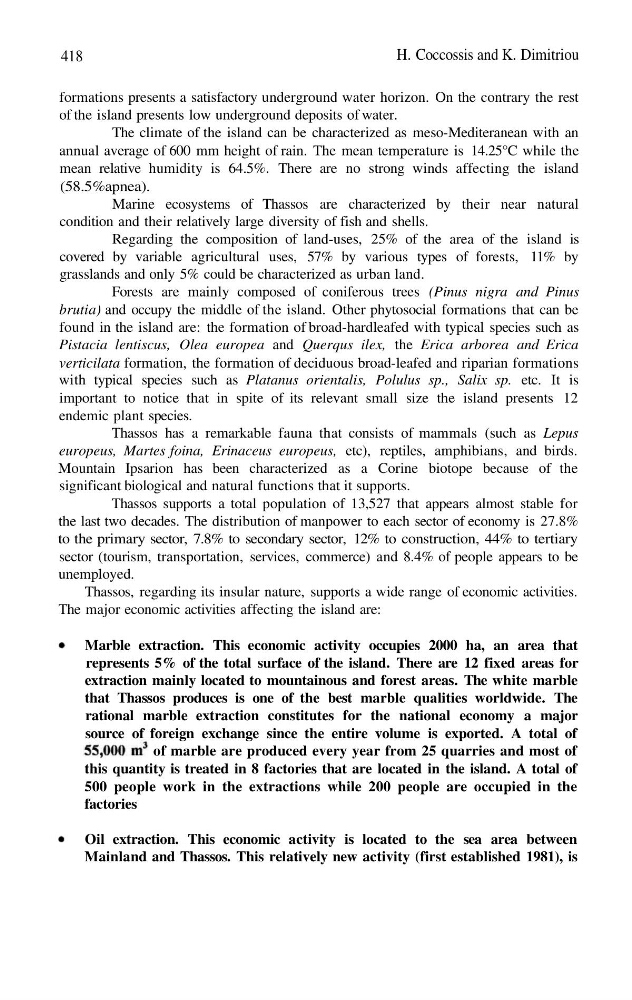
of marble are produced every year from 25 quarries and most of
this quantity is treated in 8 factories that are located in the island. A total of
500 people work in the extractions while 200 people are occupied in the
factories
Oil extraction. This economic activity is located to the sea area between
Mainland and Thassos. This relatively new activity (first established 1981), is
H. Coccossis and K. Dimitriou
formations presents a satisfactory underground water horizon. On the contrary the rest
of the island presents low underground deposits of water.
The climate of the island can be characterized as meso-Mediteranean with an
annual average of 600 mm height of rain. The mean temperature is 14.25°C while the
mean relative humidity is 64.5%. There are no strong winds affecting the island
(58.5%apnea).
Marine ecosystems of Thassos are characterized by their near natural
condition and their relatively large diversity of fish and shells.
Regarding the composition of land-uses, 25% of the area of the island is
covered by variable agricultural uses, 57% by various types of forests, 11% by
grasslands and only 5% could be characterized as urban land.
Forests are mainly composed of coniferous trees (Pinus nigra and Pinus
brutia) and occupy the middle of the island. Other phytosocial formations that can be
found in the island are: the formation of broad-hardleafed with typical species such as
Pistacia lentiscus, Olea europea and Querqus ilex, the Erica arborea and Erica
verticilata formation, the formation of deciduous broad-leafed and riparian formations
with typical species such as Platanus orientalis, Polulus sp., Salix sp. etc. It is
important to notice that in spite of its relevant small size the island presents 12
endemic plant species.
Thassos has a remarkable fauna that consists of mammals (such as Lepus
europeus, Martes foina, Erinaceus europeus, etc), reptiles, amphibians, and birds.
Mountain Ipsarion has been characterized as a Corine biotope because of the
significant biological and natural functions that it supports.
Thassos supports a total population of 13,527 that appears almost stable for
the last two decades. The distribution of manpower to each sector of economy is 27.8%
to the primary sector, 7.8% to secondary sector, 12% to construction, 44% to tertiary
sector (tourism, transportation, services, commerce) and 8.4% of people appears to be
unemployed.
Thassos, regarding its insular nature, supports a wide range of economic activities.
The major economic activities affecting the island are:
Marble extraction. This economic activity occupies 2000 ha, an area that
represents 5% of the total surface of the island. There are 12 fixed areas for
extraction mainly located to mountainous and forest areas. The white marble
that Thassos produces is one of the best marble qualities worldwide. The
rational marble extraction constitutes for the national economy a major
source of foreign exchange since the entire volume is exported. A total of
of marble are produced every year from 25 quarries and most of
this quantity is treated in 8 factories that are located in the island. A total of
500 people work in the extractions while 200 people are occupied in the
factories
Oil extraction. This economic activity is located to the sea area between
Mainland and Thassos. This relatively new activity (first established 1981), is