

Consideration on Satellite Data Correction
395
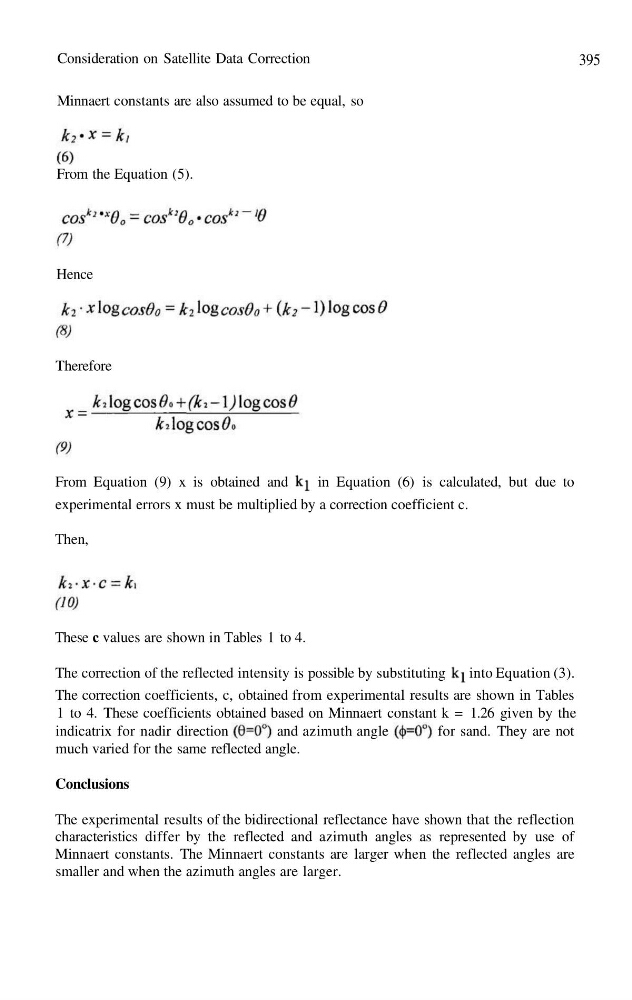
Minnaert constants are also assumed to be equal, so
From the Equation (5).
Hence
Therefore
From Equation (9) x is obtained and
in Equation (6) is calculated, but due to
experimental errors x must be multiplied by a correction coefficient c.
Then,
These c values are shown in Tables 1 to 4.
The correction of the reflected intensity is possible by substituting
into Equation (3).
The correction coefficients, c, obtained from experimental results are shown in Tables
1 to 4. These coefficients obtained based on Minnaert constant k = 1.26 given by the
indicatrix for nadir direction
and azimuth angle
for sand. They are not
much varied for the same reflected angle.
Conclusions
The experimental results of the bidirectional reflectance have shown that the reflection
characteristics differ by the reflected and azimuth angles as represented by use of
Minnaert constants. The Minnaert constants are larger when the reflected angles are
smaller and when the azimuth angles are larger.
395
Minnaert constants are also assumed to be equal, so
From the Equation (5).
Hence
Therefore
From Equation (9) x is obtained and
in Equation (6) is calculated, but due to
experimental errors x must be multiplied by a correction coefficient c.
Then,
These c values are shown in Tables 1 to 4.
The correction of the reflected intensity is possible by substituting
into Equation (3).
The correction coefficients, c, obtained from experimental results are shown in Tables
1 to 4. These coefficients obtained based on Minnaert constant k = 1.26 given by the
indicatrix for nadir direction
and azimuth angle
for sand. They are not
much varied for the same reflected angle.
Conclusions
The experimental results of the bidirectional reflectance have shown that the reflection
characteristics differ by the reflected and azimuth angles as represented by use of
Minnaert constants. The Minnaert constants are larger when the reflected angles are
smaller and when the azimuth angles are larger.