

386
H. Okayama and J. Sun
Radiometer (AVHRR) on board the NOAA Satellite, and the High Resolution Visible
(HRV) instrument on board the SPOT satellite.
In this chapter, as a fundamental experiment of a bidirectional reflectance, we
obtain the bidirectional reflectance characteristics for the sand and we discuss how to
correct the reflected intensities observed in different nadir directions. Our correction
method has merit in that it can be applied to a non-Lambertian surface.
Experiments and Results
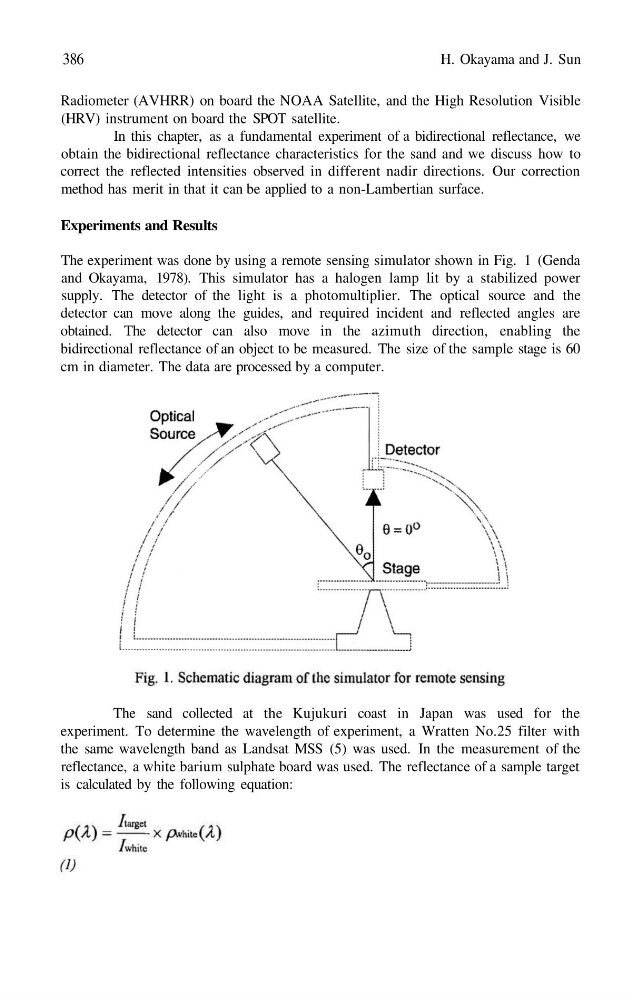
The experiment was done by using a remote sensing simulator shown in Fig. 1 (Genda
and Okayama, 1978). This simulator has a halogen lamp lit by a stabilized power
supply. The detector of the light is a photomultiplier. The optical source and the
detector can move along the guides, and required incident and reflected angles are
obtained. The detector can also move in the azimuth direction, enabling the
bidirectional reflectance of an object to be measured. The size of the sample stage is 60
cm in diameter. The data are processed by a computer.
The sand collected at the Kujukuri coast in Japan was used for the
experiment. To determine the wavelength of experiment, a Wratten No.25 filter with
the same wavelength band as Landsat MSS (5) was used. In the measurement of the
reflectance, a white barium sulphate board was used. The reflectance of a sample target
is calculated by the following equation:
H. Okayama and J. Sun
Radiometer (AVHRR) on board the NOAA Satellite, and the High Resolution Visible
(HRV) instrument on board the SPOT satellite.
In this chapter, as a fundamental experiment of a bidirectional reflectance, we
obtain the bidirectional reflectance characteristics for the sand and we discuss how to
correct the reflected intensities observed in different nadir directions. Our correction
method has merit in that it can be applied to a non-Lambertian surface.
Experiments and Results
The experiment was done by using a remote sensing simulator shown in Fig. 1 (Genda
and Okayama, 1978). This simulator has a halogen lamp lit by a stabilized power
supply. The detector of the light is a photomultiplier. The optical source and the
detector can move along the guides, and required incident and reflected angles are
obtained. The detector can also move in the azimuth direction, enabling the
bidirectional reflectance of an object to be measured. The size of the sample stage is 60
cm in diameter. The data are processed by a computer.
The sand collected at the Kujukuri coast in Japan was used for the
experiment. To determine the wavelength of experiment, a Wratten No.25 filter with
the same wavelength band as Landsat MSS (5) was used. In the measurement of the
reflectance, a white barium sulphate board was used. The reflectance of a sample target
is calculated by the following equation: