

Error Modeling and Management for Data
359
as field checking of observations, strengthening geodetic control networks, defining
and standardizing technical procedures, mandatory registration of all rights in land,
and improved professional training, all contribute to the confirmation of “... the
precision and crispness in the description and location in space and time of a spatial
entity”. Other provisions such as the use of better data processing methods, collecting
additional data, sampling at a higher frequency, improving the spatial/temporal
resolution, using better models, and improving procedures for model calibration may
be required to improve the accuracy of the data/product. However, it should be pointed
out that more accurate data needs more effort, time and expense.
Uncertainty Modeling of Geospatial Objects
The implications of the proposed strategy may be illustrated with reference to the
modeling of geospatial objects (particularly, lines and polygons). Point uncertainty
modeling has thoroughly examined in disciplines such as photogrammetry, surveying
and geodesy (Mikhail and Gracie, 1981) and, as such, this chapter will focus on
modeling the uncertainty of line and polygon objects in a GIS database. The following
is a brief evaluation of existing line uncertainty models namely the epsilon band and
error band models.
THE EPSILON BAND MODEL
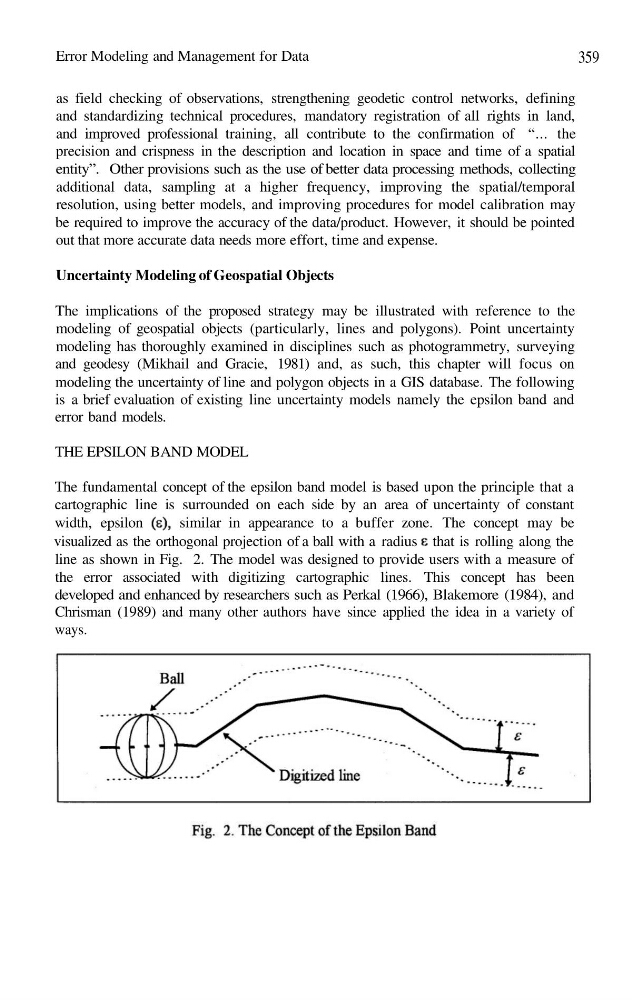
The fundamental concept of the epsilon band model is based upon the principle that a
cartographic line is surrounded on each side by an area of uncertainty of constant
width, epsilon
similar in appearance to a buffer zone. The concept may be
visualized as the orthogonal projection of a ball with a radius that is rolling along the
line as shown in Fig. 2. The model was designed to provide users with a measure of
the error associated with digitizing cartographic lines. This concept has been
developed and enhanced by researchers such as Perkal (1966), Blakemore (1984), and
Chrisman (1989) and many other authors have since applied the idea in a variety of
ways.
359
as field checking of observations, strengthening geodetic control networks, defining
and standardizing technical procedures, mandatory registration of all rights in land,
and improved professional training, all contribute to the confirmation of “... the
precision and crispness in the description and location in space and time of a spatial
entity”. Other provisions such as the use of better data processing methods, collecting
additional data, sampling at a higher frequency, improving the spatial/temporal
resolution, using better models, and improving procedures for model calibration may
be required to improve the accuracy of the data/product. However, it should be pointed
out that more accurate data needs more effort, time and expense.
Uncertainty Modeling of Geospatial Objects
The implications of the proposed strategy may be illustrated with reference to the
modeling of geospatial objects (particularly, lines and polygons). Point uncertainty
modeling has thoroughly examined in disciplines such as photogrammetry, surveying
and geodesy (Mikhail and Gracie, 1981) and, as such, this chapter will focus on
modeling the uncertainty of line and polygon objects in a GIS database. The following
is a brief evaluation of existing line uncertainty models namely the epsilon band and
error band models.
THE EPSILON BAND MODEL
The fundamental concept of the epsilon band model is based upon the principle that a
cartographic line is surrounded on each side by an area of uncertainty of constant
width, epsilon
similar in appearance to a buffer zone. The concept may be
visualized as the orthogonal projection of a ball with a radius that is rolling along the
line as shown in Fig. 2. The model was designed to provide users with a measure of
the error associated with digitizing cartographic lines. This concept has been
developed and enhanced by researchers such as Perkal (1966), Blakemore (1984), and
Chrisman (1989) and many other authors have since applied the idea in a variety of
ways.