

GIS and Aquaculture: Soft-Shell Clam Site Assessment
281
Site Characteristics
The soft-shell clam inhabits bays and estuaries, intertidally and subtidally in fairly
shallow water to depths of approximately 9m (Newell and Hidu, 1994). The potential
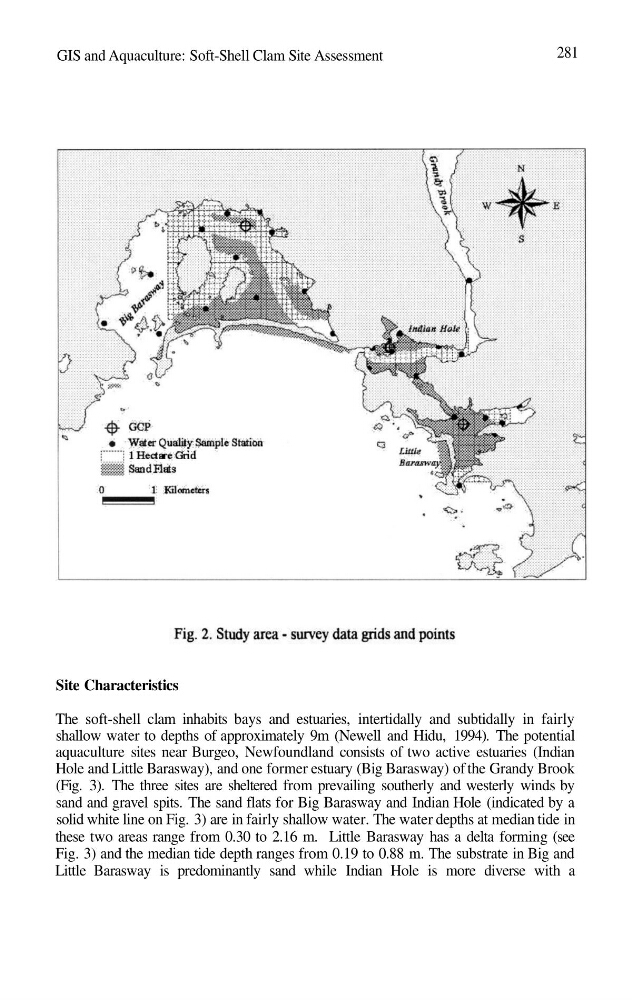
aquaculture sites near Burgeo, Newfoundland consists of two active estuaries (Indian
Hole and Little Barasway), and one former estuary (Big Barasway) of the Grandy Brook
(Fig. 3). The three sites are sheltered from prevailing southerly and westerly winds by
sand and gravel spits. The sand flats for Big Barasway and Indian Hole (indicated by a
solid white line on Fig. 3) are in fairly shallow water. The water depths at median tide in
these two areas range from 0.30 to 2.16 m. Little Barasway has a delta forming (see
Fig. 3) and the median tide depth ranges from 0.19 to 0.88 m. The substrate in Big and
Little Barasway is predominantly sand while Indian Hole is more diverse with a
281
Site Characteristics
The soft-shell clam inhabits bays and estuaries, intertidally and subtidally in fairly
shallow water to depths of approximately 9m (Newell and Hidu, 1994). The potential
aquaculture sites near Burgeo, Newfoundland consists of two active estuaries (Indian
Hole and Little Barasway), and one former estuary (Big Barasway) of the Grandy Brook
(Fig. 3). The three sites are sheltered from prevailing southerly and westerly winds by
sand and gravel spits. The sand flats for Big Barasway and Indian Hole (indicated by a
solid white line on Fig. 3) are in fairly shallow water. The water depths at median tide in
these two areas range from 0.30 to 2.16 m. Little Barasway has a delta forming (see
Fig. 3) and the median tide depth ranges from 0.19 to 0.88 m. The substrate in Big and
Little Barasway is predominantly sand while Indian Hole is more diverse with a