

Quantifying Landscape / Ecological Succession
257
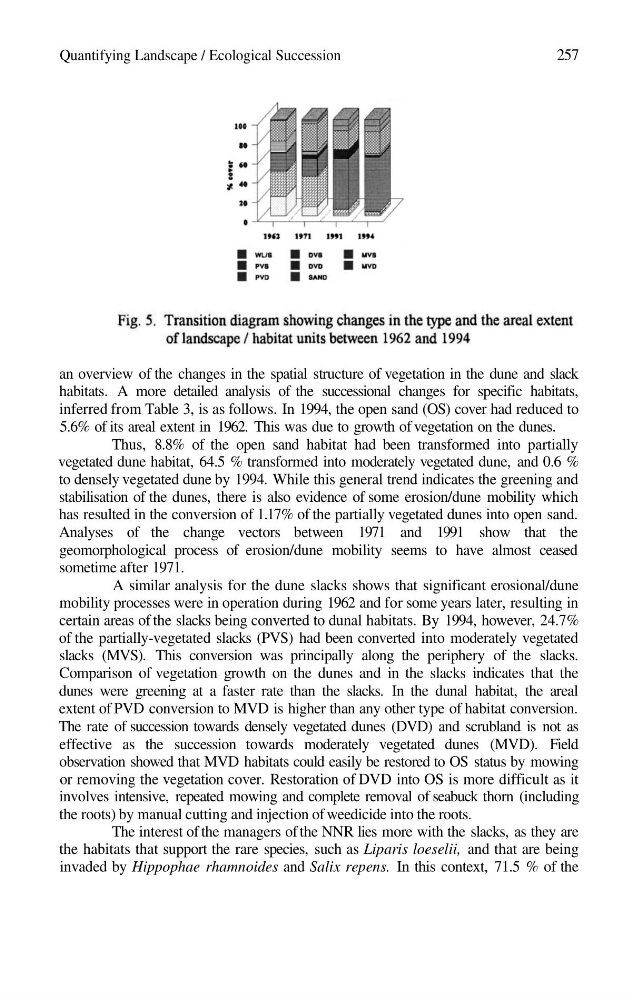
an overview of the changes in the spatial structure of vegetation in the dune and slack
habitats. A more detailed analysis of the successional changes for specific habitats,
inferred from Table 3, is as follows. In 1994, the open sand (OS) cover had reduced to
5.6% of its areal extent in 1962. This was due to growth of vegetation on the dunes.
Thus, 8.8% of the open sand habitat had been transformed into partially
vegetated dune habitat, 64.5 % transformed into moderately vegetated dune, and 0.6 %
to densely vegetated dune by 1994. While this general trend indicates the greening and
stabilisation of the dunes, there is also evidence of some erosion/dune mobility which
has resulted in the conversion of 1.17% of the partially vegetated dunes into open sand.
Analyses of the change vectors between 1971 and 1991 show that the
geomorphological process of erosion/dune mobility seems to have almost ceased
sometime after 1971.
A similar analysis for the dune slacks shows that significant erosional/dune
mobility processes were in operation during 1962 and for some years later, resulting in
certain areas of the slacks being converted to dunal habitats. By 1994, however, 24.7%
of the partially-vegetated slacks (PVS) had been converted into moderately vegetated
slacks (MVS). This conversion was principally along the periphery of the slacks.
Comparison of vegetation growth on the dunes and in the slacks indicates that the
dunes were greening at a faster rate than the slacks. In the dunal habitat, the areal
extent of PVD conversion to MVD is higher than any other type of habitat conversion.
The rate of succession towards densely vegetated dunes (DVD) and scrubland is not as
effective as the succession towards moderately vegetated dunes (MVD). Field
observation showed that MVD habitats could easily be restored to OS status by mowing
or removing the vegetation cover. Restoration of DVD into OS is more difficult as it
involves intensive, repeated mowing and complete removal of seabuck thorn (including
the roots) by manual cutting and injection of weedicide into the roots.
The interest of the managers of the NNR lies more with the slacks, as they are
the habitats that support the rare species, such as Liparis loeselii, and that are being
invaded by Hippophae rhamnoides and Salix repens. In this context, 71.5 % of the
257
an overview of the changes in the spatial structure of vegetation in the dune and slack
habitats. A more detailed analysis of the successional changes for specific habitats,
inferred from Table 3, is as follows. In 1994, the open sand (OS) cover had reduced to
5.6% of its areal extent in 1962. This was due to growth of vegetation on the dunes.
Thus, 8.8% of the open sand habitat had been transformed into partially
vegetated dune habitat, 64.5 % transformed into moderately vegetated dune, and 0.6 %
to densely vegetated dune by 1994. While this general trend indicates the greening and
stabilisation of the dunes, there is also evidence of some erosion/dune mobility which
has resulted in the conversion of 1.17% of the partially vegetated dunes into open sand.
Analyses of the change vectors between 1971 and 1991 show that the
geomorphological process of erosion/dune mobility seems to have almost ceased
sometime after 1971.
A similar analysis for the dune slacks shows that significant erosional/dune
mobility processes were in operation during 1962 and for some years later, resulting in
certain areas of the slacks being converted to dunal habitats. By 1994, however, 24.7%
of the partially-vegetated slacks (PVS) had been converted into moderately vegetated
slacks (MVS). This conversion was principally along the periphery of the slacks.
Comparison of vegetation growth on the dunes and in the slacks indicates that the
dunes were greening at a faster rate than the slacks. In the dunal habitat, the areal
extent of PVD conversion to MVD is higher than any other type of habitat conversion.
The rate of succession towards densely vegetated dunes (DVD) and scrubland is not as
effective as the succession towards moderately vegetated dunes (MVD). Field
observation showed that MVD habitats could easily be restored to OS status by mowing
or removing the vegetation cover. Restoration of DVD into OS is more difficult as it
involves intensive, repeated mowing and complete removal of seabuck thorn (including
the roots) by manual cutting and injection of weedicide into the roots.
The interest of the managers of the NNR lies more with the slacks, as they are
the habitats that support the rare species, such as Liparis loeselii, and that are being
invaded by Hippophae rhamnoides and Salix repens. In this context, 71.5 % of the