

208
A. Sh. Khabidov
with the result that the lake is filled annually and has a relatively stable water level
fluctuation regime.
At a latitude of 55°N, the man-made lake freezes in winter. The ice season
lasts about 180-190 days from November to April or May. The ice thickness can reach
ca. 1.0-1.2 m. The water level fluctuation during the iceless season is ca. 3.5 m. In
keeping with the general rule, the highest velocities of channel flows in the man-made
lake (up to 1.5 - 1.7 m/sec) during the iceless season occur in the flooded Ob River
channel with lesser flows at the depth of closure of the man-made lake (Table 1).
Based upon evidence derived from the observations, the storms of west-southwesterly, south-westerly, south-south-westerly, coinciding with or similar to the fetch
of Novosibirsk Reservoir have the largest strength, duration, and frequency. Table 1
gives the values of significant wave heights at the depth of closure of the lake which
were measured under the west-south-westerly wind with velocity of 20 m/s. As it may
be seen, the wave climate of the Novosibirsk Reservoir is truly dissimilar within
different parts of the man-made lake. During the iceless season, in the upper shallow
area of 65 km long, wave height does not exceed 0.5-0.7 m even under severe storms.
Outside this area, in the deepest places in the lake the wave height reaches 3-3.5 m.
Here waves of 1m in height are observed approximately for 74 days per season, waves
of 1-2 m height - more than 9 days per season, waves of 2-3 m - about 0.8 days per
season, and waves of 3 m and more - up to 0.06 days per season.
Surface Processes in the Coastal Zone
DEPOSITIONAL SEDIMENTARY ENVIRONMENTS OF MAN-MADE LAKES
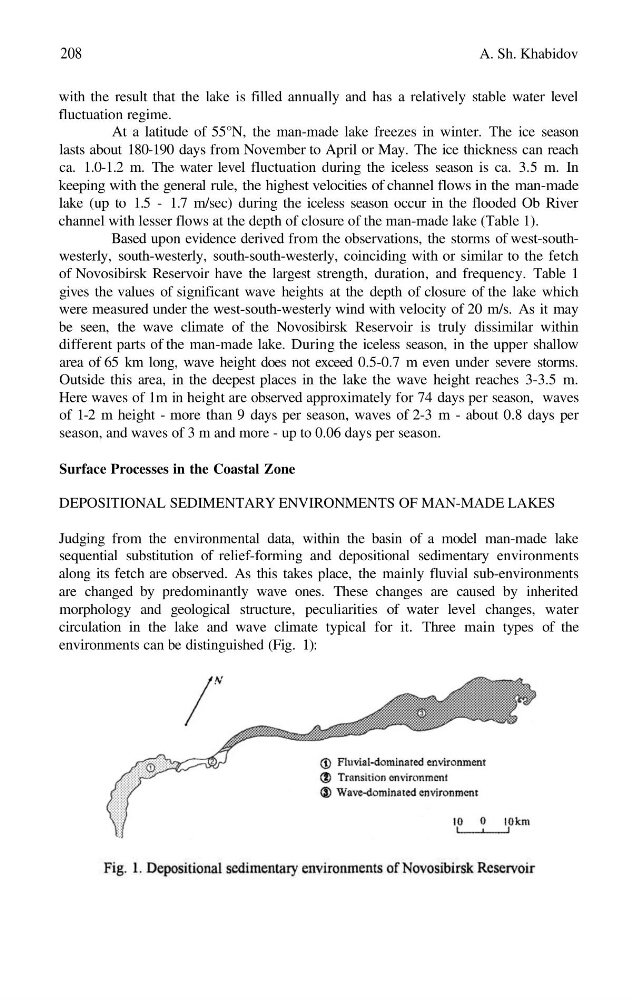
Judging from the environmental data, within the basin of a model man-made lake
sequential substitution of relief-forming and depositional sedimentary environments
along its fetch are observed. As this takes place, the mainly fluvial sub-environments
are changed by predominantly wave ones. These changes are caused by inherited
morphology and geological structure, peculiarities of water level changes, water
circulation in the lake and wave climate typical for it. Three main types of the
environments can be distinguished (Fig. 1):
A. Sh. Khabidov
with the result that the lake is filled annually and has a relatively stable water level
fluctuation regime.
At a latitude of 55°N, the man-made lake freezes in winter. The ice season
lasts about 180-190 days from November to April or May. The ice thickness can reach
ca. 1.0-1.2 m. The water level fluctuation during the iceless season is ca. 3.5 m. In
keeping with the general rule, the highest velocities of channel flows in the man-made
lake (up to 1.5 - 1.7 m/sec) during the iceless season occur in the flooded Ob River
channel with lesser flows at the depth of closure of the man-made lake (Table 1).
Based upon evidence derived from the observations, the storms of west-southwesterly, south-westerly, south-south-westerly, coinciding with or similar to the fetch
of Novosibirsk Reservoir have the largest strength, duration, and frequency. Table 1
gives the values of significant wave heights at the depth of closure of the lake which
were measured under the west-south-westerly wind with velocity of 20 m/s. As it may
be seen, the wave climate of the Novosibirsk Reservoir is truly dissimilar within
different parts of the man-made lake. During the iceless season, in the upper shallow
area of 65 km long, wave height does not exceed 0.5-0.7 m even under severe storms.
Outside this area, in the deepest places in the lake the wave height reaches 3-3.5 m.
Here waves of 1m in height are observed approximately for 74 days per season, waves
of 1-2 m height - more than 9 days per season, waves of 2-3 m - about 0.8 days per
season, and waves of 3 m and more - up to 0.06 days per season.
Surface Processes in the Coastal Zone
DEPOSITIONAL SEDIMENTARY ENVIRONMENTS OF MAN-MADE LAKES
Judging from the environmental data, within the basin of a model man-made lake
sequential substitution of relief-forming and depositional sedimentary environments
along its fetch are observed. As this takes place, the mainly fluvial sub-environments
are changed by predominantly wave ones. These changes are caused by inherited
morphology and geological structure, peculiarities of water level changes, water
circulation in the lake and wave climate typical for it. Three main types of the
environments can be distinguished (Fig. 1):