

192
Newsham et al.
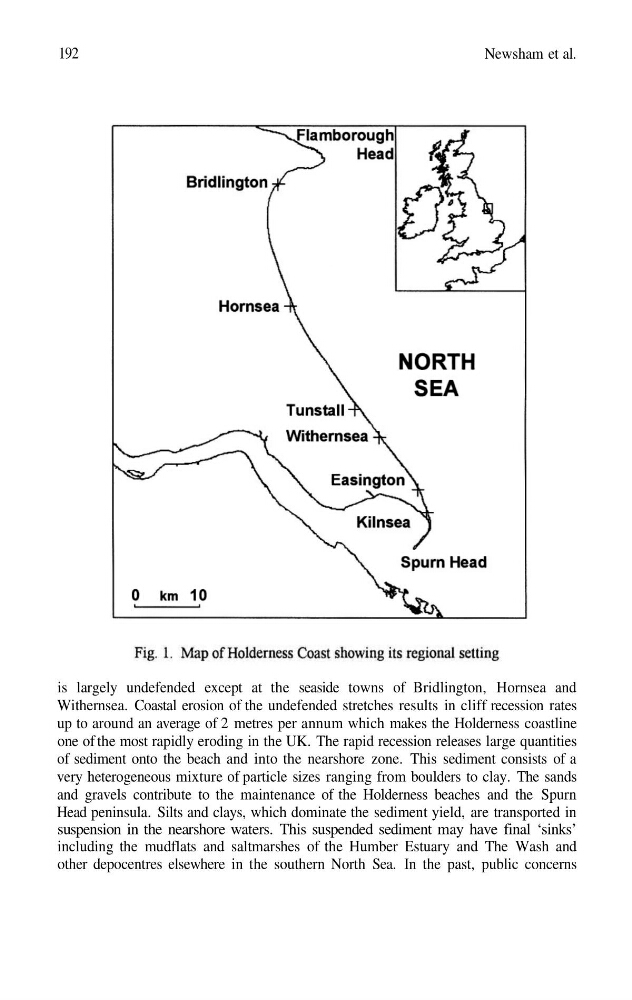
is largely undefended except at the seaside towns of Bridlington, Hornsea and
Withernsea. Coastal erosion of the undefended stretches results in cliff recession rates
up to around an average of 2 metres per annum which makes the Holderness coastline
one of the most rapidly eroding in the UK. The rapid recession releases large quantities
of sediment onto the beach and into the nearshore zone. This sediment consists of a
very heterogeneous mixture of particle sizes ranging from boulders to clay. The sands
and gravels contribute to the maintenance of the Holderness beaches and the Spurn
Head peninsula. Silts and clays, which dominate the sediment yield, are transported in
suspension in the nearshore waters. This suspended sediment may have final ‘sinks’
including the mudflats and saltmarshes of the Humber Estuary and The Wash and
other depocentres elsewhere in the southern North Sea. In the past, public concerns
Newsham et al.
is largely undefended except at the seaside towns of Bridlington, Hornsea and
Withernsea. Coastal erosion of the undefended stretches results in cliff recession rates
up to around an average of 2 metres per annum which makes the Holderness coastline
one of the most rapidly eroding in the UK. The rapid recession releases large quantities
of sediment onto the beach and into the nearshore zone. This sediment consists of a
very heterogeneous mixture of particle sizes ranging from boulders to clay. The sands
and gravels contribute to the maintenance of the Holderness beaches and the Spurn
Head peninsula. Silts and clays, which dominate the sediment yield, are transported in
suspension in the nearshore waters. This suspended sediment may have final ‘sinks’
including the mudflats and saltmarshes of the Humber Estuary and The Wash and
other depocentres elsewhere in the southern North Sea. In the past, public concerns