

160
G. Jones
be affected by flooding and weighting these figures by the Flood Loss Scores, a
nominal disruption figure of £57 million was produced (see Table 4).
The calculation of F.L.S. scores directs attention to the sections of the estuary
where flood losses are greatest in terms of extent and financial value. The financial
costs of providing improved sea defences along the entire coastline will be prohibitive
and accordingly, the previously assumed solution of 'sea-defence-at-all-costs' may no
longer be possible in the future. The scenarios made for this chapter have been based
on the assumption that the protection of main lines of communication (motorways, A
roads and main railway lines) and services essential to the well being of the community
(such as sewage plant, electricity generating stations, water pumping stations) will
justify protection at all costs as the social disruption caused by their interruption would
be too great for society to withstand. In addition, it may be necessary to protect some
residential areas although when judged on a thirty year time scale an alternative option
may be a phased withdrawal from flood prone areas with owner occupiers receiving
compensation from a government-funded ‘Flood Defence Fund’.
Even without the threat of sea level rise, Britain would face an expensive
reconstruction of its existing sea defences. The life of a sea defence system is estimated
at 50 years and many flood protection schemes around the coast of the UK. are now
approaching this age, having been strengthened after the 1953 storm surge. Many
structures will require major renewal by the first decade of the next century. The cost
of this exercise will be immense. The method described in this chapter allows
prioritising the most vulnerable key stretches of coastal and estuarine land and
indicates where financial investment will be provide a best return. The level of
statistical certainty on the likely occurrence of a 0.3 metre sea level rise remains
impossible to calculate although the meeting of the Climate Convention in Berlin in
April, 1995 provided the strongest scientific support for sea level rise.
The amount of sea level rise beyond the year 2030 will be largely determined
by the social response to the threat of global warming in the period up to 2030.
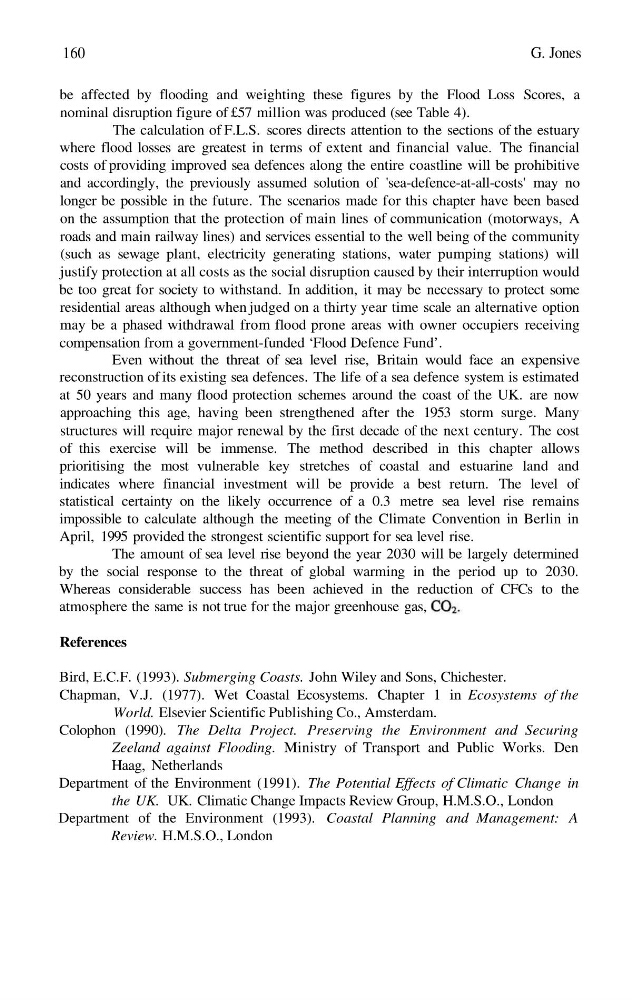
Whereas considerable success has been achieved in the reduction of CFCs to the
atmosphere the same is not true for the major greenhouse gas,
References
Bird, E.C.F. (1993). Submerging Coasts. John Wiley and Sons, Chichester.
Chapman, V.J. (1977). Wet Coastal Ecosystems. Chapter 1 in Ecosystems of the
World. Elsevier Scientific Publishing Co., Amsterdam.
Colophon (1990). The Delta Project. Preserving the Environment and Securing
Zeeland against Flooding. Ministry of Transport and Public Works. Den
Haag, Netherlands
Department of the Environment (1991). The Potential Effects of Climatic Change in
the UK. UK. Climatic Change Impacts Review Group, H.M.S.O., London
Department of the Environment (1993). Coastal Planning and Management: A
Review. H.M.S.O., London
G. Jones
be affected by flooding and weighting these figures by the Flood Loss Scores, a
nominal disruption figure of £57 million was produced (see Table 4).
The calculation of F.L.S. scores directs attention to the sections of the estuary
where flood losses are greatest in terms of extent and financial value. The financial
costs of providing improved sea defences along the entire coastline will be prohibitive
and accordingly, the previously assumed solution of 'sea-defence-at-all-costs' may no
longer be possible in the future. The scenarios made for this chapter have been based
on the assumption that the protection of main lines of communication (motorways, A
roads and main railway lines) and services essential to the well being of the community
(such as sewage plant, electricity generating stations, water pumping stations) will
justify protection at all costs as the social disruption caused by their interruption would
be too great for society to withstand. In addition, it may be necessary to protect some
residential areas although when judged on a thirty year time scale an alternative option
may be a phased withdrawal from flood prone areas with owner occupiers receiving
compensation from a government-funded ‘Flood Defence Fund’.
Even without the threat of sea level rise, Britain would face an expensive
reconstruction of its existing sea defences. The life of a sea defence system is estimated
at 50 years and many flood protection schemes around the coast of the UK. are now
approaching this age, having been strengthened after the 1953 storm surge. Many
structures will require major renewal by the first decade of the next century. The cost
of this exercise will be immense. The method described in this chapter allows
prioritising the most vulnerable key stretches of coastal and estuarine land and
indicates where financial investment will be provide a best return. The level of
statistical certainty on the likely occurrence of a 0.3 metre sea level rise remains
impossible to calculate although the meeting of the Climate Convention in Berlin in
April, 1995 provided the strongest scientific support for sea level rise.
The amount of sea level rise beyond the year 2030 will be largely determined
by the social response to the threat of global warming in the period up to 2030.
Whereas considerable success has been achieved in the reduction of CFCs to the
atmosphere the same is not true for the major greenhouse gas,
References
Bird, E.C.F. (1993). Submerging Coasts. John Wiley and Sons, Chichester.
Chapman, V.J. (1977). Wet Coastal Ecosystems. Chapter 1 in Ecosystems of the
World. Elsevier Scientific Publishing Co., Amsterdam.
Colophon (1990). The Delta Project. Preserving the Environment and Securing
Zeeland against Flooding. Ministry of Transport and Public Works. Den
Haag, Netherlands
Department of the Environment (1991). The Potential Effects of Climatic Change in
the UK. UK. Climatic Change Impacts Review Group, H.M.S.O., London
Department of the Environment (1993). Coastal Planning and Management: A
Review. H.M.S.O., London