

The Role of GIS In EEZ Management
99
Rights and Responsibilities in the EEZ
Article 56 of UNCLOS III states that within their declared EEZ, coastal states have
"sovereign rights for the purpose of exploring and exploiting, conserving and
managing the natural resources, whether living or non-living, of the waters superjacent
to the seabed and of the seabed and its subsoil, and with regard to other activities for
the economic exploitation and exploration of the zone, such as the production of
energy from the water, currents and winds" (United Nations, 1983).
The declaration of an EEZ therefore provides an entitlement to explore and
exploit for economic gain, whilst incurring the responsibility to conserve and manage
(Herriman, 1997). Thus, the rights conferred by EEZ status are qualified by certain
responsibilities. For instance, coastal states must "ensure through proper conservation
and management measures that the maintenance of the living resources in the
exclusive economic zone is not endangered by over exploitation" (United Nations,
1983).
Given full declaration of EEZs, 35% of former high seas will fall under the
jurisdiction of coastal states. The declaration of an EEZ can substantially increase the
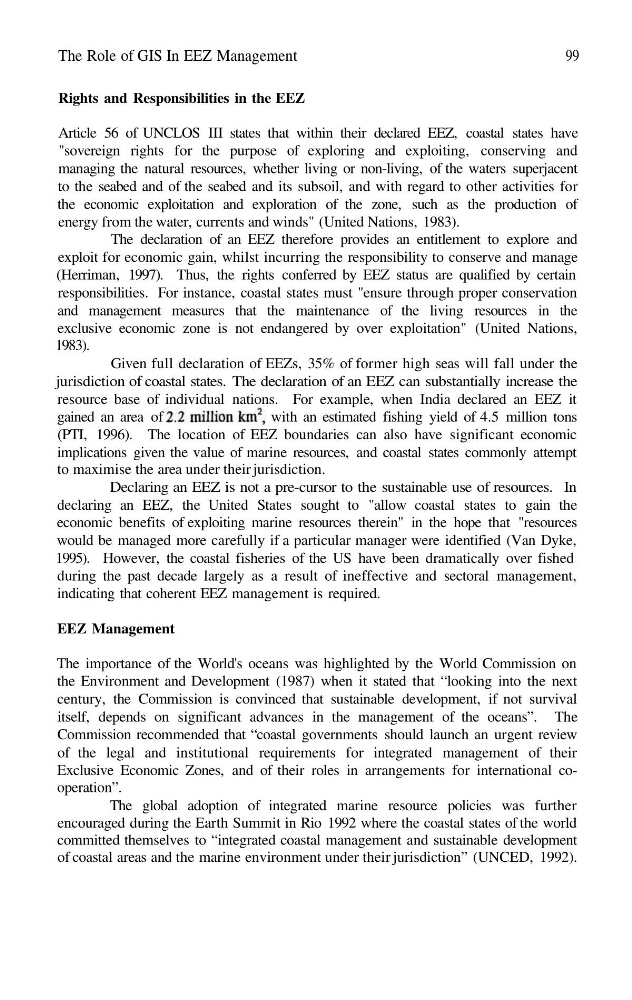
resource base of individual nations. For example, when India declared an EEZ it
gained an area of
with an estimated fishing yield of 4.5 million tons
(PTI, 1996). The location of EEZ boundaries can also have significant economic
implications given the value of marine resources, and coastal states commonly attempt
to maximise the area under their jurisdiction.
Declaring an EEZ is not a pre-cursor to the sustainable use of resources. In
declaring an EEZ, the United States sought to "allow coastal states to gain the
economic benefits of exploiting marine resources therein" in the hope that "resources
would be managed more carefully if a particular manager were identified (Van Dyke,
1995). However, the coastal fisheries of the US have been dramatically over fished
during the past decade largely as a result of ineffective and sectoral management,
indicating that coherent EEZ management is required.
EEZ Management
The importance of the World's oceans was highlighted by the World Commission on
the Environment and Development (1987) when it stated that “looking into the next
century, the Commission is convinced that sustainable development, if not survival
itself, depends on significant advances in the management of the oceans”. The
Commission recommended that “coastal governments should launch an urgent review
of the legal and institutional requirements for integrated management of their
Exclusive Economic Zones, and of their roles in arrangements for international cooperation”.
The global adoption of integrated marine resource policies was further
encouraged during the Earth Summit in Rio 1992 where the coastal states of the world
committed themselves to “integrated coastal management and sustainable development
of coastal areas and the marine environment under their jurisdiction” (UNCED, 1992).
99
Rights and Responsibilities in the EEZ
Article 56 of UNCLOS III states that within their declared EEZ, coastal states have
"sovereign rights for the purpose of exploring and exploiting, conserving and
managing the natural resources, whether living or non-living, of the waters superjacent
to the seabed and of the seabed and its subsoil, and with regard to other activities for
the economic exploitation and exploration of the zone, such as the production of
energy from the water, currents and winds" (United Nations, 1983).
The declaration of an EEZ therefore provides an entitlement to explore and
exploit for economic gain, whilst incurring the responsibility to conserve and manage
(Herriman, 1997). Thus, the rights conferred by EEZ status are qualified by certain
responsibilities. For instance, coastal states must "ensure through proper conservation
and management measures that the maintenance of the living resources in the
exclusive economic zone is not endangered by over exploitation" (United Nations,
1983).
Given full declaration of EEZs, 35% of former high seas will fall under the
jurisdiction of coastal states. The declaration of an EEZ can substantially increase the
resource base of individual nations. For example, when India declared an EEZ it
gained an area of
with an estimated fishing yield of 4.5 million tons
(PTI, 1996). The location of EEZ boundaries can also have significant economic
implications given the value of marine resources, and coastal states commonly attempt
to maximise the area under their jurisdiction.
Declaring an EEZ is not a pre-cursor to the sustainable use of resources. In
declaring an EEZ, the United States sought to "allow coastal states to gain the
economic benefits of exploiting marine resources therein" in the hope that "resources
would be managed more carefully if a particular manager were identified (Van Dyke,
1995). However, the coastal fisheries of the US have been dramatically over fished
during the past decade largely as a result of ineffective and sectoral management,
indicating that coherent EEZ management is required.
EEZ Management
The importance of the World's oceans was highlighted by the World Commission on
the Environment and Development (1987) when it stated that “looking into the next
century, the Commission is convinced that sustainable development, if not survival
itself, depends on significant advances in the management of the oceans”. The
Commission recommended that “coastal governments should launch an urgent review
of the legal and institutional requirements for integrated management of their
Exclusive Economic Zones, and of their roles in arrangements for international cooperation”.
The global adoption of integrated marine resource policies was further
encouraged during the Earth Summit in Rio 1992 where the coastal states of the world
committed themselves to “integrated coastal management and sustainable development
of coastal areas and the marine environment under their jurisdiction” (UNCED, 1992).