

68 Marine Macro- and Microalgae: An Overview
Biomass from industrial effluents and seawages
Microalgae are increasingly used in effluents and seawages for their potential to remove (and use) the
excess amount of chemicals that has generated by different sources. These are removed from wastewater
through direct uptake into the algae cells (Hoffman 1998). Wastewater treatment using algae has many
advantages. It offers the feasibility to recycle these chemicals (or nutrients) into algae biomass as a
fertilizer and thus can offset treatment cost. Oxygen rich effluent is released into water bodies after
wastewater treatment using algae (Becker 2004). The addition of carbon is not required to remove
nitrogen and phosphorus from wastewater. Chlorella (Gonzales et al. 1997), Scenedesmus (Martinez et
al. 2000), and Spirulina (Olguın et al. 2003) are the most widely used algae for nutrient removal.
Municipal seawage water typically have organic and ammonia nitrogen concentrations
(25 to 45 mg/L) and phosphorus concentrations (4 to 16 mg/L) (Tchobanoglous et al. 2003). At the final
stage of treatment, nitrogen and phosphorus are removed by algae. Few of the algae can also be used to
remove organic wastages. Some constituents of wastewater are in high concentration depending on the
type of seawage that can possibly inhibit algae growth. These constituents are urea, ammonium, organic
acids, phenolic compounds, and pesticides that can limit the use of seawage water to grow algae (Hodaifa
et al. 2008). Kim et al. reported, almost 95 and 96% removal of nitrogen and phosphorus, respectively,
by Chlorella vulgaris in 25% secondarily treated swine wastewater after four days of incubation (Kim
et al. 1998). Travieso treated distillery wastewater from an anaerobic fixed-bed reactor in a microalgae
pond and obtained 90.2%, 84.1%, and 85.5% organic nitrogen, ammonia, and total phosphorus removal,
respectively (Hodaifa et al. 2008).
Nitrogen constitutes about 8% of microalgae cell dry weight and the most important nutrient for
algae growth that constitutes the proteins (Richmond 2004). Ammonia, nitrite, nitrate, and urea are used
as nitrogen sources in microalgae cultivation because of its lower cost (Becker 2004). Phosphorus is a
macronutrient that plays an important role in growth and metabolism of algae. It is required for most
cellular processes, that involving energy transfer and nucleic acid synthesis. Phosphorous is required for
most of the cellular processes, that involving energy transfer and nucleic acid synthesis (Kull 1962). The
two most important phosphorus forms used by algae are HPO 4
–
and HPO 4
2–
. Algae utilize the soluble
form for metabolism and stores the insolubles when phosphate amounts present in the culture are limited
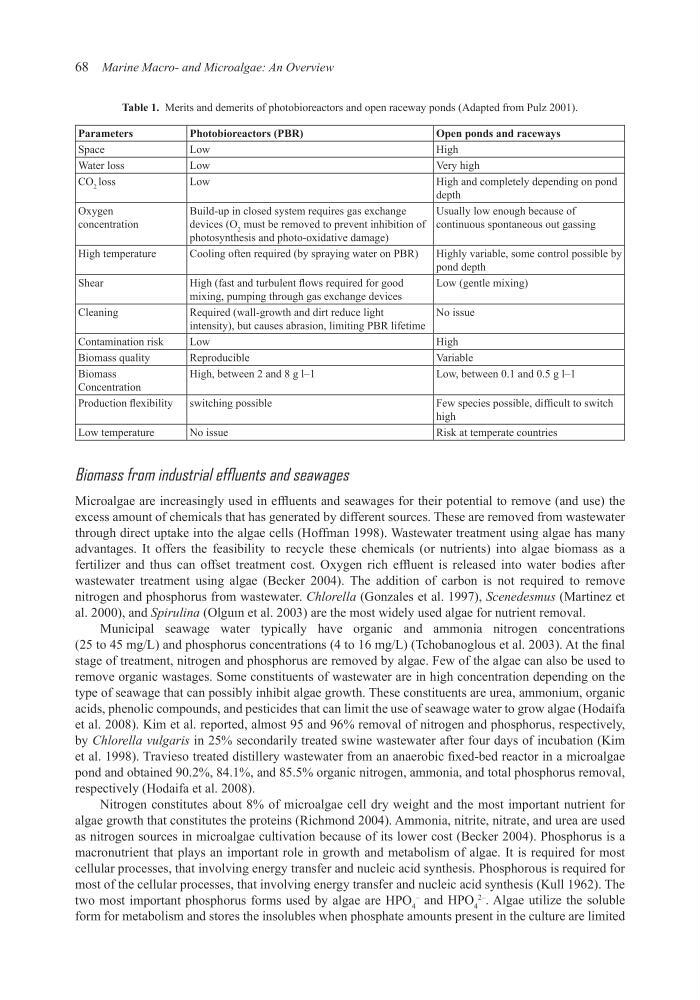
Table 1. Merits and demerits of photobioreactors and open raceway ponds (Adapted from Pulz 2001).
Parameters
Photobioreactors (PBR)
Open ponds and raceways
Space
Low
High
Water loss
Low
Very high
CO 2 loss
Low
High and completely depending on pond
depth
Oxygen
concentration
Build-up in closed system requires gas exchange
devices (O 2 must be removed to prevent inhibition of
photosynthesis and photo-oxidative damage)
Usually low enough because of
continuous spontaneous out gassing
High temperature
Cooling often required (by spraying water on PBR)
Highly variable, some control possible by
pond depth
Shear
High (fast and turbulent flows required for good
mixing, pumping through gas exchange devices
Low (gentle mixing)
Cleaning
Required (wall-growth and dirt reduce light
intensity), but causes abrasion, limiting PBR lifetime
No issue
Contamination risk
Low
High
Biomass quality
Reproducible
Variable
Biomass
Concentration
High, between 2 and 8 g l–1
Low, between 0.1 and 0.5 g l–1
Production flexibility
switching possible
Few species possible, difficult to switch
high
Low temperature
No issue
Risk at temperate countries
Biomass from industrial effluents and seawages
Microalgae are increasingly used in effluents and seawages for their potential to remove (and use) the
excess amount of chemicals that has generated by different sources. These are removed from wastewater
through direct uptake into the algae cells (Hoffman 1998). Wastewater treatment using algae has many
advantages. It offers the feasibility to recycle these chemicals (or nutrients) into algae biomass as a
fertilizer and thus can offset treatment cost. Oxygen rich effluent is released into water bodies after
wastewater treatment using algae (Becker 2004). The addition of carbon is not required to remove
nitrogen and phosphorus from wastewater. Chlorella (Gonzales et al. 1997), Scenedesmus (Martinez et
al. 2000), and Spirulina (Olguın et al. 2003) are the most widely used algae for nutrient removal.
Municipal seawage water typically have organic and ammonia nitrogen concentrations
(25 to 45 mg/L) and phosphorus concentrations (4 to 16 mg/L) (Tchobanoglous et al. 2003). At the final
stage of treatment, nitrogen and phosphorus are removed by algae. Few of the algae can also be used to
remove organic wastages. Some constituents of wastewater are in high concentration depending on the
type of seawage that can possibly inhibit algae growth. These constituents are urea, ammonium, organic
acids, phenolic compounds, and pesticides that can limit the use of seawage water to grow algae (Hodaifa
et al. 2008). Kim et al. reported, almost 95 and 96% removal of nitrogen and phosphorus, respectively,
by Chlorella vulgaris in 25% secondarily treated swine wastewater after four days of incubation (Kim
et al. 1998). Travieso treated distillery wastewater from an anaerobic fixed-bed reactor in a microalgae
pond and obtained 90.2%, 84.1%, and 85.5% organic nitrogen, ammonia, and total phosphorus removal,
respectively (Hodaifa et al. 2008).
Nitrogen constitutes about 8% of microalgae cell dry weight and the most important nutrient for
algae growth that constitutes the proteins (Richmond 2004). Ammonia, nitrite, nitrate, and urea are used
as nitrogen sources in microalgae cultivation because of its lower cost (Becker 2004). Phosphorus is a
macronutrient that plays an important role in growth and metabolism of algae. It is required for most
cellular processes, that involving energy transfer and nucleic acid synthesis. Phosphorous is required for
most of the cellular processes, that involving energy transfer and nucleic acid synthesis (Kull 1962). The
two most important phosphorus forms used by algae are HPO 4
–
and HPO 4
2–
. Algae utilize the soluble
form for metabolism and stores the insolubles when phosphate amounts present in the culture are limited
Table 1. Merits and demerits of photobioreactors and open raceway ponds (Adapted from Pulz 2001).
Parameters
Photobioreactors (PBR)
Open ponds and raceways
Space
Low
High
Water loss
Low
Very high
CO 2 loss
Low
High and completely depending on pond
depth
Oxygen
concentration
Build-up in closed system requires gas exchange
devices (O 2 must be removed to prevent inhibition of
photosynthesis and photo-oxidative damage)
Usually low enough because of
continuous spontaneous out gassing
High temperature
Cooling often required (by spraying water on PBR)
Highly variable, some control possible by
pond depth
Shear
High (fast and turbulent flows required for good
mixing, pumping through gas exchange devices
Low (gentle mixing)
Cleaning
Required (wall-growth and dirt reduce light
intensity), but causes abrasion, limiting PBR lifetime
No issue
Contamination risk
Low
High
Biomass quality
Reproducible
Variable
Biomass
Concentration
High, between 2 and 8 g l–1
Low, between 0.1 and 0.5 g l–1
Production flexibility
switching possible
Few species possible, difficult to switch
high
Low temperature
No issue
Risk at temperate countries