

Microalgal Metabolism and their Utilisation 51
astaxanthin, both in free and esterified forms linked to 16:0, 18:1, and 18:2 fatty acids (Grung et al. 1992)
and the astaxanthin pool of encysted Haematococcus is approximately 70% monoesters, 25% diesters,
and 5% free astaxanthin. Astaxanthin formation requires the synthesis of fatty acids (Schoefs et al. 2001;
Zhekisheva et al. 2002).
Astaxanthin formation and aplanospore formation generally occur together (Droop 1955); however,
some astaxanthin formation may occur in the flagellate cell stage under specific nutrient limitation
(Grünewald et al. 1997; Del Rio et al. 2005). H. pluvialis also can use organic C such as acetate either
mixotrophically or heterotrophically (Kobayashi et al. 1992) and although astaxanthin formation can be
observed in heterotrophic cultures, it is very much higher in mixotrophic cultures in the light (Orosa et al.
2001; Kang et al. 2005). There is a high degree of variation between strains in their response to acetate
concentration and their ability to use other organic C sources such as glucose, glycerol, and glycine
(Borowitzka 1992, 1995).
Astaxanthin formation in H. pluvialis and the complex mechanisms of the various stress factors has
been extensively studied and the reader is referred to a recent review paper (Lemoine and Schoefs 2010).
Like D. salina β-carotene, Haematococcus astaxanthin appears to have multiple roles in the cell. Several
studies have attributed a photoprotective role to astaxanthin, especially to UV-B irradiation (Yong and
Lee 1991; Qiu and Li 2006; Li et al. 2010), but Fan et al. (1998) found that astaxanthin-rich red cysts
are not better protected than astaxanthin-free green cells when exposed to high light. The astaxanthin
biosynthetic pathway has been shown to lower reactive oxygen species (ROS) production by lowering
cellular oxygen via an electron transport from the carotenogenic desaturation steps to the plastoquinones
and then to the plastid terminal oxidase (PTOX) (Li et al. 2008). The synthesis of triacylglycerol (TAG)
and of the fatty acids molecules needed for esterification of astaxanthin molecules also serves as an
electron sink under photo-oxidative stress (Hu et al. 2008) as the formation of a C18 fatty acid requires
approximately 24 NADPH derived from the photosynthetic electron transport chain and thus relaxes
the over-reduced electron transfer chain under high-light conditions. As with Dunaliella β-carotene
formation, the rate of astaxanthin formation is light-dependent (Li et al. 2010).
The optimum growth temperature of H. pluvialis is between 10–20ºC and, in batch culture, the
flagellated green motile stage predominates during the active phase of growth and the carotenogenic
aplanospores are formed during the stationary phase. This change in cell morphology—from the rapidly
dividing, shear sensitive, flagellated cells to the extremely robust, thick-walled, non-motile aplanospores—
means that generally a two-stage production process is used (Olaizola 2000; Cysewski and Lorenz 2004).
Here, the first stage is optimised to produce growth on the flagellated ‘green’ cells to maximise biomass
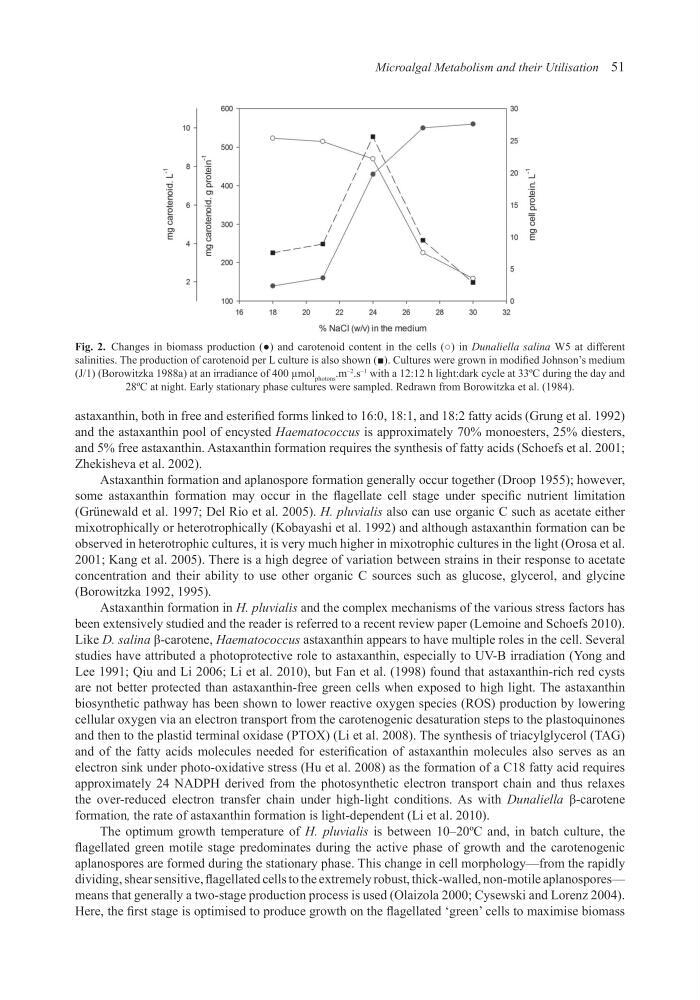
Fig. 2. Changes in biomass production (●) and carotenoid content in the cells (○) in Dunaliella salina W5 at different
salinities. The production of carotenoid per L culture is also shown (■). Cultures were grown in modified Johnson’s medium
(J/1) (Borowitzka 1988a) at an irradiance of 400 µmol photons .m
–2
.s
–1
with a 12:12 h light:dark cycle at 33ºC during the day and
28ºC at night. Early stationary phase cultures were sampled. Redrawn from Borowitzka et al. (1984).
600
30
10
/\
25
500
~c:
I
~ :_,
$
\
e
I
\
20 • __,
-o
a. 400
I
\
c
g
Ol
I
~
2
"0
I
\
15 e
e
g
\
a.
rl
2
I
\
Qi
300
"
Ol
e
I
\
Ol
E
rl
___ ___ _J
.._
10 E
Ol
'
E
200
'
100
0
16
18
20
22
24
26
28
30
32
% NaCI (wlv) in the medium
astaxanthin, both in free and esterified forms linked to 16:0, 18:1, and 18:2 fatty acids (Grung et al. 1992)
and the astaxanthin pool of encysted Haematococcus is approximately 70% monoesters, 25% diesters,
and 5% free astaxanthin. Astaxanthin formation requires the synthesis of fatty acids (Schoefs et al. 2001;
Zhekisheva et al. 2002).
Astaxanthin formation and aplanospore formation generally occur together (Droop 1955); however,
some astaxanthin formation may occur in the flagellate cell stage under specific nutrient limitation
(Grünewald et al. 1997; Del Rio et al. 2005). H. pluvialis also can use organic C such as acetate either
mixotrophically or heterotrophically (Kobayashi et al. 1992) and although astaxanthin formation can be
observed in heterotrophic cultures, it is very much higher in mixotrophic cultures in the light (Orosa et al.
2001; Kang et al. 2005). There is a high degree of variation between strains in their response to acetate
concentration and their ability to use other organic C sources such as glucose, glycerol, and glycine
(Borowitzka 1992, 1995).
Astaxanthin formation in H. pluvialis and the complex mechanisms of the various stress factors has
been extensively studied and the reader is referred to a recent review paper (Lemoine and Schoefs 2010).
Like D. salina β-carotene, Haematococcus astaxanthin appears to have multiple roles in the cell. Several
studies have attributed a photoprotective role to astaxanthin, especially to UV-B irradiation (Yong and
Lee 1991; Qiu and Li 2006; Li et al. 2010), but Fan et al. (1998) found that astaxanthin-rich red cysts
are not better protected than astaxanthin-free green cells when exposed to high light. The astaxanthin
biosynthetic pathway has been shown to lower reactive oxygen species (ROS) production by lowering
cellular oxygen via an electron transport from the carotenogenic desaturation steps to the plastoquinones
and then to the plastid terminal oxidase (PTOX) (Li et al. 2008). The synthesis of triacylglycerol (TAG)
and of the fatty acids molecules needed for esterification of astaxanthin molecules also serves as an
electron sink under photo-oxidative stress (Hu et al. 2008) as the formation of a C18 fatty acid requires
approximately 24 NADPH derived from the photosynthetic electron transport chain and thus relaxes
the over-reduced electron transfer chain under high-light conditions. As with Dunaliella β-carotene
formation, the rate of astaxanthin formation is light-dependent (Li et al. 2010).
The optimum growth temperature of H. pluvialis is between 10–20ºC and, in batch culture, the
flagellated green motile stage predominates during the active phase of growth and the carotenogenic
aplanospores are formed during the stationary phase. This change in cell morphology—from the rapidly
dividing, shear sensitive, flagellated cells to the extremely robust, thick-walled, non-motile aplanospores—
means that generally a two-stage production process is used (Olaizola 2000; Cysewski and Lorenz 2004).
Here, the first stage is optimised to produce growth on the flagellated ‘green’ cells to maximise biomass
Fig. 2. Changes in biomass production (●) and carotenoid content in the cells (○) in Dunaliella salina W5 at different
salinities. The production of carotenoid per L culture is also shown (■). Cultures were grown in modified Johnson’s medium
(J/1) (Borowitzka 1988a) at an irradiance of 400 µmol photons .m
–2
.s
–1
with a 12:12 h light:dark cycle at 33ºC during the day and
28ºC at night. Early stationary phase cultures were sampled. Redrawn from Borowitzka et al. (1984).
600
30
10
/\
25
500
~c:
I
~ :_,
$
\
e
I
\
20 • __,
-o
a. 400
I
\
c
g
Ol
I
~
2
"0
I
\
15 e
e
g
\
a.
rl
2
I
\
Qi
300
"
Ol
e
I
\
Ol
E
rl
___ ___ _J
.._
10 E
Ol
'
E
200
'
100
0
16
18
20
22
24
26
28
30
32
% NaCI (wlv) in the medium