

46 Marine Macro- and Microalgae: An Overview
supply of CO 2 and may therefore severely restrict photosynthesis in microalgae. Most microalgae studied
can take up both CO 2 and HCO 3
–
, but a few species can take up only CO 2 (e.g., Nannochloris atomus,
Nannochloris maculata, Amphidinium carterae, Heterocapsa oceanica, Monodus subterraneus and some
synurophyte algae), whereas Nannochloropsis gaditana and Nannochloropsis oculata can take up only
HCO 3
–
and not CO 2 (Colman et al. 2002; Bhatti and Colman 2008).
Most microalgae fix inorganic carbon via the Calvin-Benson cycle directly via ribulose bisphosphate
carboxylase (Rubisco). However, Rubisco has a relatively low affinity for CO 2 and it also has a dual role
as an oxygenase so that CO 2 and O 2 compete at the active binding site:
Ribulose-1,5-bisphosphate + CO 2 + H 2 O → 2 x glycerate-3-P
Ribulose-1,5-bisphosphate + O 2 → glycerate-3-P + glycolate-2-P
The extent to which the competitive reactions of Rubisco occur depends on the O 2 and CO 2
concentrations at the Rubisco active site and the type of Rubisco in the particular algae taxon (Giordano
et al. 2005; Beardall and Raven 2016). Actively photosynthesising algae cultures raise the pH due to
CO 2 uptake, thus effectively reducing the amount of free CO 2 available as well as producing O 2 which
inhibits C-fixation because of the oxygenase activity of the Rubisco. In large-scale outdoor cultures O 2
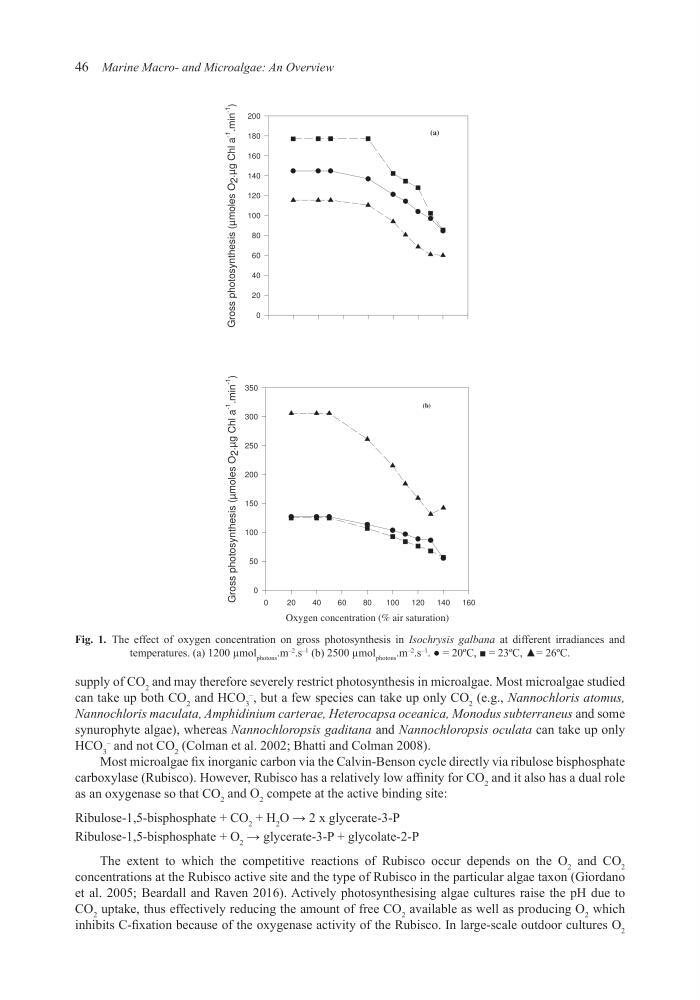
Fig. 1. The effect of oxygen concentration on gross photosynthesis in Isochrysis galbana at different irradiances and
temperatures. (a) 1200 µmol photons .m
–2
.s
–1
(b) 2500 µmol photons .m
–2
.s
–1
. ● = 20ºC, ■ = 23ºC, ▲= 26ºC.
Gross photosynthesis (µmoles O
2 .µg Chl a
-1
.min
-1
)
0
20
40
60
80
100
120
140
160
180
200
(a)
Oxygen concentration (% air saturation)
0
20
40
60
80
100
120
140
160
Gross photosynthesis (µmoles O
2 .µg Chl a
-1
.min
-1
)
0
50
100
150
200
250
300
350
(b)
supply of CO 2 and may therefore severely restrict photosynthesis in microalgae. Most microalgae studied
can take up both CO 2 and HCO 3
–
, but a few species can take up only CO 2 (e.g., Nannochloris atomus,
Nannochloris maculata, Amphidinium carterae, Heterocapsa oceanica, Monodus subterraneus and some
synurophyte algae), whereas Nannochloropsis gaditana and Nannochloropsis oculata can take up only
HCO 3
–
and not CO 2 (Colman et al. 2002; Bhatti and Colman 2008).
Most microalgae fix inorganic carbon via the Calvin-Benson cycle directly via ribulose bisphosphate
carboxylase (Rubisco). However, Rubisco has a relatively low affinity for CO 2 and it also has a dual role
as an oxygenase so that CO 2 and O 2 compete at the active binding site:
Ribulose-1,5-bisphosphate + CO 2 + H 2 O → 2 x glycerate-3-P
Ribulose-1,5-bisphosphate + O 2 → glycerate-3-P + glycolate-2-P
The extent to which the competitive reactions of Rubisco occur depends on the O 2 and CO 2
concentrations at the Rubisco active site and the type of Rubisco in the particular algae taxon (Giordano
et al. 2005; Beardall and Raven 2016). Actively photosynthesising algae cultures raise the pH due to
CO 2 uptake, thus effectively reducing the amount of free CO 2 available as well as producing O 2 which
inhibits C-fixation because of the oxygenase activity of the Rubisco. In large-scale outdoor cultures O 2
Fig. 1. The effect of oxygen concentration on gross photosynthesis in Isochrysis galbana at different irradiances and
temperatures. (a) 1200 µmol photons .m
–2
.s
–1
(b) 2500 µmol photons .m
–2
.s
–1
. ● = 20ºC, ■ = 23ºC, ▲= 26ºC.
Gross photosynthesis (µmoles O
2 .µg Chl a
-1
.min
-1
)
0
20
40
60
80
100
120
140
160
180
200
(a)
Oxygen concentration (% air saturation)
0
20
40
60
80
100
120
140
160
Gross photosynthesis (µmoles O
2 .µg Chl a
-1
.min
-1
)
0
50
100
150
200
250
300
350
(b)