

44 Marine Macro- and Microalgae: An Overview
of both energy and carbon building blocks (i.e., mixotrophy) and some can utilise organic carbon as an
energy source in the dark (i.e., heterotrophy).
Photosynthesis is the process leading to primary production and can be described simply as a
composite chain of cascading events starting with photon capture by the photosynthetic pigments and
extending through O 2 -evolution to C-fixation (Kroon et al. 1993). Antennae pigments catch photon
energy and funnel this towards a transmembrane structure in the thylakoid, called Photosystem II (PSII),
via resonance transfer. It is at PSII that primary charge separation occurs and electron transport continues
from PSII to Photosystem I (PSI) via the cytochrome b 6 /f complex. Photons are absorbed at PSI also, to
provide the reducing power needed to produce NADPH. During these ‘light reactions’ of photosynthesis,
hydroxyl ions are released into the thylakoid lumen resulting in the development of an electrochemical
gradient. ATPsynthase complexes bound within the thylakoid membrane utilise this electrochemical
gradient to synthesize ATP in the stroma. Thus, simple reductants are the product of the light reactions
of photosynthesis, with NADPH potentially yielding one molecule of CH 2 O (Jumars 1993). For a more
detailed account of the photosynthetic reactions, the reader is referred to Falkowski and Raven (2007) and
the book edited by Papageorgiou and Govindjee (2004).
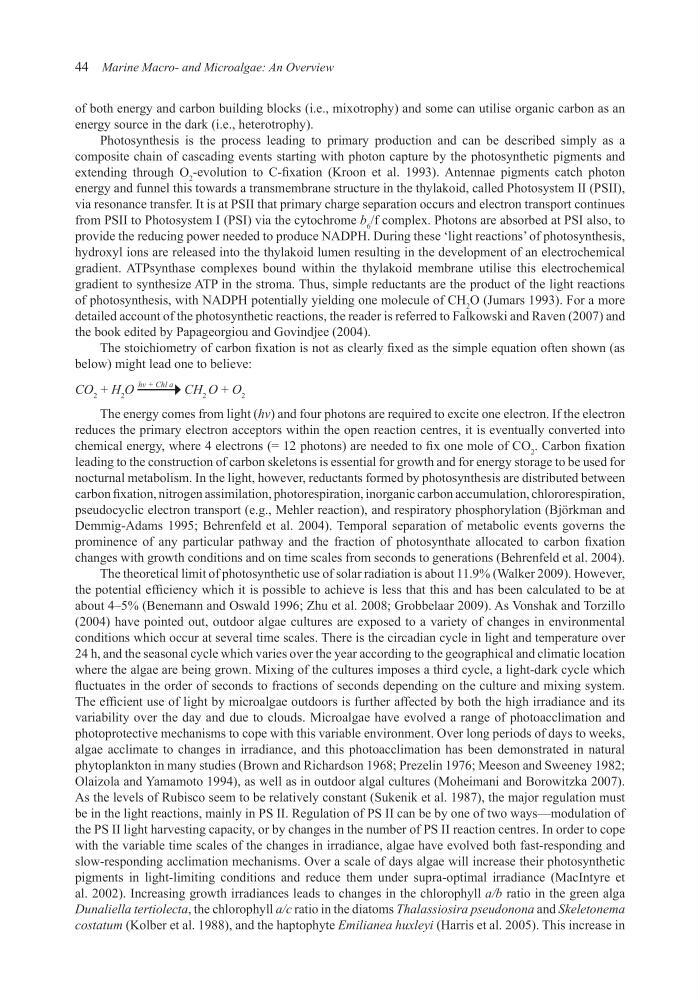
The stoichiometry of carbon fixation is not as clearly fixed as the simple equation often shown (as
below) might lead one to believe:
CO 2 + H 2 O
hv + Chl a CH 2 O + O 2
The energy comes from light (hv) and four photons are required to excite one electron. If the electron
reduces the primary electron acceptors within the open reaction centres, it is eventually converted into
chemical energy, where 4 electrons (= 12 photons) are needed to fix one mole of CO 2 . Carbon fixation
leading to the construction of carbon skeletons is essential for growth and for energy storage to be used for
nocturnal metabolism. In the light, however, reductants formed by photosynthesis are distributed between
carbon fixation, nitrogen assimilation, photorespiration, inorganic carbon accumulation, chlororespiration,
pseudocyclic electron transport (e.g., Mehler reaction), and respiratory phosphorylation (Björkman and
Demmig-Adams 1995; Behrenfeld et al. 2004). Temporal separation of metabolic events governs the
prominence of any particular pathway and the fraction of photosynthate allocated to carbon fixation
changes with growth conditions and on time scales from seconds to generations (Behrenfeld et al. 2004).
The theoretical limit of photosynthetic use of solar radiation is about 11.9% (Walker 2009). However,
the potential efficiency which it is possible to achieve is less that this and has been calculated to be at
about 4–5% (Benemann and Oswald 1996; Zhu et al. 2008; Grobbelaar 2009). As Vonshak and Torzillo
(2004) have pointed out, outdoor algae cultures are exposed to a variety of changes in environmental
conditions which occur at several time scales. There is the circadian cycle in light and temperature over
24 h, and the seasonal cycle which varies over the year according to the geographical and climatic location
where the algae are being grown. Mixing of the cultures imposes a third cycle, a light-dark cycle which
fluctuates in the order of seconds to fractions of seconds depending on the culture and mixing system.
The efficient use of light by microalgae outdoors is further affected by both the high irradiance and its
variability over the day and due to clouds. Microalgae have evolved a range of photoacclimation and
photoprotective mechanisms to cope with this variable environment. Over long periods of days to weeks,
algae acclimate to changes in irradiance, and this photoacclimation has been demonstrated in natural
phytoplankton in many studies (Brown and Richardson 1968; Prezelin 1976; Meeson and Sweeney 1982;
Olaizola and Yamamoto 1994), as well as in outdoor algal cultures (Moheimani and Borowitzka 2007).
As the levels of Rubisco seem to be relatively constant (Sukenik et al. 1987), the major regulation must
be in the light reactions, mainly in PS II. Regulation of PS II can be by one of two ways—modulation of
the PS II light harvesting capacity, or by changes in the number of PS II reaction centres. In order to cope
with the variable time scales of the changes in irradiance, algae have evolved both fast-responding and
slow-responding acclimation mechanisms. Over a scale of days algae will increase their photosynthetic
pigments in light-limiting conditions and reduce them under supra-optimal irradiance (MacIntyre et
al. 2002). Increasing growth irradiances leads to changes in the chlorophyll a/b ratio in the green alga
Dunaliella tertiolecta, the chlorophyll a/c ratio in the diatoms Thalassiosira pseudonona and Skeletonema
costatum (Kolber et al. 1988), and the haptophyte Emilianea huxleyi (Harris et al. 2005). This increase in
of both energy and carbon building blocks (i.e., mixotrophy) and some can utilise organic carbon as an
energy source in the dark (i.e., heterotrophy).
Photosynthesis is the process leading to primary production and can be described simply as a
composite chain of cascading events starting with photon capture by the photosynthetic pigments and
extending through O 2 -evolution to C-fixation (Kroon et al. 1993). Antennae pigments catch photon
energy and funnel this towards a transmembrane structure in the thylakoid, called Photosystem II (PSII),
via resonance transfer. It is at PSII that primary charge separation occurs and electron transport continues
from PSII to Photosystem I (PSI) via the cytochrome b 6 /f complex. Photons are absorbed at PSI also, to
provide the reducing power needed to produce NADPH. During these ‘light reactions’ of photosynthesis,
hydroxyl ions are released into the thylakoid lumen resulting in the development of an electrochemical
gradient. ATPsynthase complexes bound within the thylakoid membrane utilise this electrochemical
gradient to synthesize ATP in the stroma. Thus, simple reductants are the product of the light reactions
of photosynthesis, with NADPH potentially yielding one molecule of CH 2 O (Jumars 1993). For a more
detailed account of the photosynthetic reactions, the reader is referred to Falkowski and Raven (2007) and
the book edited by Papageorgiou and Govindjee (2004).
The stoichiometry of carbon fixation is not as clearly fixed as the simple equation often shown (as
below) might lead one to believe:
CO 2 + H 2 O
hv + Chl a CH 2 O + O 2
The energy comes from light (hv) and four photons are required to excite one electron. If the electron
reduces the primary electron acceptors within the open reaction centres, it is eventually converted into
chemical energy, where 4 electrons (= 12 photons) are needed to fix one mole of CO 2 . Carbon fixation
leading to the construction of carbon skeletons is essential for growth and for energy storage to be used for
nocturnal metabolism. In the light, however, reductants formed by photosynthesis are distributed between
carbon fixation, nitrogen assimilation, photorespiration, inorganic carbon accumulation, chlororespiration,
pseudocyclic electron transport (e.g., Mehler reaction), and respiratory phosphorylation (Björkman and
Demmig-Adams 1995; Behrenfeld et al. 2004). Temporal separation of metabolic events governs the
prominence of any particular pathway and the fraction of photosynthate allocated to carbon fixation
changes with growth conditions and on time scales from seconds to generations (Behrenfeld et al. 2004).
The theoretical limit of photosynthetic use of solar radiation is about 11.9% (Walker 2009). However,
the potential efficiency which it is possible to achieve is less that this and has been calculated to be at
about 4–5% (Benemann and Oswald 1996; Zhu et al. 2008; Grobbelaar 2009). As Vonshak and Torzillo
(2004) have pointed out, outdoor algae cultures are exposed to a variety of changes in environmental
conditions which occur at several time scales. There is the circadian cycle in light and temperature over
24 h, and the seasonal cycle which varies over the year according to the geographical and climatic location
where the algae are being grown. Mixing of the cultures imposes a third cycle, a light-dark cycle which
fluctuates in the order of seconds to fractions of seconds depending on the culture and mixing system.
The efficient use of light by microalgae outdoors is further affected by both the high irradiance and its
variability over the day and due to clouds. Microalgae have evolved a range of photoacclimation and
photoprotective mechanisms to cope with this variable environment. Over long periods of days to weeks,
algae acclimate to changes in irradiance, and this photoacclimation has been demonstrated in natural
phytoplankton in many studies (Brown and Richardson 1968; Prezelin 1976; Meeson and Sweeney 1982;
Olaizola and Yamamoto 1994), as well as in outdoor algal cultures (Moheimani and Borowitzka 2007).
As the levels of Rubisco seem to be relatively constant (Sukenik et al. 1987), the major regulation must
be in the light reactions, mainly in PS II. Regulation of PS II can be by one of two ways—modulation of
the PS II light harvesting capacity, or by changes in the number of PS II reaction centres. In order to cope
with the variable time scales of the changes in irradiance, algae have evolved both fast-responding and
slow-responding acclimation mechanisms. Over a scale of days algae will increase their photosynthetic
pigments in light-limiting conditions and reduce them under supra-optimal irradiance (MacIntyre et
al. 2002). Increasing growth irradiances leads to changes in the chlorophyll a/b ratio in the green alga
Dunaliella tertiolecta, the chlorophyll a/c ratio in the diatoms Thalassiosira pseudonona and Skeletonema
costatum (Kolber et al. 1988), and the haptophyte Emilianea huxleyi (Harris et al. 2005). This increase in