

Present and Future Economic and Environmental Impacts of Microalgal Technology 321
absolute or relative levels of intercellular or intracellular metabolites; this regulation can occur at the
transcriptional or translational levels. The tools for modifying carbon partitioning have evolved over
time from natural strain selection, through mutagenesis and screening, through the use of recombinant
methods for metabolic engineering, through “industrialized” molecular biology in the form of the various
high throughput “omics” platforms (genomics, transcriptomics, proteomics, and metabolomics). These
tools can be utilized to accelerate targeted metabolic engineering of algal strains through synthetic
biology as demonstrated in Ajjawi et al. (2017). In this work a combination of transcriptomics and a
CRISPR/cas9 genome editing pipeline was used to identify a transcription factor (ZnCys) that negatively
regulates lipid accumulation in Nannochloropsis gaditana. By attenuating and fine-tuning the expression
of this transcription factor, lipid productivity was doubled with minimal impact on biomass productivity.
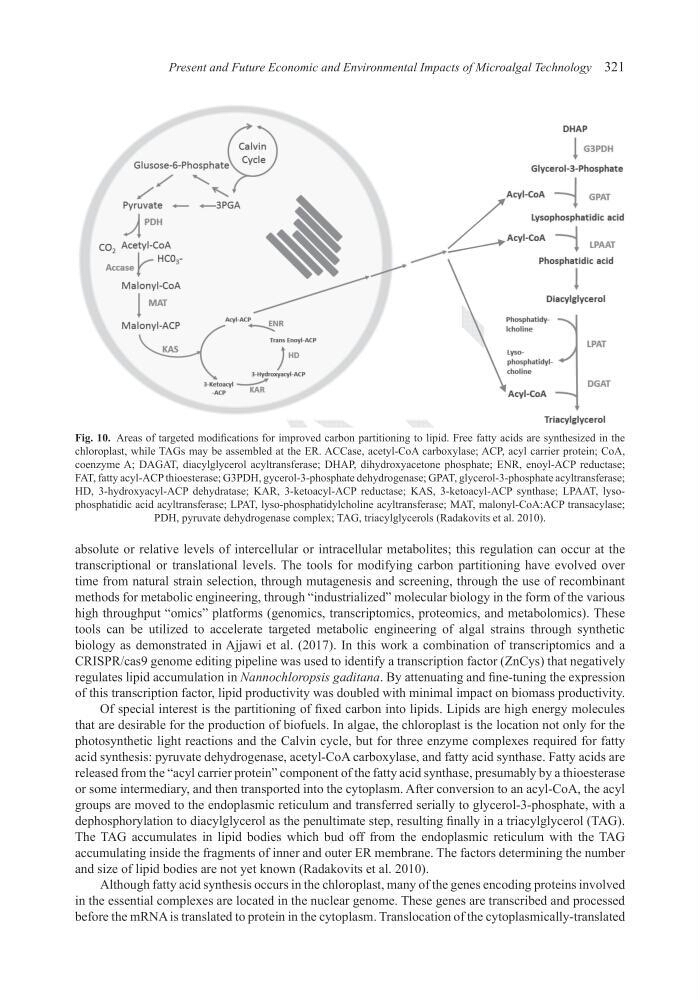
Of special interest is the partitioning of fixed carbon into lipids. Lipids are high energy molecules
that are desirable for the production of biofuels. In algae, the chloroplast is the location not only for the
photosynthetic light reactions and the Calvin cycle, but for three enzyme complexes required for fatty
acid synthesis: pyruvate dehydrogenase, acetyl-CoA carboxylase, and fatty acid synthase. Fatty acids are
released from the “acyl carrier protein” component of the fatty acid synthase, presumably by a thioesterase
or some intermediary, and then transported into the cytoplasm. After conversion to an acyl-CoA, the acyl
groups are moved to the endoplasmic reticulum and transferred serially to glycerol-3-phosphate, with a
dephosphorylation to diacylglycerol as the penultimate step, resulting finally in a triacylglycerol (TAG).
The TAG accumulates in lipid bodies which bud off from the endoplasmic reticulum with the TAG
accumulating inside the fragments of inner and outer ER membrane. The factors determining the number
and size of lipid bodies are not yet known (Radakovits et al. 2010).
Although fatty acid synthesis occurs in the chloroplast, many of the genes encoding proteins involved
in the essential complexes are located in the nuclear genome. These genes are transcribed and processed
before the mRNA is translated to protein in the cytoplasm. Translocation of the cytoplasmically-translated
Fig. 10. Areas of targeted modifications for improved carbon partitioning to lipid. Free fatty acids are synthesized in the
chloroplast, while TAGs may be assembled at the ER. ACCase, acetyl-CoA carboxylase; ACP, acyl carrier protein; CoA,
coenzyme A; DAGAT, diacylglycerol acyltransferase; DHAP, dihydroxyacetone phosphate; ENR, enoyl-ACP reductase;
FAT, fatty acyl-ACP thioesterase; G3PDH, gycerol-3-phosphate dehydrogenase; GPAT, glycerol-3-phosphate acyltransferase;
HD, 3-hydroxyacyl-ACP dehydratase; KAR, 3-ketoacyl-ACP reductase; KAS, 3-ketoacyl-ACP synthase; LPAAT, lysophosphatidic acid acyltransferase; LPAT, lyso-phosphatidylcholine acyltransferase; MAT, malonyl-CoA:ACP transacylase;
PDH, pyruvate dehydrogenase complex; TAG, triacylglycerols (Radakovits et al. 2010).
DHAP
Glusose-6-Phosphate
l
G3PDH
/
/
'-.:......
Glyceroi-3-Phosphate
Pyruvate -
_ 3 PGA
_
I
~
A
/
,.,., •• , •• , :::.,
"""" 1~ HCO, -
~Aovi-CoA --J
(
--I LPAAT
Mr :·· ~---····oh·r, .. ,
Mal~ onyi-ACP
Acyi-AcP
Diacylglycerol
--tNR
PhosphatidyKAS
Trans Enoyi-ACP
!choline
)
HD
LysoLPAT
3--Ketoacyl ~oxyacyl ACP
phosphatidyi·ACP
KAR
choline
DGAT
Acyi-CoA
Triacylglycerol
absolute or relative levels of intercellular or intracellular metabolites; this regulation can occur at the
transcriptional or translational levels. The tools for modifying carbon partitioning have evolved over
time from natural strain selection, through mutagenesis and screening, through the use of recombinant
methods for metabolic engineering, through “industrialized” molecular biology in the form of the various
high throughput “omics” platforms (genomics, transcriptomics, proteomics, and metabolomics). These
tools can be utilized to accelerate targeted metabolic engineering of algal strains through synthetic
biology as demonstrated in Ajjawi et al. (2017). In this work a combination of transcriptomics and a
CRISPR/cas9 genome editing pipeline was used to identify a transcription factor (ZnCys) that negatively
regulates lipid accumulation in Nannochloropsis gaditana. By attenuating and fine-tuning the expression
of this transcription factor, lipid productivity was doubled with minimal impact on biomass productivity.
Of special interest is the partitioning of fixed carbon into lipids. Lipids are high energy molecules
that are desirable for the production of biofuels. In algae, the chloroplast is the location not only for the
photosynthetic light reactions and the Calvin cycle, but for three enzyme complexes required for fatty
acid synthesis: pyruvate dehydrogenase, acetyl-CoA carboxylase, and fatty acid synthase. Fatty acids are
released from the “acyl carrier protein” component of the fatty acid synthase, presumably by a thioesterase
or some intermediary, and then transported into the cytoplasm. After conversion to an acyl-CoA, the acyl
groups are moved to the endoplasmic reticulum and transferred serially to glycerol-3-phosphate, with a
dephosphorylation to diacylglycerol as the penultimate step, resulting finally in a triacylglycerol (TAG).
The TAG accumulates in lipid bodies which bud off from the endoplasmic reticulum with the TAG
accumulating inside the fragments of inner and outer ER membrane. The factors determining the number
and size of lipid bodies are not yet known (Radakovits et al. 2010).
Although fatty acid synthesis occurs in the chloroplast, many of the genes encoding proteins involved
in the essential complexes are located in the nuclear genome. These genes are transcribed and processed
before the mRNA is translated to protein in the cytoplasm. Translocation of the cytoplasmically-translated
Fig. 10. Areas of targeted modifications for improved carbon partitioning to lipid. Free fatty acids are synthesized in the
chloroplast, while TAGs may be assembled at the ER. ACCase, acetyl-CoA carboxylase; ACP, acyl carrier protein; CoA,
coenzyme A; DAGAT, diacylglycerol acyltransferase; DHAP, dihydroxyacetone phosphate; ENR, enoyl-ACP reductase;
FAT, fatty acyl-ACP thioesterase; G3PDH, gycerol-3-phosphate dehydrogenase; GPAT, glycerol-3-phosphate acyltransferase;
HD, 3-hydroxyacyl-ACP dehydratase; KAR, 3-ketoacyl-ACP reductase; KAS, 3-ketoacyl-ACP synthase; LPAAT, lysophosphatidic acid acyltransferase; LPAT, lyso-phosphatidylcholine acyltransferase; MAT, malonyl-CoA:ACP transacylase;
PDH, pyruvate dehydrogenase complex; TAG, triacylglycerols (Radakovits et al. 2010).
DHAP
Glusose-6-Phosphate
l
G3PDH
/
/
'-.:......
Glyceroi-3-Phosphate
Pyruvate -
_ 3 PGA
_
I
~
A
/
,.,., •• , •• , :::.,
"""" 1~ HCO, -
~Aovi-CoA --J
(
--I LPAAT
Mr :·· ~---····oh·r, .. ,
Mal~ onyi-ACP
Acyi-AcP
Diacylglycerol
--tNR
PhosphatidyKAS
Trans Enoyi-ACP
!choline
)
HD
LysoLPAT
3--Ketoacyl ~oxyacyl ACP
phosphatidyi·ACP
KAR
choline
DGAT
Acyi-CoA
Triacylglycerol