

Present and Future Economic and Environmental Impacts of Microalgal Technology 319
higher biomass productivity and titers: we need to improve the conversion of light energy into fixed
carbon and the channeling of that fixed carbon into the desired product. We believe that engineering
of cultivation systems (raceways and PBRs) may result in gains in productivity and development of
cultivation strategies (for example continuous vs. batch, with or without nutrient limitation) may be used
to selectively accumulate certain products. However, we believe that these gains will be modest. We
need to develop systems and strategies that will result in order of magnitude improvements in economic
efficiency. We propose that these processes and strategies will necessarily include advanced microalgal
strains generated through selection, mutation, and genetic modification. In this section, we explore three
approaches that may result in significant gains in productivity.
Photosynthetic efficiency
Microalgae have adapted to survive under conditions of varying irradiance induced by vertical movement
through the water column, changes with cloud cover, and time of day and season. In response, microalgal
photosystems are quite flexible (Falkowski and Chen 2003): microalgae can, for example, change the
size of their photosynthetic antenna (useful but slow) and the relative importance of wasteful reactions
designed to dissipate excess light energy to avoid damage (useful and fast but wasteful). The microalga
strategy of survival is to adapt to low light conditions by increasing the size of their antennae and, when
exposed to high light (for example at midday), open up safety valves to dissipate excessive absorbed light
energy such as non-photochemical quenching (dissipation of absorbed light energy as heat), reduction
of O 2 to H 2 O via the water-water cycle and associated Mehler reaction (photorespiration) or the use of
oxydases (e.g., plastid terminal oxidase or PTOX). It has been suggested that up to 80% of absorbed light
on a sunny day may be wasted by photosynthetic organisms through NPQ and photorespiration (Melis
2009).
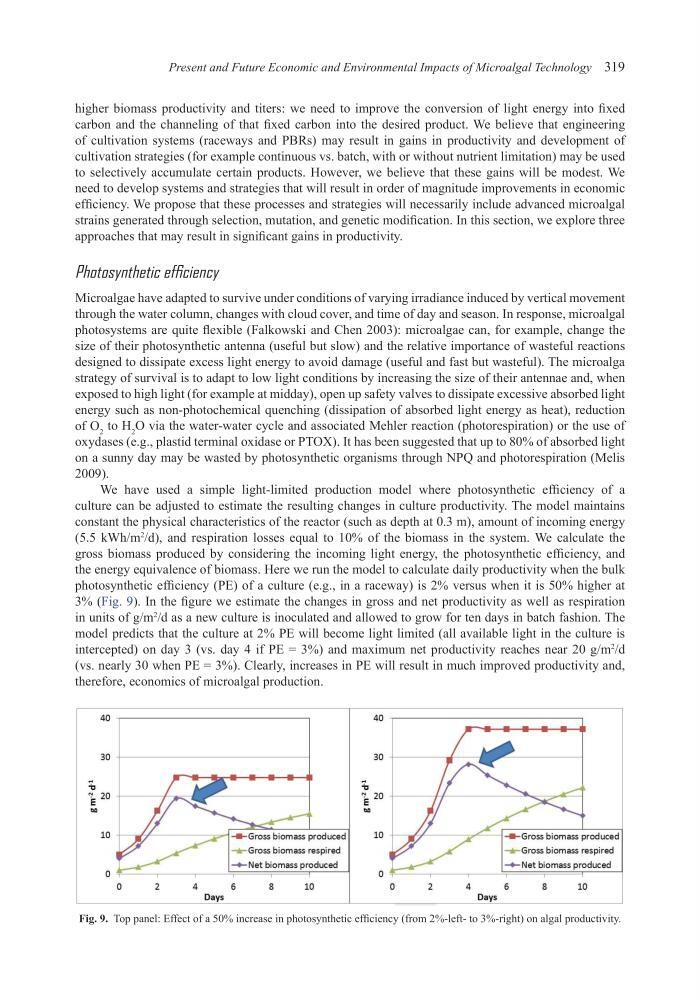
We have used a simple light-limited production model where photosynthetic efficiency of a
culture can be adjusted to estimate the resulting changes in culture productivity. The model maintains
constant the physical characteristics of the reactor (such as depth at 0.3 m), amount of incoming energy
(5.5 kWh/m
2
/d), and respiration losses equal to 10% of the biomass in the system. We calculate the
gross biomass produced by considering the incoming light energy, the photosynthetic efficiency, and
the energy equivalence of biomass. Here we run the model to calculate daily productivity when the bulk
photosynthetic efficiency (PE) of a culture (e.g., in a raceway) is 2% versus when it is 50% higher at
3% (Fig. 9). In the figure we estimate the changes in gross and net productivity as well as respiration
in units of g/m
2
/d as a new culture is inoculated and allowed to grow for ten days in batch fashion. The
model predicts that the culture at 2% PE will become light limited (all available light in the culture is
intercepted) on day 3 (vs. day 4 if PE = 3%) and maximum net productivity reaches near 20 g/m
2
/d
(vs. nearly 30 when PE = 3%). Clearly, increases in PE will result in much improved productivity and,
therefore, economics of microalgal production.
Fig. 9. Top panel: Effect of a 50% increase in photosynthetic efficiency (from 2%-left- to 3%-right) on algal productivity.
40
40
30
30
"'c
1: 20
110
10
10
-.- Gross biomass respired
-.- Gross biomass respired
-+- Net biomass produced
-+- Net biomass produced
0
0
0
2
4
6
8
10
0
2
4
6
8
10
Days
Days
higher biomass productivity and titers: we need to improve the conversion of light energy into fixed
carbon and the channeling of that fixed carbon into the desired product. We believe that engineering
of cultivation systems (raceways and PBRs) may result in gains in productivity and development of
cultivation strategies (for example continuous vs. batch, with or without nutrient limitation) may be used
to selectively accumulate certain products. However, we believe that these gains will be modest. We
need to develop systems and strategies that will result in order of magnitude improvements in economic
efficiency. We propose that these processes and strategies will necessarily include advanced microalgal
strains generated through selection, mutation, and genetic modification. In this section, we explore three
approaches that may result in significant gains in productivity.
Photosynthetic efficiency
Microalgae have adapted to survive under conditions of varying irradiance induced by vertical movement
through the water column, changes with cloud cover, and time of day and season. In response, microalgal
photosystems are quite flexible (Falkowski and Chen 2003): microalgae can, for example, change the
size of their photosynthetic antenna (useful but slow) and the relative importance of wasteful reactions
designed to dissipate excess light energy to avoid damage (useful and fast but wasteful). The microalga
strategy of survival is to adapt to low light conditions by increasing the size of their antennae and, when
exposed to high light (for example at midday), open up safety valves to dissipate excessive absorbed light
energy such as non-photochemical quenching (dissipation of absorbed light energy as heat), reduction
of O 2 to H 2 O via the water-water cycle and associated Mehler reaction (photorespiration) or the use of
oxydases (e.g., plastid terminal oxidase or PTOX). It has been suggested that up to 80% of absorbed light
on a sunny day may be wasted by photosynthetic organisms through NPQ and photorespiration (Melis
2009).
We have used a simple light-limited production model where photosynthetic efficiency of a
culture can be adjusted to estimate the resulting changes in culture productivity. The model maintains
constant the physical characteristics of the reactor (such as depth at 0.3 m), amount of incoming energy
(5.5 kWh/m
2
/d), and respiration losses equal to 10% of the biomass in the system. We calculate the
gross biomass produced by considering the incoming light energy, the photosynthetic efficiency, and
the energy equivalence of biomass. Here we run the model to calculate daily productivity when the bulk
photosynthetic efficiency (PE) of a culture (e.g., in a raceway) is 2% versus when it is 50% higher at
3% (Fig. 9). In the figure we estimate the changes in gross and net productivity as well as respiration
in units of g/m
2
/d as a new culture is inoculated and allowed to grow for ten days in batch fashion. The
model predicts that the culture at 2% PE will become light limited (all available light in the culture is
intercepted) on day 3 (vs. day 4 if PE = 3%) and maximum net productivity reaches near 20 g/m
2
/d
(vs. nearly 30 when PE = 3%). Clearly, increases in PE will result in much improved productivity and,
therefore, economics of microalgal production.
Fig. 9. Top panel: Effect of a 50% increase in photosynthetic efficiency (from 2%-left- to 3%-right) on algal productivity.
40
40
30
30
"'c
1: 20
110
10
10
-.- Gross biomass respired
-.- Gross biomass respired
-+- Net biomass produced
-+- Net biomass produced
0
0
0
2
4
6
8
10
0
2
4
6
8
10
Days
Days