

Present and Future Economic and Environmental Impacts of Microalgal Technology 315
many nutritional benefits, microalgal biomass has usually been available as a nutritional supplement
in capsules or powders. Algae biomass tends to have strong smell and taste that is hard to mask when
formulated with ordinary foods (e.g., breads, pasta, sauces). The authors suggest possible solutions
including formulation of exotic (to western palates) snacks and foods together with familiar Asian and
Indian spices, encapsulation of the algal biomass or removal of odor-causing compounds.
In summary, microalgae represent a valid source of protein for human nutrition with a smaller fresh
water footprint than protein obtained from traditional agriculture (vegetable and, especially, animal).
Some strains, like the relatively easy to grow, harvest and process Arthrospira, have been used by
human populations for centuries and hold the promise of providing nutritional and economic benefits to
disadvantaged populations.
The future of microalgal technology
As has been mentioned earlier in this chapter and many other places, microalgae hold the promise of
environmentally benign production of many useful chemicals, environmental remediation, and economic
opportunities. However, this promise will only be realized in the costs make these diverse applications
economically feasible. In this section we will briefly consider:
1. The different scales at which different types of microalgal products are expected to have an impact,
2. The critical need to select the best suited microalgal strains,
3. The genetic resources or products available from microalgae that have, so far, garnered little
attention,
4. The use of biotechnology to transform microalgal production, and
5. The future impacts of a more efficient and much larger microalgal technology industry.
Products versus scale
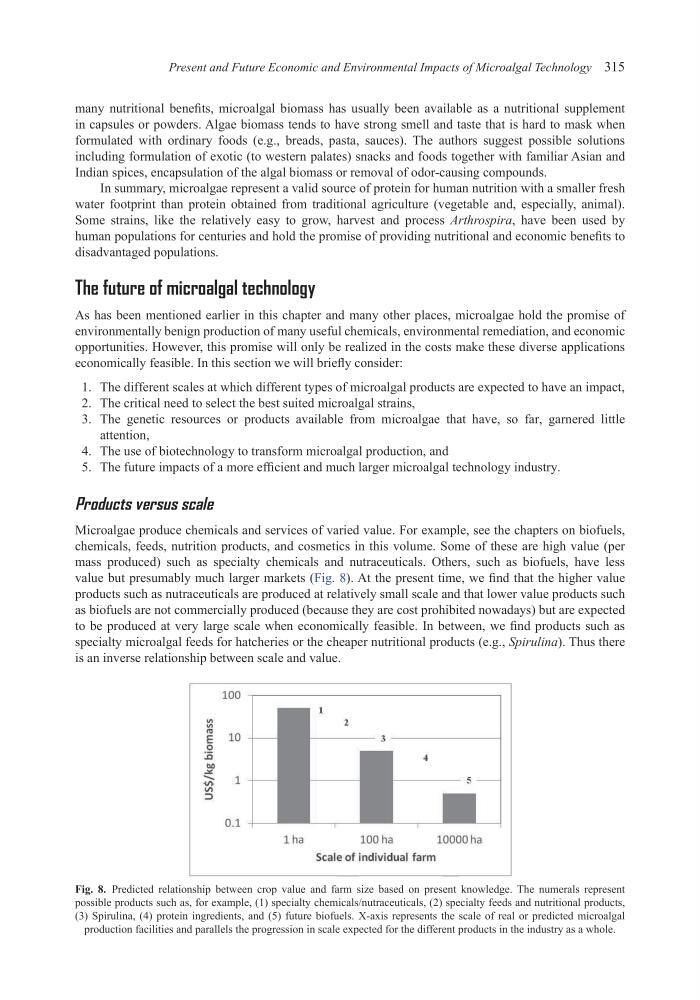
Microalgae produce chemicals and services of varied value. For example, see the chapters on biofuels,
chemicals, feeds, nutrition products, and cosmetics in this volume. Some of these are high value (per
mass produced) such as specialty chemicals and nutraceuticals. Others, such as biofuels, have less
value but presumably much larger markets (Fig. 8). At the present time, we find that the higher value
products such as nutraceuticals are produced at relatively small scale and that lower value products such
as biofuels are not commercially produced (because they are cost prohibited nowadays) but are expected
to be produced at very large scale when economically feasible. In between, we find products such as
specialty microalgal feeds for hatcheries or the cheaper nutritional products (e.g., Spirulina). Thus there
is an inverse relationship between scale and value.
Fig. 8. Predicted relationship between crop value and farm size based on present knowledge. The numerals represent
possible products such as, for example, (1) specialty chemicals/nutraceuticals, (2) specialty feeds and nutritional products,
(3) Spirulina, (4) protein ingredients, and (5) future biofuels. X-axis represents the scale of real or predicted microalgal
production facilities and parallels the progression in scale expected for the different products in the industry as a whole.
100
Ill
Ill
"' 10
E
0
:0
bl)
-"'
........
1
...,.
II'>
:::::1
0.1
1 ha
100 ha
10000 ha
Scale of individual farm
many nutritional benefits, microalgal biomass has usually been available as a nutritional supplement
in capsules or powders. Algae biomass tends to have strong smell and taste that is hard to mask when
formulated with ordinary foods (e.g., breads, pasta, sauces). The authors suggest possible solutions
including formulation of exotic (to western palates) snacks and foods together with familiar Asian and
Indian spices, encapsulation of the algal biomass or removal of odor-causing compounds.
In summary, microalgae represent a valid source of protein for human nutrition with a smaller fresh
water footprint than protein obtained from traditional agriculture (vegetable and, especially, animal).
Some strains, like the relatively easy to grow, harvest and process Arthrospira, have been used by
human populations for centuries and hold the promise of providing nutritional and economic benefits to
disadvantaged populations.
The future of microalgal technology
As has been mentioned earlier in this chapter and many other places, microalgae hold the promise of
environmentally benign production of many useful chemicals, environmental remediation, and economic
opportunities. However, this promise will only be realized in the costs make these diverse applications
economically feasible. In this section we will briefly consider:
1. The different scales at which different types of microalgal products are expected to have an impact,
2. The critical need to select the best suited microalgal strains,
3. The genetic resources or products available from microalgae that have, so far, garnered little
attention,
4. The use of biotechnology to transform microalgal production, and
5. The future impacts of a more efficient and much larger microalgal technology industry.
Products versus scale
Microalgae produce chemicals and services of varied value. For example, see the chapters on biofuels,
chemicals, feeds, nutrition products, and cosmetics in this volume. Some of these are high value (per
mass produced) such as specialty chemicals and nutraceuticals. Others, such as biofuels, have less
value but presumably much larger markets (Fig. 8). At the present time, we find that the higher value
products such as nutraceuticals are produced at relatively small scale and that lower value products such
as biofuels are not commercially produced (because they are cost prohibited nowadays) but are expected
to be produced at very large scale when economically feasible. In between, we find products such as
specialty microalgal feeds for hatcheries or the cheaper nutritional products (e.g., Spirulina). Thus there
is an inverse relationship between scale and value.
Fig. 8. Predicted relationship between crop value and farm size based on present knowledge. The numerals represent
possible products such as, for example, (1) specialty chemicals/nutraceuticals, (2) specialty feeds and nutritional products,
(3) Spirulina, (4) protein ingredients, and (5) future biofuels. X-axis represents the scale of real or predicted microalgal
production facilities and parallels the progression in scale expected for the different products in the industry as a whole.
100
Ill
Ill
"' 10
E
0
:0
bl)
-"'
........
1
...,.
II'>
:::::1
0.1
1 ha
100 ha
10000 ha
Scale of individual farm