

Present and Future Economic and Environmental Impacts of Microalgal Technology 309
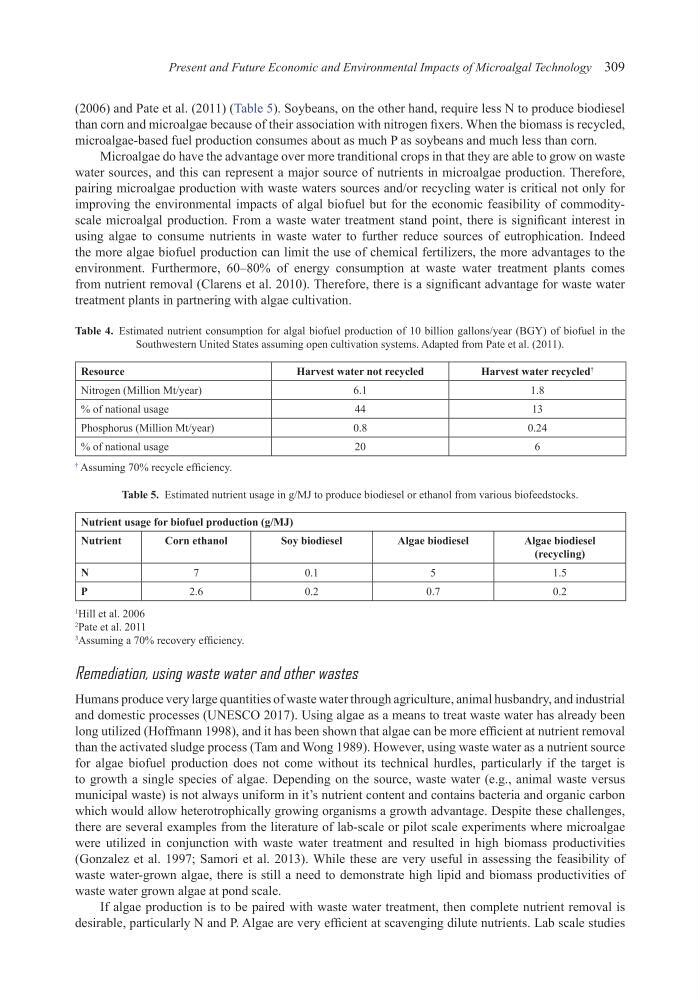
(2006) and Pate et al. (2011) (Table 5). Soybeans, on the other hand, require less N to produce biodiesel
than corn and microalgae because of their association with nitrogen fixers. When the biomass is recycled,
microalgae-based fuel production consumes about as much P as soybeans and much less than corn.
Microalgae do have the advantage over more tranditional crops in that they are able to grow on waste
water sources, and this can represent a major source of nutrients in microalgae production. Therefore,
pairing microalgae production with waste waters sources and/or recycling water is critical not only for
improving the environmental impacts of algal biofuel but for the economic feasibility of commodityscale microalgal production. From a waste water treatment stand point, there is significant interest in
using algae to consume nutrients in waste water to further reduce sources of eutrophication. Indeed
the more algae biofuel production can limit the use of chemical fertilizers, the more advantages to the
environment. Furthermore, 60–80% of energy consumption at waste water treatment plants comes
from nutrient removal (Clarens et al. 2010). Therefore, there is a significant advantage for waste water
treatment plants in partnering with algae cultivation.
Table 4. Estimated nutrient consumption for algal biofuel production of 10 billion gallons/year (BGY) of biofuel in the
Southwestern United States assuming open cultivation systems. Adapted from Pate et al. (2011).
Resource
Harvest water not recycled
Harvest water recycled
†
Nitrogen (Million Mt/year)
6.1
1.8
% of national usage
44
13
Phosphorus (Million Mt/year)
0.8
0.24
% of national usage
20
6
†
Assuming 70% recycle efficiency.
Table 5. Estimated nutrient usage in g/MJ to produce biodiesel or ethanol from various biofeedstocks.
Nutrient usage for biofuel production (g/MJ)
Nutrient
Corn ethanol
Soy biodiesel
Algae biodiesel
Algae biodiesel
(recycling)
N
7
0.1
5
1.5
P
2.6
0.2
0.7
0.2
1
Hill et al. 2006
2
Pate et al. 2011
3
Assuming a 70% recovery efficiency.
Remediation, using waste water and other wastes
Humans produce very large quantities of waste water through agriculture, animal husbandry, and industrial
and domestic processes (UNESCO 2017). Using algae as a means to treat waste water has already been
long utilized (Hoffmann 1998), and it has been shown that algae can be more efficient at nutrient removal
than the activated sludge process (Tam and Wong 1989). However, using waste water as a nutrient source
for algae biofuel production does not come without its technical hurdles, particularly if the target is
to growth a single species of algae. Depending on the source, waste water (e.g., animal waste versus
municipal waste) is not always uniform in it’s nutrient content and contains bacteria and organic carbon
which would allow heterotrophically growing organisms a growth advantage. Despite these challenges,
there are several examples from the literature of lab-scale or pilot scale experiments where microalgae
were utilized in conjunction with waste water treatment and resulted in high biomass productivities
(Gonzalez et al. 1997; Samori et al. 2013). While these are very useful in assessing the feasibility of
waste water-grown algae, there is still a need to demonstrate high lipid and biomass productivities of
waste water grown algae at pond scale.
If algae production is to be paired with waste water treatment, then complete nutrient removal is
desirable, particularly N and P. Algae are very efficient at scavenging dilute nutrients. Lab scale studies
(2006) and Pate et al. (2011) (Table 5). Soybeans, on the other hand, require less N to produce biodiesel
than corn and microalgae because of their association with nitrogen fixers. When the biomass is recycled,
microalgae-based fuel production consumes about as much P as soybeans and much less than corn.
Microalgae do have the advantage over more tranditional crops in that they are able to grow on waste
water sources, and this can represent a major source of nutrients in microalgae production. Therefore,
pairing microalgae production with waste waters sources and/or recycling water is critical not only for
improving the environmental impacts of algal biofuel but for the economic feasibility of commodityscale microalgal production. From a waste water treatment stand point, there is significant interest in
using algae to consume nutrients in waste water to further reduce sources of eutrophication. Indeed
the more algae biofuel production can limit the use of chemical fertilizers, the more advantages to the
environment. Furthermore, 60–80% of energy consumption at waste water treatment plants comes
from nutrient removal (Clarens et al. 2010). Therefore, there is a significant advantage for waste water
treatment plants in partnering with algae cultivation.
Table 4. Estimated nutrient consumption for algal biofuel production of 10 billion gallons/year (BGY) of biofuel in the
Southwestern United States assuming open cultivation systems. Adapted from Pate et al. (2011).
Resource
Harvest water not recycled
Harvest water recycled
†
Nitrogen (Million Mt/year)
6.1
1.8
% of national usage
44
13
Phosphorus (Million Mt/year)
0.8
0.24
% of national usage
20
6
†
Assuming 70% recycle efficiency.
Table 5. Estimated nutrient usage in g/MJ to produce biodiesel or ethanol from various biofeedstocks.
Nutrient usage for biofuel production (g/MJ)
Nutrient
Corn ethanol
Soy biodiesel
Algae biodiesel
Algae biodiesel
(recycling)
N
7
0.1
5
1.5
P
2.6
0.2
0.7
0.2
1
Hill et al. 2006
2
Pate et al. 2011
3
Assuming a 70% recovery efficiency.
Remediation, using waste water and other wastes
Humans produce very large quantities of waste water through agriculture, animal husbandry, and industrial
and domestic processes (UNESCO 2017). Using algae as a means to treat waste water has already been
long utilized (Hoffmann 1998), and it has been shown that algae can be more efficient at nutrient removal
than the activated sludge process (Tam and Wong 1989). However, using waste water as a nutrient source
for algae biofuel production does not come without its technical hurdles, particularly if the target is
to growth a single species of algae. Depending on the source, waste water (e.g., animal waste versus
municipal waste) is not always uniform in it’s nutrient content and contains bacteria and organic carbon
which would allow heterotrophically growing organisms a growth advantage. Despite these challenges,
there are several examples from the literature of lab-scale or pilot scale experiments where microalgae
were utilized in conjunction with waste water treatment and resulted in high biomass productivities
(Gonzalez et al. 1997; Samori et al. 2013). While these are very useful in assessing the feasibility of
waste water-grown algae, there is still a need to demonstrate high lipid and biomass productivities of
waste water grown algae at pond scale.
If algae production is to be paired with waste water treatment, then complete nutrient removal is
desirable, particularly N and P. Algae are very efficient at scavenging dilute nutrients. Lab scale studies