

Present and Future Economic and Environmental Impacts of Microalgal Technology 303
in produced microalgal products today. Although not an economic activity per se, we might consider the
value of green water production as a near term goal for the industry’s output (US$ 24 Bn per year). The
value and economic impact of village-level microalgal production (see for example Habib et al. 2008)
is much more difficult to estimate although Abdulqader et al. (2000) have estimated the value of dihé
(a local Spirulina product) naturally harvested from Lake Kossorom in Chad at more than US$100,000
per year (about 40 ton biomass). In this section, we will explore some of the economic impacts that
microalgal technology is having on two geographically but economically different areas in Southern
California (USA).
Microalgal technologists claim that the economic impacts of their industry are positive. Here we
explore two case studies where microalgal economic activity has had positive effects: San Diego and
Imperial Counties. Many economic activities can be considered when one evaluates the economic
impacts of the microalgal industry such as
• public money awarded to universities to conduct research,
• public money given to private companies to spur research and innovation,
• venture capital raised to found new companies,
• money raised from product sales (i.e., revenue) and
• employment created both directly and indirectly from those above.
It is also true that money spent by the microalgal industry do not always bear fruit. In some cases
companies have ceased operations resulting in loss of investment and public money and creating
unemployment. We also briefly touch upon some of the challenges that starting companies face in the
microalgal space.
Positive economic impacts: 2 case studies in the US
Southern California in the US, where Synthetic Genomics is located, has been a hotbed of microalgal
research and production for many years. Here we explore the economic impact that microalgal technology
activities have had in two very different areas: San Diego County, a coastal metropolitan area that hosts
several large public research institutions as well as established and new private enterprises, and Imperial
County, a largely traditional agricultural area in the southern California desert about 200 km inland from
San Diego (Table 2).
Southern California’s San Diego County
San Diego County is the second most populous county in the State of California (after Los Angeles
County). It has a varied economy including manufacturing, military, services, education, and agriculture.
Several public educational entities are located here engaged in microalgal research (e.g., University
of California-San Diego, San Diego State University, University of San Diego, Scripps Institution of
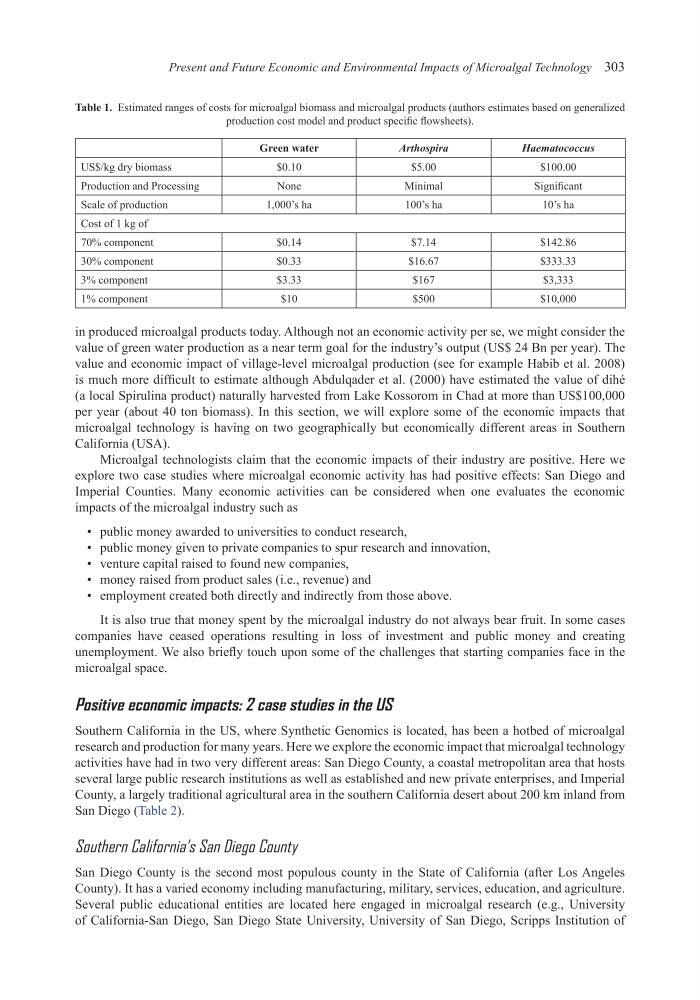
Table 1. Estimated ranges of costs for microalgal biomass and microalgal products (authors estimates based on generalized
production cost model and product specific flowsheets).
Green water
Arthospira
Haematococcus
US$/kg dry biomass
$0.10
$5.00
$100.00
Production and Processing
None
Minimal
Significant
Scale of production
1,000’s ha
100’s ha
10’s ha
Cost of 1 kg of
70% component
$0.14
$7.14
$142.86
30% component
$0.33
$16.67
$333.33
3% component
$3.33
$167
$3,333
1% component
$10
$500
$10,000
in produced microalgal products today. Although not an economic activity per se, we might consider the
value of green water production as a near term goal for the industry’s output (US$ 24 Bn per year). The
value and economic impact of village-level microalgal production (see for example Habib et al. 2008)
is much more difficult to estimate although Abdulqader et al. (2000) have estimated the value of dihé
(a local Spirulina product) naturally harvested from Lake Kossorom in Chad at more than US$100,000
per year (about 40 ton biomass). In this section, we will explore some of the economic impacts that
microalgal technology is having on two geographically but economically different areas in Southern
California (USA).
Microalgal technologists claim that the economic impacts of their industry are positive. Here we
explore two case studies where microalgal economic activity has had positive effects: San Diego and
Imperial Counties. Many economic activities can be considered when one evaluates the economic
impacts of the microalgal industry such as
• public money awarded to universities to conduct research,
• public money given to private companies to spur research and innovation,
• venture capital raised to found new companies,
• money raised from product sales (i.e., revenue) and
• employment created both directly and indirectly from those above.
It is also true that money spent by the microalgal industry do not always bear fruit. In some cases
companies have ceased operations resulting in loss of investment and public money and creating
unemployment. We also briefly touch upon some of the challenges that starting companies face in the
microalgal space.
Positive economic impacts: 2 case studies in the US
Southern California in the US, where Synthetic Genomics is located, has been a hotbed of microalgal
research and production for many years. Here we explore the economic impact that microalgal technology
activities have had in two very different areas: San Diego County, a coastal metropolitan area that hosts
several large public research institutions as well as established and new private enterprises, and Imperial
County, a largely traditional agricultural area in the southern California desert about 200 km inland from
San Diego (Table 2).
Southern California’s San Diego County
San Diego County is the second most populous county in the State of California (after Los Angeles
County). It has a varied economy including manufacturing, military, services, education, and agriculture.
Several public educational entities are located here engaged in microalgal research (e.g., University
of California-San Diego, San Diego State University, University of San Diego, Scripps Institution of
Table 1. Estimated ranges of costs for microalgal biomass and microalgal products (authors estimates based on generalized
production cost model and product specific flowsheets).
Green water
Arthospira
Haematococcus
US$/kg dry biomass
$0.10
$5.00
$100.00
Production and Processing
None
Minimal
Significant
Scale of production
1,000’s ha
100’s ha
10’s ha
Cost of 1 kg of
70% component
$0.14
$7.14
$142.86
30% component
$0.33
$16.67
$333.33
3% component
$3.33
$167
$3,333
1% component
$10
$500
$10,000