

Present and Future Economic and Environmental Impacts of Microalgal Technology 301
amount of microalgae produced commercially is around 10 x 10
3
metric tons worldwide most of which
was Arthrospira sp. (Grewe and Pulz 2012). More recent estimates (as of 2016) indicate about 15 x 10
3
and 10 x 10
3
metric tons of Arthrospira and Chlorella respectively (Slocombe and Benemann 2016). Note
that the estimate for Chlorella includes heterotrophic production.
Much of this biomass is sold as high value food supplements that can command prices well above
$10/kg (Benemann 2010). In 2004, Pulz and Gross (2004) estimated the size of the market at 5000 metric
tons/yr with a value of US$1.25 Bn/yr. Assuming that the tonnage has already increased significantly as
noted above, the value of the market today could is expected to be significantly larger. If one is to believe
the projections made by researchers and venture capitalists, future commercial microalgal production is
certain to increase substantially.
Interestingly, the total tonnage of all microalgae utilized worldwide is much higher; it has been
calculated as high as 240 million tons. Most of this biomass is not produced in photobioreactors or open
ponds but as “green water” to support the nutrition of mostly herbivorous fish and shrimp for aquaculture
(Neori 2011). That author (that is, Neori 2011), estimates that the cost of producing such “green water”
algal biomass must be on the order of less than US$0.1/kg to support the economic production of fish
species with value as low as US$0.5/kg. Note that 240 million tons at US$0.1/kg is equivalent to 24 Bn
US$/yr, one order of magnitude higher than that of commercial microalgae production.
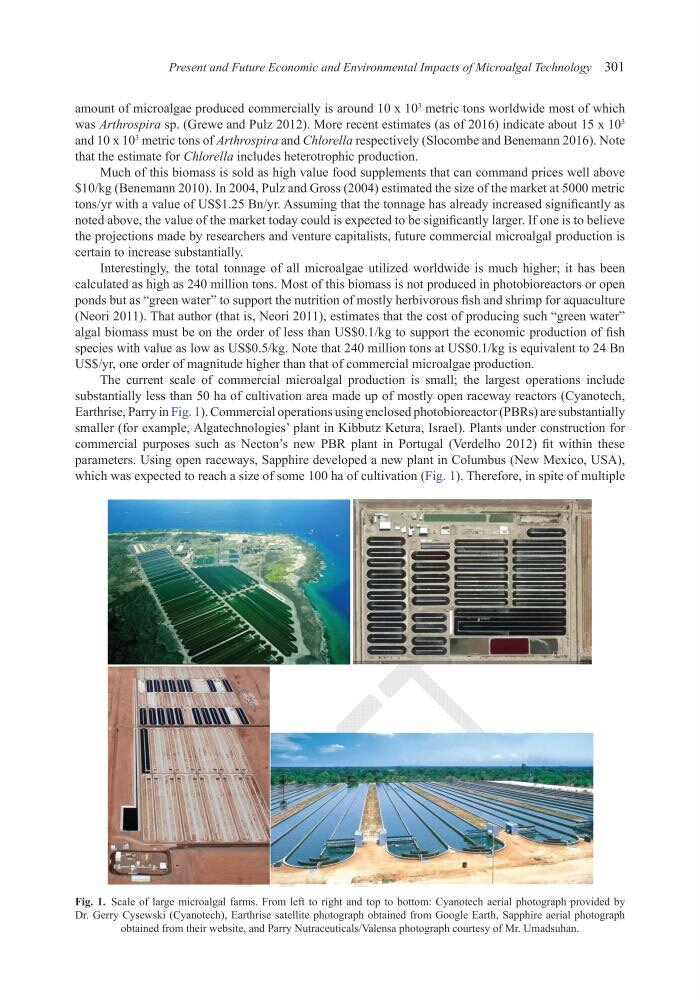
The current scale of commercial microalgal production is small; the largest operations include
substantially less than 50 ha of cultivation area made up of mostly open raceway reactors (Cyanotech,
Earthrise, Parry in Fig. 1). Commercial operations using enclosed photobioreactor (PBRs) are substantially
smaller (for example, Algatechnologies’ plant in Kibbutz Ketura, Israel). Plants under construction for
commercial purposes such as Necton’s new PBR plant in Portugal (Verdelho 2012) fit within these
parameters. Using open raceways, Sapphire developed a new plant in Columbus (New Mexico, USA),
which was expected to reach a size of some 100 ha of cultivation (Fig. 1). Therefore, in spite of multiple
Fig. 1. Scale of large microalgal farms. From left to right and top to bottom: Cyanotech aerial photograph provided by
Dr. Gerry Cysewski (Cyanotech), Earthrise satellite photograph obtained from Google Earth, Sapphire aerial photograph
obtained from their website, and Parry Nutraceuticals/Valensa photograph courtesy of Mr. Umadsuhan.
amount of microalgae produced commercially is around 10 x 10
3
metric tons worldwide most of which
was Arthrospira sp. (Grewe and Pulz 2012). More recent estimates (as of 2016) indicate about 15 x 10
3
and 10 x 10
3
metric tons of Arthrospira and Chlorella respectively (Slocombe and Benemann 2016). Note
that the estimate for Chlorella includes heterotrophic production.
Much of this biomass is sold as high value food supplements that can command prices well above
$10/kg (Benemann 2010). In 2004, Pulz and Gross (2004) estimated the size of the market at 5000 metric
tons/yr with a value of US$1.25 Bn/yr. Assuming that the tonnage has already increased significantly as
noted above, the value of the market today could is expected to be significantly larger. If one is to believe
the projections made by researchers and venture capitalists, future commercial microalgal production is
certain to increase substantially.
Interestingly, the total tonnage of all microalgae utilized worldwide is much higher; it has been
calculated as high as 240 million tons. Most of this biomass is not produced in photobioreactors or open
ponds but as “green water” to support the nutrition of mostly herbivorous fish and shrimp for aquaculture
(Neori 2011). That author (that is, Neori 2011), estimates that the cost of producing such “green water”
algal biomass must be on the order of less than US$0.1/kg to support the economic production of fish
species with value as low as US$0.5/kg. Note that 240 million tons at US$0.1/kg is equivalent to 24 Bn
US$/yr, one order of magnitude higher than that of commercial microalgae production.
The current scale of commercial microalgal production is small; the largest operations include
substantially less than 50 ha of cultivation area made up of mostly open raceway reactors (Cyanotech,
Earthrise, Parry in Fig. 1). Commercial operations using enclosed photobioreactor (PBRs) are substantially
smaller (for example, Algatechnologies’ plant in Kibbutz Ketura, Israel). Plants under construction for
commercial purposes such as Necton’s new PBR plant in Portugal (Verdelho 2012) fit within these
parameters. Using open raceways, Sapphire developed a new plant in Columbus (New Mexico, USA),
which was expected to reach a size of some 100 ha of cultivation (Fig. 1). Therefore, in spite of multiple
Fig. 1. Scale of large microalgal farms. From left to right and top to bottom: Cyanotech aerial photograph provided by
Dr. Gerry Cysewski (Cyanotech), Earthrise satellite photograph obtained from Google Earth, Sapphire aerial photograph
obtained from their website, and Parry Nutraceuticals/Valensa photograph courtesy of Mr. Umadsuhan.