

Improving Marine Algae for Bioenergy 279
Improving CO 2 fixation
Carbon assimilation takes place in all algae, as well as in cyanobacteria, through the metabolic route
known as Calvin (or Calvin-Benson-Bassham) cycle. The initial step in this pathway is the fixation
of CO 2 mediated by ribulose 1,5-bisphosphate carboxylase/oxygenase (Rubisco). Cyanobacterial
and most eukaryotic Rubiscos are composed of eight large and eight small subunits, assembled in a
hexadecameric holoenzyme. Sequence comparison has revealed two evolutive branches among the
hexadecameric Rubiscos (Tabita et al. 2008). One of them comprises the enzymes of cyanobacteria,
green algae, and higher plants, encoding the large subunit in the chloroplast genome and the small
subunit in the nucleus. These enzymes are called “green-like” Rubiscos. On the other hand, red and
brown algae encode both subunits in the chloroplast, and the corresponding enzymes show a significant
divergence (at the sequence level) from the green-like forms, termed “red-like” Rubiscos. In all cases, the
catalytic site resides at the contact surface between large subunits. Rubisco catalyzes the carboxylation
of ribulose 1,5-bisphosphate (RuBP) to produce two molecules of 3-phosphoglycerate, which are further
metabolized through the Calvin cycle. However, Rubisco also promotes the oxygenation of RuBP, thus
rendering only one molecule of phosphoglycerate and another of 2-phosphoglycolate. This latter reaction
initiates the photorespiratory pathway, which metabolizes 2-phosphoglycolate to recover two thirds of its
carbon as 3-phosphoglycerate, while the other third is released as CO 2 . Therefore, loss of CO 2 through
photorespiration opposes CO 2 fixation through the Calvin cycle, and the net balance between the two
outcomes determines the rate of carbon biomass accumulation. Rubisco oxygenase activity is thought to
be an unavoidable escape of the catalytic mechanism, while the photorespiratory pathway appears to be
just a metabolic solution to avoid the accumulation of 2-phosphoglycolate (which inhibits Calvin cycle
enzymes) and to salvage part of its carbon. Despite photorespiration having acquired some secondary
functions (such as protection against oxidative stress), the experimental fact is that favouring carbon
fixation over photorespiration—by raising the environmental CO 2 /O 2 ratio—substantially increases the
growth rate of plants. Therefore, biotechnological suppression or reduction of the oxygenase activity of
Rubisco would, in principle, enhance biomass production significantly.
The ratio of the carboxylase (Vc) to oxygenase (Vo) activity of Rubisco is known to be proportional
to the corresponding ratio of substrate concentrations:
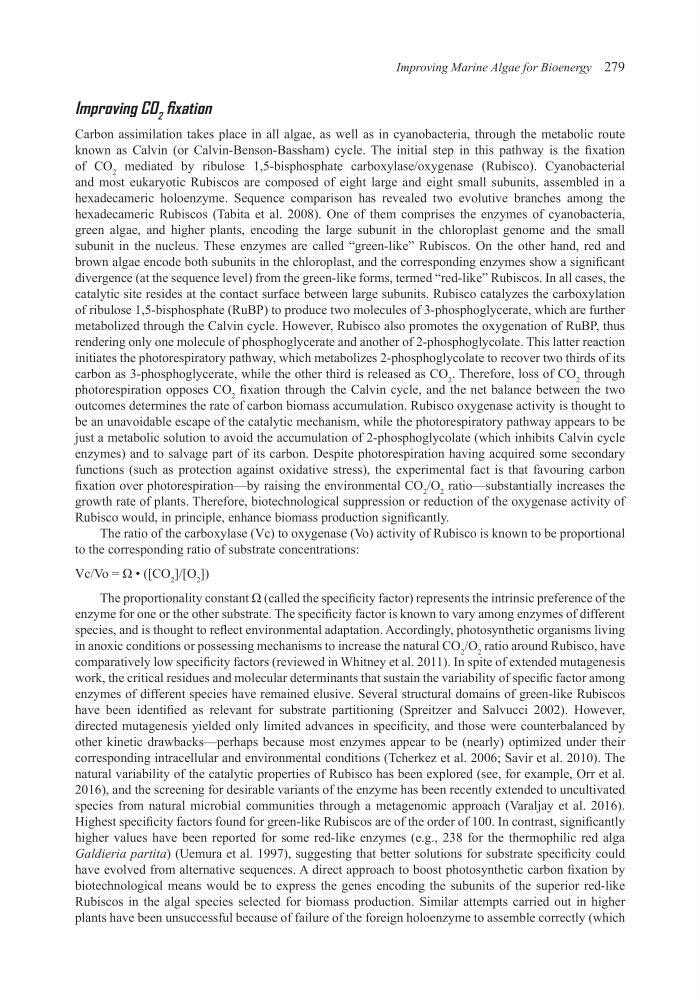
Vc/Vo = Ω • ([CO 2 ]/[O 2 ])
The proportionality constant Ω (called the specificity factor) represents the intrinsic preference of the
enzyme for one or the other substrate. The specificity factor is known to vary among enzymes of different
species, and is thought to reflect environmental adaptation. Accordingly, photosynthetic organisms living
in anoxic conditions or possessing mechanisms to increase the natural CO 2 /O 2 ratio around Rubisco, have
comparatively low specificity factors (reviewed in Whitney et al. 2011). In spite of extended mutagenesis
work, the critical residues and molecular determinants that sustain the variability of specific factor among
enzymes of different species have remained elusive. Several structural domains of green-like Rubiscos
have been identified as relevant for substrate partitioning (Spreitzer and Salvucci 2002). However,
directed mutagenesis yielded only limited advances in specificity, and those were counterbalanced by
other kinetic drawbacks—perhaps because most enzymes appear to be (nearly) optimized under their
corresponding intracellular and environmental conditions (Tcherkez et al. 2006; Savir et al. 2010). The
natural variability of the catalytic properties of Rubisco has been explored (see, for example, Orr et al.
2016), and the screening for desirable variants of the enzyme has been recently extended to uncultivated
species from natural microbial communities through a metagenomic approach (Varaljay et al. 2016).
Highest specificity factors found for green-like Rubiscos are of the order of 100. In contrast, significantly
higher values have been reported for some red-like enzymes (e.g., 238 for the thermophilic red alga
Galdieria partita) (Uemura et al. 1997), suggesting that better solutions for substrate specificity could
have evolved from alternative sequences. A direct approach to boost photosynthetic carbon fixation by
biotechnological means would be to express the genes encoding the subunits of the superior red-like
Rubiscos in the algal species selected for biomass production. Similar attempts carried out in higher
plants have been unsuccessful because of failure of the foreign holoenzyme to assemble correctly (which
Improving CO 2 fixation
Carbon assimilation takes place in all algae, as well as in cyanobacteria, through the metabolic route
known as Calvin (or Calvin-Benson-Bassham) cycle. The initial step in this pathway is the fixation
of CO 2 mediated by ribulose 1,5-bisphosphate carboxylase/oxygenase (Rubisco). Cyanobacterial
and most eukaryotic Rubiscos are composed of eight large and eight small subunits, assembled in a
hexadecameric holoenzyme. Sequence comparison has revealed two evolutive branches among the
hexadecameric Rubiscos (Tabita et al. 2008). One of them comprises the enzymes of cyanobacteria,
green algae, and higher plants, encoding the large subunit in the chloroplast genome and the small
subunit in the nucleus. These enzymes are called “green-like” Rubiscos. On the other hand, red and
brown algae encode both subunits in the chloroplast, and the corresponding enzymes show a significant
divergence (at the sequence level) from the green-like forms, termed “red-like” Rubiscos. In all cases, the
catalytic site resides at the contact surface between large subunits. Rubisco catalyzes the carboxylation
of ribulose 1,5-bisphosphate (RuBP) to produce two molecules of 3-phosphoglycerate, which are further
metabolized through the Calvin cycle. However, Rubisco also promotes the oxygenation of RuBP, thus
rendering only one molecule of phosphoglycerate and another of 2-phosphoglycolate. This latter reaction
initiates the photorespiratory pathway, which metabolizes 2-phosphoglycolate to recover two thirds of its
carbon as 3-phosphoglycerate, while the other third is released as CO 2 . Therefore, loss of CO 2 through
photorespiration opposes CO 2 fixation through the Calvin cycle, and the net balance between the two
outcomes determines the rate of carbon biomass accumulation. Rubisco oxygenase activity is thought to
be an unavoidable escape of the catalytic mechanism, while the photorespiratory pathway appears to be
just a metabolic solution to avoid the accumulation of 2-phosphoglycolate (which inhibits Calvin cycle
enzymes) and to salvage part of its carbon. Despite photorespiration having acquired some secondary
functions (such as protection against oxidative stress), the experimental fact is that favouring carbon
fixation over photorespiration—by raising the environmental CO 2 /O 2 ratio—substantially increases the
growth rate of plants. Therefore, biotechnological suppression or reduction of the oxygenase activity of
Rubisco would, in principle, enhance biomass production significantly.
The ratio of the carboxylase (Vc) to oxygenase (Vo) activity of Rubisco is known to be proportional
to the corresponding ratio of substrate concentrations:
Vc/Vo = Ω • ([CO 2 ]/[O 2 ])
The proportionality constant Ω (called the specificity factor) represents the intrinsic preference of the
enzyme for one or the other substrate. The specificity factor is known to vary among enzymes of different
species, and is thought to reflect environmental adaptation. Accordingly, photosynthetic organisms living
in anoxic conditions or possessing mechanisms to increase the natural CO 2 /O 2 ratio around Rubisco, have
comparatively low specificity factors (reviewed in Whitney et al. 2011). In spite of extended mutagenesis
work, the critical residues and molecular determinants that sustain the variability of specific factor among
enzymes of different species have remained elusive. Several structural domains of green-like Rubiscos
have been identified as relevant for substrate partitioning (Spreitzer and Salvucci 2002). However,
directed mutagenesis yielded only limited advances in specificity, and those were counterbalanced by
other kinetic drawbacks—perhaps because most enzymes appear to be (nearly) optimized under their
corresponding intracellular and environmental conditions (Tcherkez et al. 2006; Savir et al. 2010). The
natural variability of the catalytic properties of Rubisco has been explored (see, for example, Orr et al.
2016), and the screening for desirable variants of the enzyme has been recently extended to uncultivated
species from natural microbial communities through a metagenomic approach (Varaljay et al. 2016).
Highest specificity factors found for green-like Rubiscos are of the order of 100. In contrast, significantly
higher values have been reported for some red-like enzymes (e.g., 238 for the thermophilic red alga
Galdieria partita) (Uemura et al. 1997), suggesting that better solutions for substrate specificity could
have evolved from alternative sequences. A direct approach to boost photosynthetic carbon fixation by
biotechnological means would be to express the genes encoding the subunits of the superior red-like
Rubiscos in the algal species selected for biomass production. Similar attempts carried out in higher
plants have been unsuccessful because of failure of the foreign holoenzyme to assemble correctly (which