

Microalgae for Feed 169
microalgal biomass to partially replace fish oils in adult feeding, thus decreasing the levels of environmental
contamination generated by these industries, and concomitantly providing higher quality fish flesh, offers
an outstanding opportunity for the expansion of global aquaculture production (Sweetman 2009).
Main feed market areas were microalgae may have a valuable application can be classified into four
groups: (i) pets (dogs, cats, birds, tropical fish, rabbits and rodents); (ii) aquaculture (e.g., salmonidae,
sparidae, and bivalves); (iii) husbandry (e.g., poultry, cattle, swine); (iv) and others (e.g., race horses).
Apart from responding to nutritional daily demands, microalgae can be tailored for specialty feed
applications in critical growth stages of the animal.
Microalgae in pet feeds
A promising application for microalgal biomass is the pet food market, where effects on the external
appearance of the pet (shiny hair, beautiful feathers) are as important as the health-promoting ones (Pulz
and Gross 2004).
Within this sector, consumers are noticed to be increasingly aware and demanding while purchasing
feed, paying close attention to labels, packaging and marketing claims, and directing their preferences to
natural products and/or supplements with multiple benefits. Pet humanization has thus led to specialized
formulas, with foods addressing weight loss and management, arthritis relief, sensitive skin, diabetes,
digestive/urinary tract health, heart health, immune system support, and mental development and
health. In Japan, pet foods focused on the aging and senior pet population are popular (Dias and Sendão
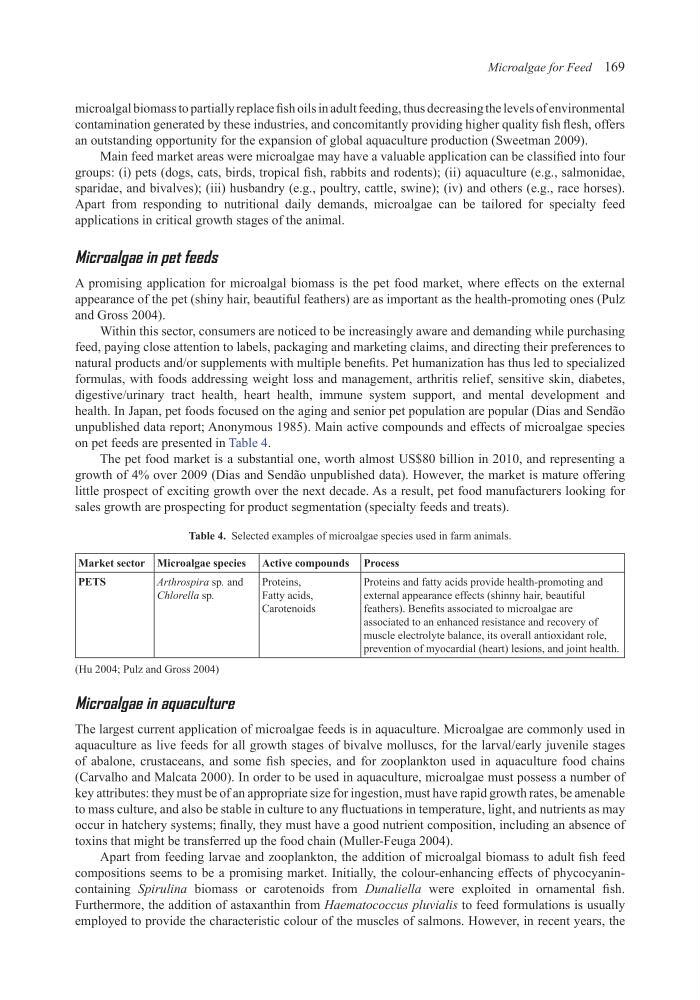
unpublished data report; Anonymous 1985). Main active compounds and effects of microalgae species
on pet feeds are presented in Table 4.
The pet food market is a substantial one, worth almost US$80 billion in 2010, and representing a
growth of 4% over 2009 (Dias and Sendão unpublished data). However, the market is mature offering
little prospect of exciting growth over the next decade. As a result, pet food manufacturers looking for
sales growth are prospecting for product segmentation (specialty feeds and treats).
Table 4. Selected examples of microalgae species used in farm animals.
Market sector Microalgae species Active compounds Process
PETS
Arthrospira sp. and
Chlorella sp.
Proteins,
Fatty acids,
Carotenoids
Proteins and fatty acids provide health-promoting and
external appearance effects (shinny hair, beautiful
feathers). Benefits associated to microalgae are
associated to an enhanced resistance and recovery of
muscle electrolyte balance, its overall antioxidant role,
prevention of myocardial (heart) lesions, and joint health.
(Hu 2004; Pulz and Gross 2004)
Microalgae in aquaculture
The largest current application of microalgae feeds is in aquaculture. Microalgae are commonly used in
aquaculture as live feeds for all growth stages of bivalve molluscs, for the larval/early juvenile stages
of abalone, crustaceans, and some fish species, and for zooplankton used in aquaculture food chains
(Carvalho and Malcata 2000). In order to be used in aquaculture, microalgae must possess a number of
key attributes: they must be of an appropriate size for ingestion, must have rapid growth rates, be amenable
to mass culture, and also be stable in culture to any fluctuations in temperature, light, and nutrients as may
occur in hatchery systems; finally, they must have a good nutrient composition, including an absence of
toxins that might be transferred up the food chain (Muller-Feuga 2004).
Apart from feeding larvae and zooplankton, the addition of microalgal biomass to adult fish feed
compositions seems to be a promising market. Initially, the colour-enhancing effects of phycocyanincontaining Spirulina biomass or carotenoids from Dunaliella were exploited in ornamental fish.
Furthermore, the addition of astaxanthin from Haematococcus pluvialis to feed formulations is usually
employed to provide the characteristic colour of the muscles of salmons. However, in recent years, the
microalgal biomass to partially replace fish oils in adult feeding, thus decreasing the levels of environmental
contamination generated by these industries, and concomitantly providing higher quality fish flesh, offers
an outstanding opportunity for the expansion of global aquaculture production (Sweetman 2009).
Main feed market areas were microalgae may have a valuable application can be classified into four
groups: (i) pets (dogs, cats, birds, tropical fish, rabbits and rodents); (ii) aquaculture (e.g., salmonidae,
sparidae, and bivalves); (iii) husbandry (e.g., poultry, cattle, swine); (iv) and others (e.g., race horses).
Apart from responding to nutritional daily demands, microalgae can be tailored for specialty feed
applications in critical growth stages of the animal.
Microalgae in pet feeds
A promising application for microalgal biomass is the pet food market, where effects on the external
appearance of the pet (shiny hair, beautiful feathers) are as important as the health-promoting ones (Pulz
and Gross 2004).
Within this sector, consumers are noticed to be increasingly aware and demanding while purchasing
feed, paying close attention to labels, packaging and marketing claims, and directing their preferences to
natural products and/or supplements with multiple benefits. Pet humanization has thus led to specialized
formulas, with foods addressing weight loss and management, arthritis relief, sensitive skin, diabetes,
digestive/urinary tract health, heart health, immune system support, and mental development and
health. In Japan, pet foods focused on the aging and senior pet population are popular (Dias and Sendão
unpublished data report; Anonymous 1985). Main active compounds and effects of microalgae species
on pet feeds are presented in Table 4.
The pet food market is a substantial one, worth almost US$80 billion in 2010, and representing a
growth of 4% over 2009 (Dias and Sendão unpublished data). However, the market is mature offering
little prospect of exciting growth over the next decade. As a result, pet food manufacturers looking for
sales growth are prospecting for product segmentation (specialty feeds and treats).
Table 4. Selected examples of microalgae species used in farm animals.
Market sector Microalgae species Active compounds Process
PETS
Arthrospira sp. and
Chlorella sp.
Proteins,
Fatty acids,
Carotenoids
Proteins and fatty acids provide health-promoting and
external appearance effects (shinny hair, beautiful
feathers). Benefits associated to microalgae are
associated to an enhanced resistance and recovery of
muscle electrolyte balance, its overall antioxidant role,
prevention of myocardial (heart) lesions, and joint health.
(Hu 2004; Pulz and Gross 2004)
Microalgae in aquaculture
The largest current application of microalgae feeds is in aquaculture. Microalgae are commonly used in
aquaculture as live feeds for all growth stages of bivalve molluscs, for the larval/early juvenile stages
of abalone, crustaceans, and some fish species, and for zooplankton used in aquaculture food chains
(Carvalho and Malcata 2000). In order to be used in aquaculture, microalgae must possess a number of
key attributes: they must be of an appropriate size for ingestion, must have rapid growth rates, be amenable
to mass culture, and also be stable in culture to any fluctuations in temperature, light, and nutrients as may
occur in hatchery systems; finally, they must have a good nutrient composition, including an absence of
toxins that might be transferred up the food chain (Muller-Feuga 2004).
Apart from feeding larvae and zooplankton, the addition of microalgal biomass to adult fish feed
compositions seems to be a promising market. Initially, the colour-enhancing effects of phycocyanincontaining Spirulina biomass or carotenoids from Dunaliella were exploited in ornamental fish.
Furthermore, the addition of astaxanthin from Haematococcus pluvialis to feed formulations is usually
employed to provide the characteristic colour of the muscles of salmons. However, in recent years, the