

150 Marine Macro- and Microalgae: An Overview
About 80 percent of the agar produced globally is for food applications (see Tables 1 and 2), the
remaining 10 percent being used for bacteriological plates and other biotechnology uses (in particular
agarose electrophoresis). Agar has been classified as GRAS (Generally Recognized as Safe) by the United
States of America Food and Drug Administration, which has set maximum usage levels depending on
particular applications. In the baked goods industry, the ability of agar gels to withstand high temperatures
allows for its use as a stabilizer and thickener in pie fillings, icings, and meringues. Cakes, buns, etc., are
often pre-packed in various kinds of modern wrapping materials and often stick to them, especially in
hot weather; by reducing the quantity of water and adding some agar, a more stable, smoother, non-stick
icing may be obtained (McHugh 2003; Pereira et al. 2009a). Some agars, especially those extracted from
Gracilaria chilensis, can be used in confectionery with very high sugar content, such as fruit candies.
These agars are said to be “sugar reactive” because the sugar (sucrose) increases the strength of the gel.
Since agar is tasteless, it does not interfere with the flavors of foodstuffs; this contrasts with some of its
competitive gums that require the addition of calcium or potassium salts to form gels. In Asian countries,
it is a popular component of jellies; this has its origin in the early practice of boiling seaweed, straining it,
and adding flavors to the liquid before cooling to form a jelly (McHugh 2003). The remaining 20 percent
is accounted for biotechnological applications (Armisen and Galatas 2000). A list of different uses and
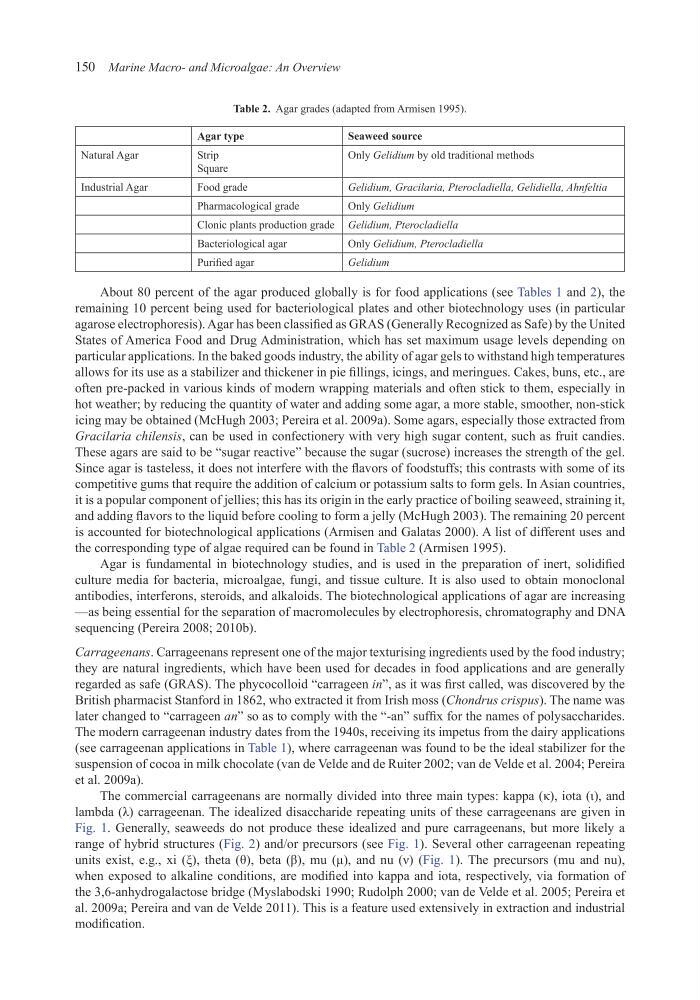
the corresponding type of algae required can be found in Table 2 (Armisen 1995).
Agar is fundamental in biotechnology studies, and is used in the preparation of inert, solidified
culture media for bacteria, microalgae, fungi, and tissue culture. It is also used to obtain monoclonal
antibodies, interferons, steroids, and alkaloids. The biotechnological applications of agar are increasing
—as being essential for the separation of macromolecules by electrophoresis, chromatography and DNA
sequencing (Pereira 2008; 2010b).
Carrageenans. Carrageenans represent one of the major texturising ingredients used by the food industry;
they are natural ingredients, which have been used for decades in food applications and are generally
regarded as safe (GRAS). The phycocolloid “carrageen in”, as it was first called, was discovered by the
British pharmacist Stanford in 1862, who extracted it from Irish moss (Chondrus crispus). The name was
later changed to “carrageen an” so as to comply with the “-an” suffix for the names of polysaccharides.
The modern carrageenan industry dates from the 1940s, receiving its impetus from the dairy applications
(see carrageenan applications in Table 1), where carrageenan was found to be the ideal stabilizer for the
suspension of cocoa in milk chocolate (van de Velde and de Ruiter 2002; van de Velde et al. 2004; Pereira
et al. 2009a).
The commercial carrageenans are normally divided into three main types: kappa (κ), iota (ι), and
lambda (λ) carrageenan. The idealized disaccharide repeating units of these carrageenans are given in
Fig. 1. Generally, seaweeds do not produce these idealized and pure carrageenans, but more likely a
range of hybrid structures (Fig. 2) and/or precursors (see Fig. 1). Several other carrageenan repeating
units exist, e.g., xi (ξ), theta (θ), beta (β), mu (μ), and nu (ν) (Fig. 1). The precursors (mu and nu),
when exposed to alkaline conditions, are modified into kappa and iota, respectively, via formation of
the 3,6-anhydrogalactose bridge (Myslabodski 1990; Rudolph 2000; van de Velde et al. 2005; Pereira et
al. 2009a; Pereira and van de Velde 2011). This is a feature used extensively in extraction and industrial
modification.
Table 2. Agar grades (adapted from Armisen 1995).
Agar type
Seaweed source
Natural Agar
Strip
Square
Only Gelidium by old traditional methods
Industrial Agar
Food grade
Gelidium, Gracilaria, Pterocladiella, Gelidiella, Ahnfeltia
Pharmacological grade
Only Gelidium
Clonic plants production grade Gelidium, Pterocladiella
Bacteriological agar
Only Gelidium, Pterocladiella
Purified agar
Gelidium
About 80 percent of the agar produced globally is for food applications (see Tables 1 and 2), the
remaining 10 percent being used for bacteriological plates and other biotechnology uses (in particular
agarose electrophoresis). Agar has been classified as GRAS (Generally Recognized as Safe) by the United
States of America Food and Drug Administration, which has set maximum usage levels depending on
particular applications. In the baked goods industry, the ability of agar gels to withstand high temperatures
allows for its use as a stabilizer and thickener in pie fillings, icings, and meringues. Cakes, buns, etc., are
often pre-packed in various kinds of modern wrapping materials and often stick to them, especially in
hot weather; by reducing the quantity of water and adding some agar, a more stable, smoother, non-stick
icing may be obtained (McHugh 2003; Pereira et al. 2009a). Some agars, especially those extracted from
Gracilaria chilensis, can be used in confectionery with very high sugar content, such as fruit candies.
These agars are said to be “sugar reactive” because the sugar (sucrose) increases the strength of the gel.
Since agar is tasteless, it does not interfere with the flavors of foodstuffs; this contrasts with some of its
competitive gums that require the addition of calcium or potassium salts to form gels. In Asian countries,
it is a popular component of jellies; this has its origin in the early practice of boiling seaweed, straining it,
and adding flavors to the liquid before cooling to form a jelly (McHugh 2003). The remaining 20 percent
is accounted for biotechnological applications (Armisen and Galatas 2000). A list of different uses and
the corresponding type of algae required can be found in Table 2 (Armisen 1995).
Agar is fundamental in biotechnology studies, and is used in the preparation of inert, solidified
culture media for bacteria, microalgae, fungi, and tissue culture. It is also used to obtain monoclonal
antibodies, interferons, steroids, and alkaloids. The biotechnological applications of agar are increasing
—as being essential for the separation of macromolecules by electrophoresis, chromatography and DNA
sequencing (Pereira 2008; 2010b).
Carrageenans. Carrageenans represent one of the major texturising ingredients used by the food industry;
they are natural ingredients, which have been used for decades in food applications and are generally
regarded as safe (GRAS). The phycocolloid “carrageen in”, as it was first called, was discovered by the
British pharmacist Stanford in 1862, who extracted it from Irish moss (Chondrus crispus). The name was
later changed to “carrageen an” so as to comply with the “-an” suffix for the names of polysaccharides.
The modern carrageenan industry dates from the 1940s, receiving its impetus from the dairy applications
(see carrageenan applications in Table 1), where carrageenan was found to be the ideal stabilizer for the
suspension of cocoa in milk chocolate (van de Velde and de Ruiter 2002; van de Velde et al. 2004; Pereira
et al. 2009a).
The commercial carrageenans are normally divided into three main types: kappa (κ), iota (ι), and
lambda (λ) carrageenan. The idealized disaccharide repeating units of these carrageenans are given in
Fig. 1. Generally, seaweeds do not produce these idealized and pure carrageenans, but more likely a
range of hybrid structures (Fig. 2) and/or precursors (see Fig. 1). Several other carrageenan repeating
units exist, e.g., xi (ξ), theta (θ), beta (β), mu (μ), and nu (ν) (Fig. 1). The precursors (mu and nu),
when exposed to alkaline conditions, are modified into kappa and iota, respectively, via formation of
the 3,6-anhydrogalactose bridge (Myslabodski 1990; Rudolph 2000; van de Velde et al. 2005; Pereira et
al. 2009a; Pereira and van de Velde 2011). This is a feature used extensively in extraction and industrial
modification.
Table 2. Agar grades (adapted from Armisen 1995).
Agar type
Seaweed source
Natural Agar
Strip
Square
Only Gelidium by old traditional methods
Industrial Agar
Food grade
Gelidium, Gracilaria, Pterocladiella, Gelidiella, Ahnfeltia
Pharmacological grade
Only Gelidium
Clonic plants production grade Gelidium, Pterocladiella
Bacteriological agar
Only Gelidium, Pterocladiella
Purified agar
Gelidium