

Introduction to the Marine Algae: Overview 5
The various types of gametes can be classified according to relative size and motility. When both
are motile and the same size (isogametes) the process is called isogamy; when gametes differ in size
(heterogametes) they can undertake the anisogamy process, when both are motile but one is small (male,
by convention) and the other is large (female); or the oogamy process, in which only the male gamete is
motile and fuses with a very large and non-motile female gamete.
Gametes may also be morphologically identical or markedly different from vegetative cells,
depending on the algal group. When similar they can only be distinguished based on the DNA ploidy.
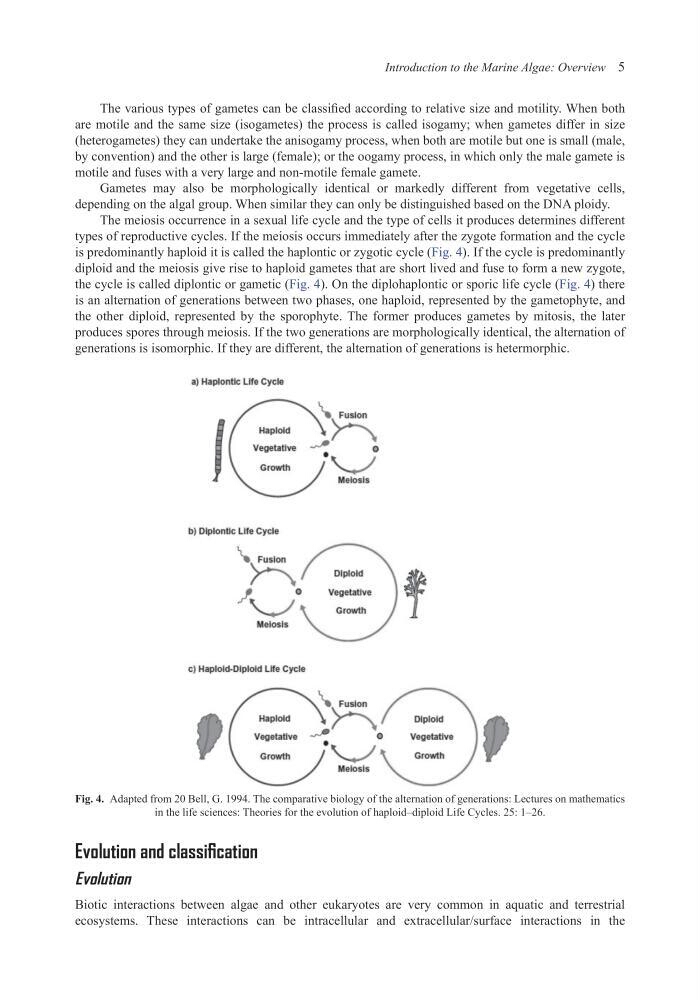
The meiosis occurrence in a sexual life cycle and the type of cells it produces determines different
types of reproductive cycles. If the meiosis occurs immediately after the zygote formation and the cycle
is predominantly haploid it is called the haplontic or zygotic cycle (Fig. 4). If the cycle is predominantly
diploid and the meiosis give rise to haploid gametes that are short lived and fuse to form a new zygote,
the cycle is called diplontic or gametic (Fig. 4). On the diplohaplontic or sporic life cycle (Fig. 4) there
is an alternation of generations between two phases, one haploid, represented by the gametophyte, and
the other diploid, represented by the sporophyte. The former produces gametes by mitosis, the later
produces spores through meiosis. If the two generations are morphologically identical, the alternation of
generations is isomorphic. If they are different, the alternation of generations is hetermorphic.
Fig. 4. Adapted from 20 Bell, G. 1994. The comparative biology of the alternation of generations: Lectures on mathematics
in the life sciences: Theories for the evolution of haploid–diploid Life Cycles. 25: 1–26.
Evolution and classification
Evolution
Biotic interactions between algae and other eukaryotes are very common in aquatic and terrestrial
ecosystems. These interactions can be intracellular and extracellular/surface interactions in the
a) Haplontic: Life Cycle
b) Dlplontlc L fe Cycle
\.~
J:
c) Haplold-Diplold ILife Cycle
The various types of gametes can be classified according to relative size and motility. When both
are motile and the same size (isogametes) the process is called isogamy; when gametes differ in size
(heterogametes) they can undertake the anisogamy process, when both are motile but one is small (male,
by convention) and the other is large (female); or the oogamy process, in which only the male gamete is
motile and fuses with a very large and non-motile female gamete.
Gametes may also be morphologically identical or markedly different from vegetative cells,
depending on the algal group. When similar they can only be distinguished based on the DNA ploidy.
The meiosis occurrence in a sexual life cycle and the type of cells it produces determines different
types of reproductive cycles. If the meiosis occurs immediately after the zygote formation and the cycle
is predominantly haploid it is called the haplontic or zygotic cycle (Fig. 4). If the cycle is predominantly
diploid and the meiosis give rise to haploid gametes that are short lived and fuse to form a new zygote,
the cycle is called diplontic or gametic (Fig. 4). On the diplohaplontic or sporic life cycle (Fig. 4) there
is an alternation of generations between two phases, one haploid, represented by the gametophyte, and
the other diploid, represented by the sporophyte. The former produces gametes by mitosis, the later
produces spores through meiosis. If the two generations are morphologically identical, the alternation of
generations is isomorphic. If they are different, the alternation of generations is hetermorphic.
Fig. 4. Adapted from 20 Bell, G. 1994. The comparative biology of the alternation of generations: Lectures on mathematics
in the life sciences: Theories for the evolution of haploid–diploid Life Cycles. 25: 1–26.
Evolution and classification
Evolution
Biotic interactions between algae and other eukaryotes are very common in aquatic and terrestrial
ecosystems. These interactions can be intracellular and extracellular/surface interactions in the
a) Haplontic: Life Cycle
b) Dlplontlc L fe Cycle
\.~
J:
c) Haplold-Diplold ILife Cycle