

Microalgal Downstream Processing: Harvesting, Drying, Extraction, Separation, and Purification 91
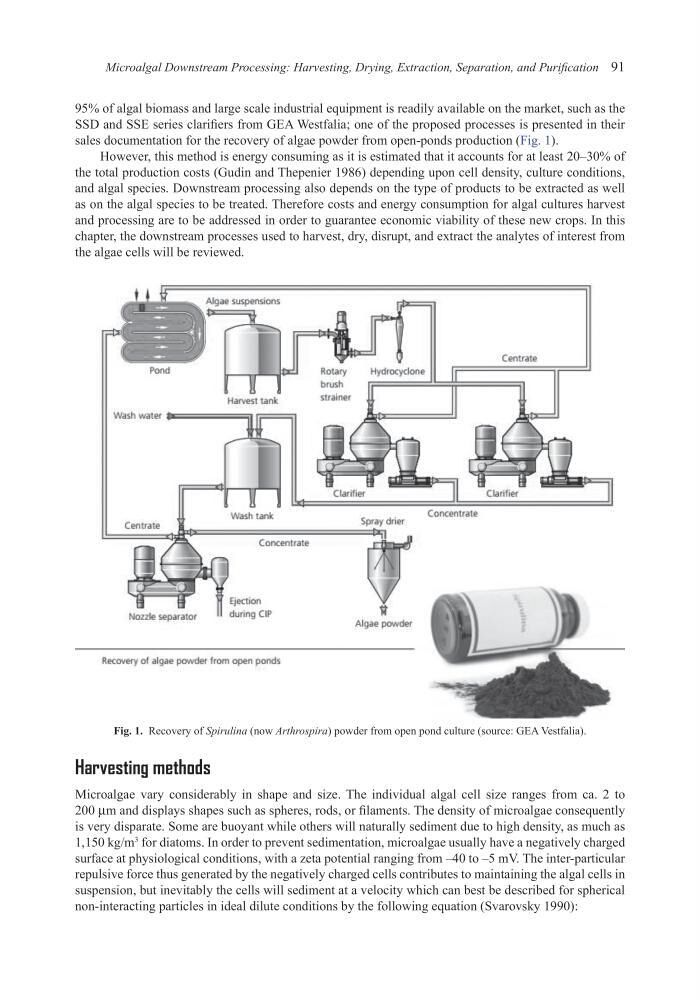
95% of algal biomass and large scale industrial equipment is readily available on the market, such as the
SSD and SSE series clarifiers from GEA Westfalia; one of the proposed processes is presented in their
sales documentation for the recovery of algae powder from open-ponds production (Fig. 1).
However, this method is energy consuming as it is estimated that it accounts for at least 20–30% of
the total production costs (Gudin and Thepenier 1986) depending upon cell density, culture conditions,
and algal species. Downstream processing also depends on the type of products to be extracted as well
as on the algal species to be treated. Therefore costs and energy consumption for algal cultures harvest
and processing are to be addressed in order to guarantee economic viability of these new crops. In this
chapter, the downstream processes used to harvest, dry, disrupt, and extract the analytes of interest from
the algae cells will be reviewed.
Fig. 1. Recovery of Spirulina (now Arthrospira) powder from open pond culture (source: GEA Vestfalia).
Harvesting methods
Microalgae vary considerably in shape and size. The individual algal cell size ranges from ca. 2 to
200 mm and displays shapes such as spheres, rods, or filaments. The density of microalgae consequently
is very disparate. Some are buoyant while others will naturally sediment due to high density, as much as
1,150 kg/m
3
for diatoms. In order to prevent sedimentation, microalgae usually have a negatively charged
surface at physiological conditions, with a zeta potential ranging from –40 to –5 mV. The inter-particular
repulsive force thus generated by the negatively charged cells contributes to maintaining the algal cells in
suspension, but inevitably the cells will sediment at a velocity which can best be described for spherical
non-interacting particles in ideal dilute conditions by the following equation (Svarovsky 1990):
Ce-ntrate
Nozz&e separator
Wash tank
Concentrate
Ejection
during CIP
Recovery of .llgae powder ftom open ponds
Centrate
Alga• powd
95% of algal biomass and large scale industrial equipment is readily available on the market, such as the
SSD and SSE series clarifiers from GEA Westfalia; one of the proposed processes is presented in their
sales documentation for the recovery of algae powder from open-ponds production (Fig. 1).
However, this method is energy consuming as it is estimated that it accounts for at least 20–30% of
the total production costs (Gudin and Thepenier 1986) depending upon cell density, culture conditions,
and algal species. Downstream processing also depends on the type of products to be extracted as well
as on the algal species to be treated. Therefore costs and energy consumption for algal cultures harvest
and processing are to be addressed in order to guarantee economic viability of these new crops. In this
chapter, the downstream processes used to harvest, dry, disrupt, and extract the analytes of interest from
the algae cells will be reviewed.
Fig. 1. Recovery of Spirulina (now Arthrospira) powder from open pond culture (source: GEA Vestfalia).
Harvesting methods
Microalgae vary considerably in shape and size. The individual algal cell size ranges from ca. 2 to
200 mm and displays shapes such as spheres, rods, or filaments. The density of microalgae consequently
is very disparate. Some are buoyant while others will naturally sediment due to high density, as much as
1,150 kg/m
3
for diatoms. In order to prevent sedimentation, microalgae usually have a negatively charged
surface at physiological conditions, with a zeta potential ranging from –40 to –5 mV. The inter-particular
repulsive force thus generated by the negatively charged cells contributes to maintaining the algal cells in
suspension, but inevitably the cells will sediment at a velocity which can best be described for spherical
non-interacting particles in ideal dilute conditions by the following equation (Svarovsky 1990):
Ce-ntrate
Nozz&e separator
Wash tank
Concentrate
Ejection
during CIP
Recovery of .llgae powder ftom open ponds
Centrate
Alga• powd