

Nutritional Freshwater Life
76
Sagittaria cuneata (E. Sheld.)
Order: Alismatales
Family: Alismataceae
Common name: Arumleaf arrowhead,
duck potato.
Distribution: Native to much of North
America, including most of Canada as
well as the western and northeastern
United States (New England, Great
Lakes, Great Plains, Rocky Mountains,
Great Basin, and Pacific Coast states).
Habitat: Slow-moving and stagnant
water bodies such as ponds, lakes, and
small streams.
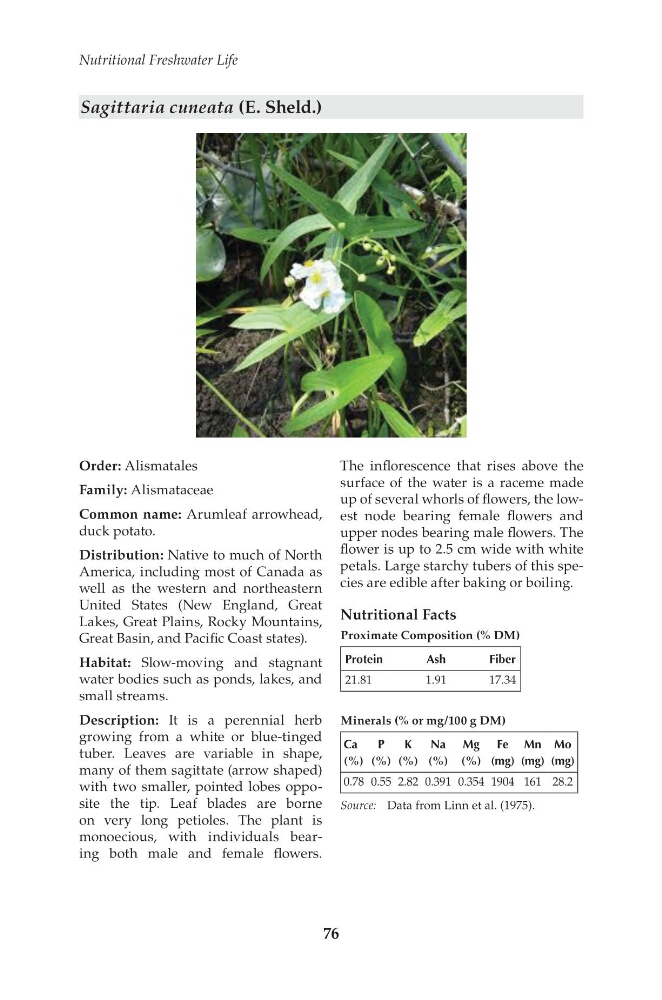
Description: It is a perennial herb
growing from a white or blue-tinged
tuber. Leaves are variable in shape,
many of them sagittate (arrow shaped)
with two smaller, pointed lobes opposite the tip. Leaf blades are borne
on very long petioles. The plant is
monoecious, with individuals bearing both male and female flowers.
The inflorescence that rises above the
surface of the water is a raceme made
up of several whorls of flowers, the lowest node bearing female flowers and
upper nodes bearing male flowers. The
flower is up to 2.5 cm wide with white
petals. Large starchy tubers of this species are edible after baking or boiling.
Nutritional Facts
Proximate Composition (% DM)
Protein
Ash
Fiber
21.81
1.91
17.34
Minerals (% or mg/100 g DM)
Ca
(%)
P
(%)
K
(%)
Na
(%)
Mg
(%)
Fe
(mg)
Mn
(mg)
Mo
(mg)
0.78 0.55 2.82 0.391 0.354 1904 161 28.2
Source: Data from Linn et al. (1975).
76
Sagittaria cuneata (E. Sheld.)
Order: Alismatales
Family: Alismataceae
Common name: Arumleaf arrowhead,
duck potato.
Distribution: Native to much of North
America, including most of Canada as
well as the western and northeastern
United States (New England, Great
Lakes, Great Plains, Rocky Mountains,
Great Basin, and Pacific Coast states).
Habitat: Slow-moving and stagnant
water bodies such as ponds, lakes, and
small streams.
Description: It is a perennial herb
growing from a white or blue-tinged
tuber. Leaves are variable in shape,
many of them sagittate (arrow shaped)
with two smaller, pointed lobes opposite the tip. Leaf blades are borne
on very long petioles. The plant is
monoecious, with individuals bearing both male and female flowers.
The inflorescence that rises above the
surface of the water is a raceme made
up of several whorls of flowers, the lowest node bearing female flowers and
upper nodes bearing male flowers. The
flower is up to 2.5 cm wide with white
petals. Large starchy tubers of this species are edible after baking or boiling.
Nutritional Facts
Proximate Composition (% DM)
Protein
Ash
Fiber
21.81
1.91
17.34
Minerals (% or mg/100 g DM)
Ca
(%)
P
(%)
K
(%)
Na
(%)
Mg
(%)
Fe
(mg)
Mn
(mg)
Mo
(mg)
0.78 0.55 2.82 0.391 0.354 1904 161 28.2
Source: Data from Linn et al. (1975).