

Algae and Plants
69
Vitamins (µg/g WW)
Asc
γT
αT
Thi
Rib
551.8
12.2
3.5
9.0
8.9
Asc, ascorbic acid; γT, γ-tocopherol; αT,
α-tocopherol; Thi, thiamin; Rib, riboflavin.
Source: Data from Ng et al. (2012).
Class: Liliopsida (Monocotyledons)
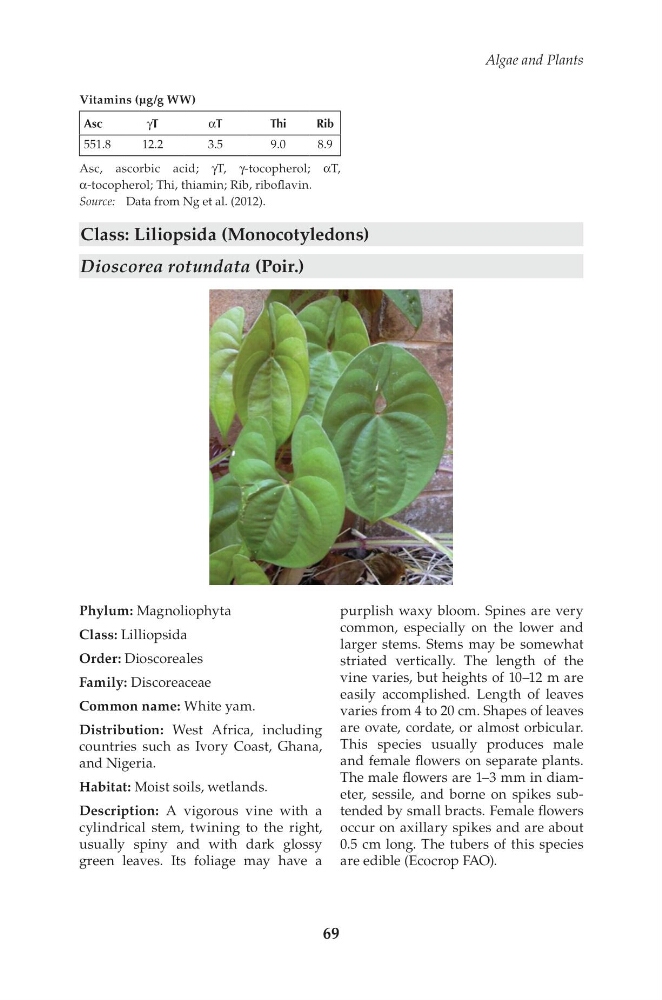
Dioscorea rotundata (Poir.)
Phylum: Magnoliophyta
Class: Lilliopsida
Order: Dioscoreales
Family: Discoreaceae
Common name: White yam.
Distribution: West Africa, including
countries such as Ivory Coast, Ghana,
and Nigeria.
Habitat: Moist soils, wetlands.
Description: A vigorous vine with a
cylindrical stem, twining to the right,
usually spiny and with dark glossy
green leaves. Its foliage may have a
purplish waxy bloom. Spines are very
common, especially on the lower and
larger stems. Stems may be somewhat
striated vertically. The length of the
vine varies, but heights of 10–12 m are
easily accomplished. Length of leaves
varies from 4 to 20 cm. Shapes of leaves
are ovate, cordate, or almost orbicular.
This species usually produces male
and female flowers on separate plants.
The male flowers are 1–3 mm in diameter, sessile, and borne on spikes subtended by small bracts. Female flowers
occur on axillary spikes and are about
0.5 cm long. The tubers of this species
are edible (Ecocrop FAO).
69
Vitamins (µg/g WW)
Asc
γT
αT
Thi
Rib
551.8
12.2
3.5
9.0
8.9
Asc, ascorbic acid; γT, γ-tocopherol; αT,
α-tocopherol; Thi, thiamin; Rib, riboflavin.
Source: Data from Ng et al. (2012).
Class: Liliopsida (Monocotyledons)
Dioscorea rotundata (Poir.)
Phylum: Magnoliophyta
Class: Lilliopsida
Order: Dioscoreales
Family: Discoreaceae
Common name: White yam.
Distribution: West Africa, including
countries such as Ivory Coast, Ghana,
and Nigeria.
Habitat: Moist soils, wetlands.
Description: A vigorous vine with a
cylindrical stem, twining to the right,
usually spiny and with dark glossy
green leaves. Its foliage may have a
purplish waxy bloom. Spines are very
common, especially on the lower and
larger stems. Stems may be somewhat
striated vertically. The length of the
vine varies, but heights of 10–12 m are
easily accomplished. Length of leaves
varies from 4 to 20 cm. Shapes of leaves
are ovate, cordate, or almost orbicular.
This species usually produces male
and female flowers on separate plants.
The male flowers are 1–3 mm in diameter, sessile, and borne on spikes subtended by small bracts. Female flowers
occur on axillary spikes and are about
0.5 cm long. The tubers of this species
are edible (Ecocrop FAO).