

Nutritional Freshwater Life
56
Nasturtium officinale (W.T. Aiton)
Order: Brassicales
Family: Brassicaceae
Common name: Watercress.
Distribution: Europe, including Britain,
from Sweden and Denmark south and
east to North Africa and West Asia (Plants
for a Future, 1996–2012).
Habitat: Lakes, ponds, and in slowmoving water in rivers, canals, and
streams; brooks, ditches, and pond
margins.
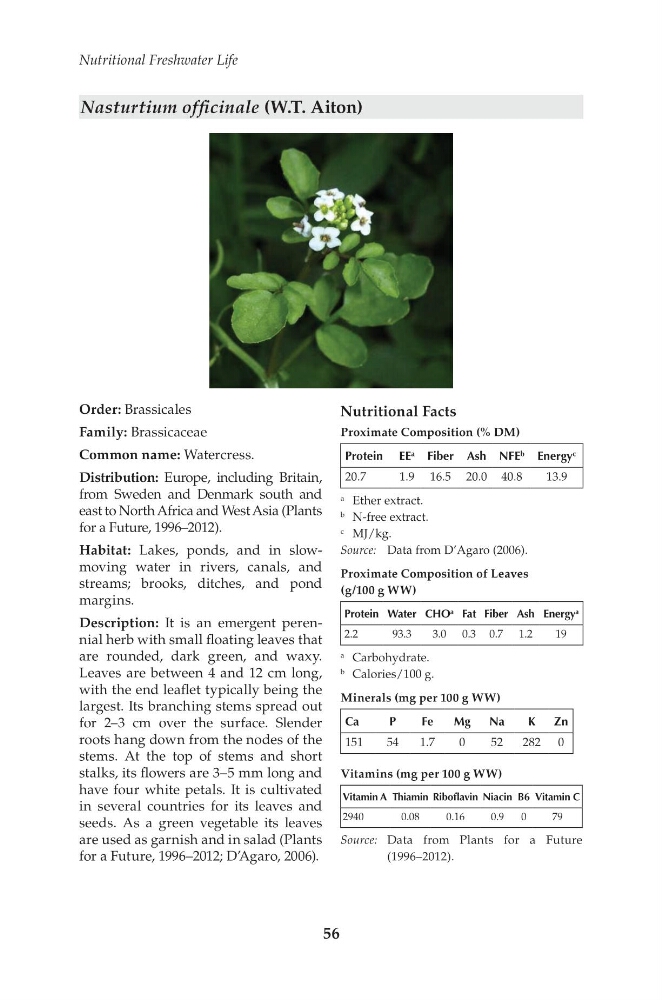
Description: It is an emergent perennial herb with small floating leaves that
are rounded, dark green, and waxy.
Leaves are between 4 and 12 cm long,
with the end leaflet typically being the
largest. Its branching stems spread out
for 2–3 cm over the surface. Slender
roots hang down from the nodes of the
stems. At the top of stems and short
stalks, its flowers are 3–5 mm long and
have four white petals. It is cultivated
in several countries for its leaves and
seeds. As a green vegetable its leaves
are used as garnish and in salad (Plants
for a Future, 1996–2012; D’Agaro, 2006).
Nutritional Facts
Proximate Composition (% DM)
Protein EE a Fiber Ash NFE b Energy c
20.7
1.9 16.5 20.0 40.8
13.9
a Ether extract.
b N-free extract.
c MJ/kg.
Source: Data from D’Agaro (2006).
Proximate Composition of Leaves
(g/100 g WW)
Protein Water CHO a Fat Fiber Ash Energy a
2.2
93.3
3.0 0.3 0.7 1.2
19
a Carbohydrate.
b Calories/100 g.
Minerals (mg per 100 g WW)
Ca
P
Fe
Mg
Na
K
Zn
151
54
1.7
0
52
282 0
Vitamins (mg per 100 g WW)
Vitamin A Thiamin Riboflavin Niacin B6 Vitamin C
2940
0.08
0.16
0.9
0
79
Source: Data from Plants for a Future
(1996–2012).
56
Nasturtium officinale (W.T. Aiton)
Order: Brassicales
Family: Brassicaceae
Common name: Watercress.
Distribution: Europe, including Britain,
from Sweden and Denmark south and
east to North Africa and West Asia (Plants
for a Future, 1996–2012).
Habitat: Lakes, ponds, and in slowmoving water in rivers, canals, and
streams; brooks, ditches, and pond
margins.
Description: It is an emergent perennial herb with small floating leaves that
are rounded, dark green, and waxy.
Leaves are between 4 and 12 cm long,
with the end leaflet typically being the
largest. Its branching stems spread out
for 2–3 cm over the surface. Slender
roots hang down from the nodes of the
stems. At the top of stems and short
stalks, its flowers are 3–5 mm long and
have four white petals. It is cultivated
in several countries for its leaves and
seeds. As a green vegetable its leaves
are used as garnish and in salad (Plants
for a Future, 1996–2012; D’Agaro, 2006).
Nutritional Facts
Proximate Composition (% DM)
Protein EE a Fiber Ash NFE b Energy c
20.7
1.9 16.5 20.0 40.8
13.9
a Ether extract.
b N-free extract.
c MJ/kg.
Source: Data from D’Agaro (2006).
Proximate Composition of Leaves
(g/100 g WW)
Protein Water CHO a Fat Fiber Ash Energy a
2.2
93.3
3.0 0.3 0.7 1.2
19
a Carbohydrate.
b Calories/100 g.
Minerals (mg per 100 g WW)
Ca
P
Fe
Mg
Na
K
Zn
151
54
1.7
0
52
282 0
Vitamins (mg per 100 g WW)
Vitamin A Thiamin Riboflavin Niacin B6 Vitamin C
2940
0.08
0.16
0.9
0
79
Source: Data from Plants for a Future
(1996–2012).