

Algae and Plants
43
Nelumbo nucifera (Gaertn.)
Order: Proteales
Family: Nelumbonaceae
Common name: Indian lotus, sacred
lotus.
Habitat: Small ponds and shallow
areas of lakes and rivers.
Distribution: Asia (Iran to Japan);
northern Australia (Missouri Botanical
Garden).
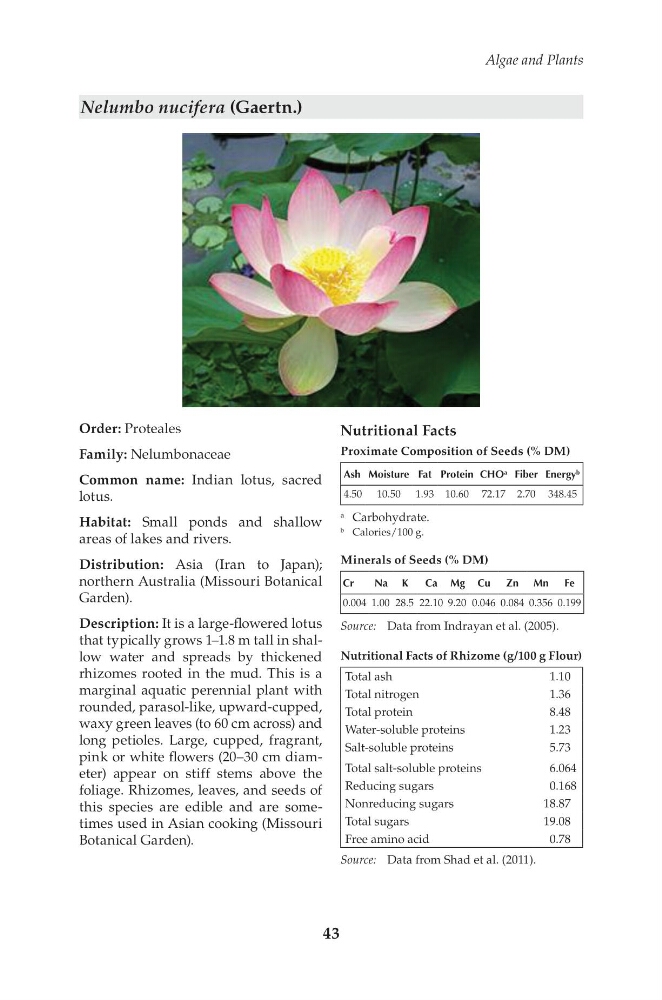
Description: It is a large-flowered lotus
that typically grows 1–1.8 m tall in shallow water and spreads by thickened
rhizomes rooted in the mud. This is a
marginal aquatic perennial plant with
rounded, parasol-like, upward-cupped,
waxy green leaves (to 60 cm across) and
long petioles. Large, cupped, fragrant,
pink or white flowers (20–30 cm diameter) appear on stiff stems above the
foliage. Rhizomes, leaves, and seeds of
this species are edible and are sometimes used in Asian cooking (Missouri
Botanical Garden).
Nutritional Facts
Proximate Composition of Seeds (% DM)
Ash Moisture Fat Protein CHO a Fiber Energy b
4.50 10.50 1.93 10.60 72.17 2.70 348.45
a Carbohydrate.
b Calories/100 g.
Minerals of Seeds (% DM)
Cr
Na K
Ca Mg Cu
Zn Mn
Fe
0.004 1.00 28.5 22.10 9.20 0.046 0.084 0.356 0.199
Source: Data from Indrayan et al. (2005).
Nutritional Facts of Rhizome (g/100 g Flour)
Total ash
1.10
Total nitrogen
1.36
Total protein
8.48
Water-soluble proteins
1.23
Salt-soluble proteins
5.73
Total salt-soluble proteins
6.064
Reducing sugars
0.168
Nonreducing sugars
18.87
Total sugars
19.08
Free amino acid
0.78
Source: Data from Shad et al. (2011).
43
Nelumbo nucifera (Gaertn.)
Order: Proteales
Family: Nelumbonaceae
Common name: Indian lotus, sacred
lotus.
Habitat: Small ponds and shallow
areas of lakes and rivers.
Distribution: Asia (Iran to Japan);
northern Australia (Missouri Botanical
Garden).
Description: It is a large-flowered lotus
that typically grows 1–1.8 m tall in shallow water and spreads by thickened
rhizomes rooted in the mud. This is a
marginal aquatic perennial plant with
rounded, parasol-like, upward-cupped,
waxy green leaves (to 60 cm across) and
long petioles. Large, cupped, fragrant,
pink or white flowers (20–30 cm diameter) appear on stiff stems above the
foliage. Rhizomes, leaves, and seeds of
this species are edible and are sometimes used in Asian cooking (Missouri
Botanical Garden).
Nutritional Facts
Proximate Composition of Seeds (% DM)
Ash Moisture Fat Protein CHO a Fiber Energy b
4.50 10.50 1.93 10.60 72.17 2.70 348.45
a Carbohydrate.
b Calories/100 g.
Minerals of Seeds (% DM)
Cr
Na K
Ca Mg Cu
Zn Mn
Fe
0.004 1.00 28.5 22.10 9.20 0.046 0.084 0.356 0.199
Source: Data from Indrayan et al. (2005).
Nutritional Facts of Rhizome (g/100 g Flour)
Total ash
1.10
Total nitrogen
1.36
Total protein
8.48
Water-soluble proteins
1.23
Salt-soluble proteins
5.73
Total salt-soluble proteins
6.064
Reducing sugars
0.168
Nonreducing sugars
18.87
Total sugars
19.08
Free amino acid
0.78
Source: Data from Shad et al. (2011).