

Algae and Plants
23
Nonessential Amino Acids
Alanine
5.82
Arginine
5.98
Aspartic acid
6.34
Cystine
0.67
Glutamic acid
8.94
Glycine
3.50
Histidine
1.08
Proline
2.97
Serine
4.00
Tyrosine
4.60
Minerals (mg/kg DM)
Calcium
1315
Potassium
15,400
Zinc
39
Magnesium
1915
Manganese
25
Selenium
0.40 a
Iron
580
Phosphorus
8942
a mg.
Source: Data from Australian
Spirulina (2014).
Arthrospira maxima (Setchell & N.L. Gardner)
Geitler 1932 (= Spirulina maxima)
Order: Chroococcales
Family: Spirulinaceae
Common name: Spirulina.
Distribution: Africa, Asia, Australia,
New Zealand, Europe (AlgaeBase).
Habitat: Lakes.
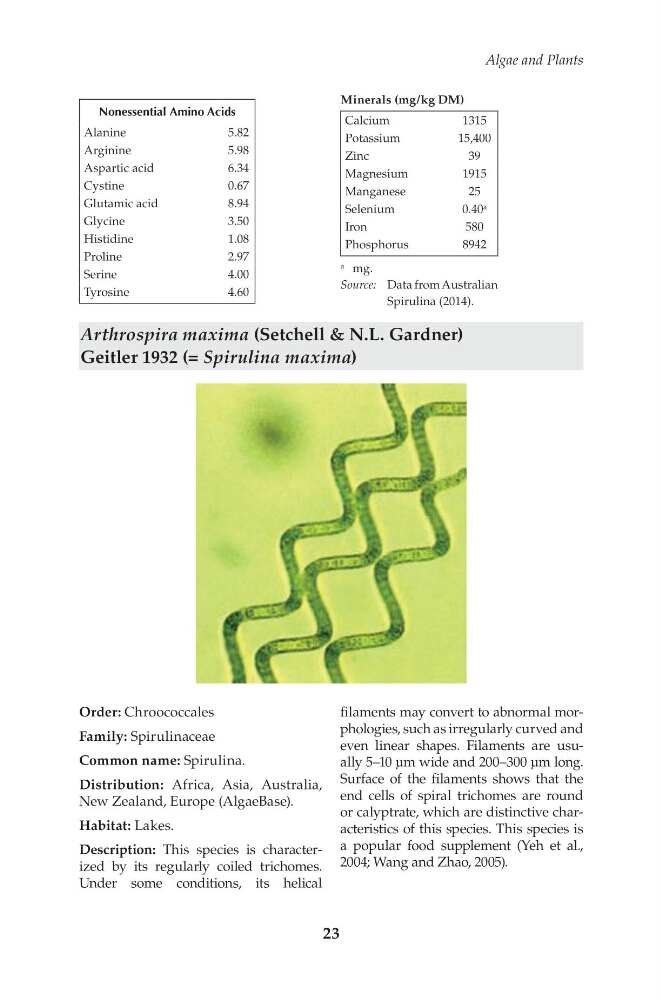
Description: This species is characterized by its regularly coiled trichomes.
Under some conditions, its helical
filaments may convert to abnormal morphologies, such as irregularly curved and
even linear shapes. Filaments are usually 5–10 µm wide and 200–300 µm long.
Surface of the filaments shows that the
end cells of spiral trichomes are round
or calyptrate, which are distinctive characteristics of this species. This species is
a popular food supplement (Yeh et al.,
2004; Wang and Zhao, 2005).
23
Nonessential Amino Acids
Alanine
5.82
Arginine
5.98
Aspartic acid
6.34
Cystine
0.67
Glutamic acid
8.94
Glycine
3.50
Histidine
1.08
Proline
2.97
Serine
4.00
Tyrosine
4.60
Minerals (mg/kg DM)
Calcium
1315
Potassium
15,400
Zinc
39
Magnesium
1915
Manganese
25
Selenium
0.40 a
Iron
580
Phosphorus
8942
a mg.
Source: Data from Australian
Spirulina (2014).
Arthrospira maxima (Setchell & N.L. Gardner)
Geitler 1932 (= Spirulina maxima)
Order: Chroococcales
Family: Spirulinaceae
Common name: Spirulina.
Distribution: Africa, Asia, Australia,
New Zealand, Europe (AlgaeBase).
Habitat: Lakes.
Description: This species is characterized by its regularly coiled trichomes.
Under some conditions, its helical
filaments may convert to abnormal morphologies, such as irregularly curved and
even linear shapes. Filaments are usually 5–10 µm wide and 200–300 µm long.
Surface of the filaments shows that the
end cells of spiral trichomes are round
or calyptrate, which are distinctive characteristics of this species. This species is
a popular food supplement (Yeh et al.,
2004; Wang and Zhao, 2005).