

Nutritional Freshwater Life
14
Order: Chlamydomonadales
Family: Chlamydomonadaceae
Common name: Green alga.
Distribution: Worldwide.
Habitat: Soil and freshwater.
Description: It is a single-cell green
alga about 10 µm in diameter that
swims with two flagella. It has a large
cup-shaped chloroplast, a large pyrenoid, and an “eyespot” that senses light.
Each cell typically has two anterior
contractile vacuoles. Nucleus is single
and typically central. Basal bodies, connected by striated (proximal and distal)
fiber systems, exhibit clockwise absolute configuration. The extract of this
species could be used as a substitute for
yeast extract in food-related industries
(Kightlinger et al., 2014).
Nutritional Facts
Proximate Composition (% DM)
Protein
CHO a
Lipids
48
17
21
a Carbohydrate.
Source: Data from Becker (2006).
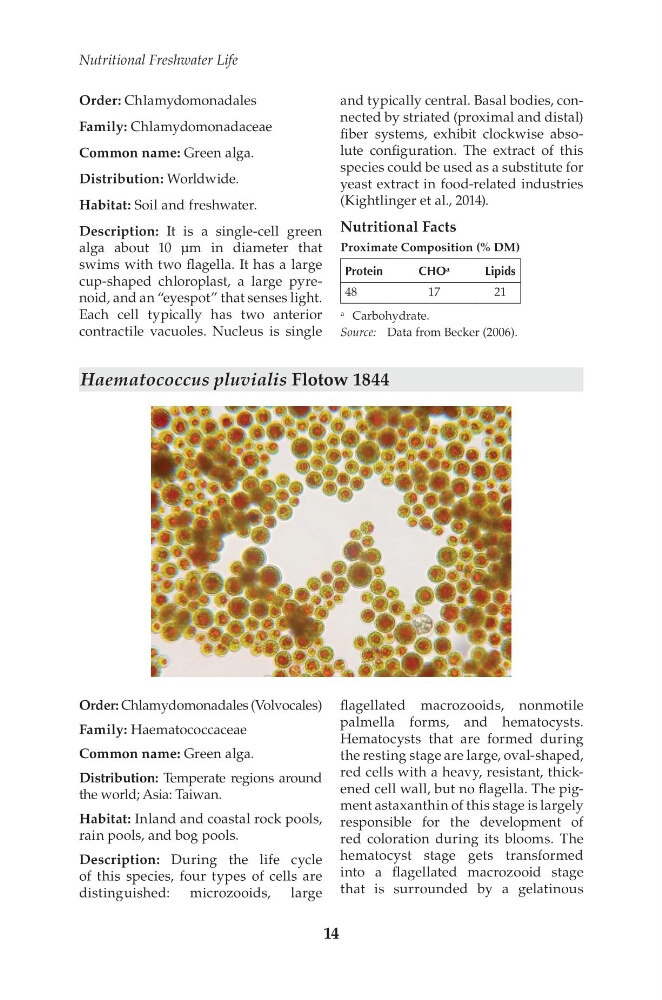
Haematococcus pluvialis Flotow 1844
Order: Chlamydomonadales (Volvocales)
Family: Haematococcaceae
Common name: Green alga.
Distribution: Temperate regions around
the world; Asia: Taiwan.
Habitat: Inland and coastal rock pools,
rain pools, and bog pools.
Description: During the life cycle
of this species, four types of cells are
distinguished: microzooids, large
flagellated macrozooids, nonmotile
palmella forms, and hematocysts.
Hem atocysts that are formed during
the resting stage are large, oval-shaped,
red cells with a heavy, resistant, thickened cell wall, but no flagella. The pigment astaxanthin of this stage is largely
responsible for the development of
red coloration during its blooms. The
hematocyst stage gets transformed
into a flagellated macrozooid stage
that is surrounded by a gelatinous
14
Order: Chlamydomonadales
Family: Chlamydomonadaceae
Common name: Green alga.
Distribution: Worldwide.
Habitat: Soil and freshwater.
Description: It is a single-cell green
alga about 10 µm in diameter that
swims with two flagella. It has a large
cup-shaped chloroplast, a large pyrenoid, and an “eyespot” that senses light.
Each cell typically has two anterior
contractile vacuoles. Nucleus is single
and typically central. Basal bodies, connected by striated (proximal and distal)
fiber systems, exhibit clockwise absolute configuration. The extract of this
species could be used as a substitute for
yeast extract in food-related industries
(Kightlinger et al., 2014).
Nutritional Facts
Proximate Composition (% DM)
Protein
CHO a
Lipids
48
17
21
a Carbohydrate.
Source: Data from Becker (2006).
Haematococcus pluvialis Flotow 1844
Order: Chlamydomonadales (Volvocales)
Family: Haematococcaceae
Common name: Green alga.
Distribution: Temperate regions around
the world; Asia: Taiwan.
Habitat: Inland and coastal rock pools,
rain pools, and bog pools.
Description: During the life cycle
of this species, four types of cells are
distinguished: microzooids, large
flagellated macrozooids, nonmotile
palmella forms, and hematocysts.
Hem atocysts that are formed during
the resting stage are large, oval-shaped,
red cells with a heavy, resistant, thickened cell wall, but no flagella. The pigment astaxanthin of this stage is largely
responsible for the development of
red coloration during its blooms. The
hematocyst stage gets transformed
into a flagellated macrozooid stage
that is surrounded by a gelatinous